Tuesday, May 29, 2018

Discover Florida!

Limpkin Chicks at Sweetwater Wetlands Park
One of the things I like about traveling is being adventurous and open to exploring new places. When I'm in another city or state or country, I seek out interesting restaurants, museums and parks. I get on those hop on/ hop off double decker bus tours and wander international museums with my English language audio guide. I scope out nature refuges and botanical gardens on Google maps. I want to make the most of my short stay. But when I'm at home, I'm not nearly as creative and resourceful, and I'm a terrible procrastinator. I get into a routine and stick close to home. You know how it goes--you can live in a city for years and never explore the famous local attraction just around the corner, unless an out of town visitor comes and you want to show them all the best things. So it was when my family and I were in Florida. We lived there for nearly 20 years, and yet in all that time, I never made the trip to the greater Orlando area to visit the numerous nature parks down there. I always meant to, but just never got around to it. Sure, we figured out how to go to the theme parks with our kids and out of town visitors, and drove to the airport all the time, but it always seemed too difficult to drive all the way down there to watch birds and hike for a day. But last month I finally remedied that. My husband had a week-long meeting in Orlando, so as soon as I learned that we were going, I got busy and plotted out my exploring route. I was finally going to see Merritt Island, Disney Wilderness and Circle B Bar Preserve! I guess what it took for me to really start to explore Florida was to come as a visitor.

Black-bellied Whistling Ducks at Sweetwater Wetlands Park

We started our trip with a short stay in Gainesville, where I crammed in quick visits to the parks that were so familiar when we lived there. And they are spectacular parks. This is part of the reason why I can almost forgive myself for putting off exploring more in central Florida. Gainesville has a lot going on. Now that I live firmly inland and in the Piedmont (I love saying that) the coastal areas, swamps and sandhills of Florida are very exotic and exciting. And there is an incredible amount of wildlife. I'm not sure if Floridians realize how extraordinary this is. When you live there, you can get used to seeing eagles, cranes and osprey flying overhead. A Great Egret standing in a retention pond is no big deal. Alligators, schmalligators. Ho hum. But not for me. I'm a tourist now! It had been a year since my last visit and I was pretty jazzed at all the critters around me.

Florida's unbelievable nature on display at Circle B Bar Reserve

In Gainesville, I made sure to visit the spectacular Sweetwater Wetlands Park with my photo buddy, Maralee, and got my Limpkin, Common Gallinule, and Osprey fix out of the way. Most of the birds were raising young and I saw numerous Limpkin chicks learning to eat exotic apple snails. This is a cool story. When I was first learning about birds in Gainesville, about 12 years ago, Limpkins were rare in this part of the state. Their food source, the Florida Apple Snail, was disappearing, displaced by the larger, exotic Island Apple Snail. But 5-6 years ago more Limpkins were appearing in the region and people realized that the Limpkins were learning to eat the bigger, tougher snails. After they figured out how to pry them open, it was all over. Limpkins everywhere. And soon they told the endangered Snail Kites and now a few of them have been hanging out in Gainesville for the past 2 years. Perhaps they will also adapt and thrive. One can hope. Anyway, I watched dozens of juvenile Limpkins fussing for adults to feed them huge, gloppy snails. Maralee and I also made a short visit to catch up with our friend, the Ditch. It was lovely, as always, buzzing and fluttering and alive with Sundews, Butterwort and Ladies Tresses Orchids. It was exciting to have to watch out for Cottonmouths again (we didn't see any) as we scrambled through the tall, wet grass. We don't have them up here in North Georgia.

Anhinga drying her wings at Sweetwater Wetlands Park

Glossy Ibis at Sweetwater Wetlands Park
 
Limpkin adult feeding an apple snail to a chick at Sweetwater Wetlands Park

Bobolink at Sweetwater Wetlands Park

Red-winged Blackbird at Sweetwater Wetlands Park

Common Gallinule and Chick at Sweetwater Wetlands Park

Osprey with Chick at Sweetwater Wetlands Park

Ladies Tresses Orchids in the Ditch

Little Metalmark Butterfly in the Ditch

I couldn't leave Gainesville without stopping at Morningside Nature Center. I only had a little while there, but I did see the beautiful Cypress Dome, still full of water after last season's storms, and the incredible Long Leaf Pine Sandhill. 

Cypress Dome from the Boardwalk at Morningside Nature Center

Sandhill at Morningside Nature Center

Pinewoods Milkweed (Asclepias humistrata) at Morningside Nature Center

On our last day in town, my husband and I made it over to La Chua trail at Paynes Prairie State Preserve, to visit with my former fellow Sunday trail volunteer, Helene. Most of the trail is closed currently as a result of flooding from last year's hurricanes. Thank goodness for the terrific raised board walk that allows visitors to see at least a little of the basin when the wet prairie is flooded. Looking over the railing of the boardwalk, I had the perfect vantage to see the smaller things in the water and mud, such as snakes. The water snakes were very active and I saw 5 or six, in addition to a lovely Ribbon Snake.

Ribbon Snake at La Chua Trail

And then we were off to Orlando for more adventure. Our hotel was right next to the Disney resorts and was a beautiful, tropical vacation zone. On the days when I was not away on adventures, I enjoyed walking around the lake and nature trails at the hotel. I saw quite a bit of wildlife there, golf course and tennis courts notwithstanding. I could have just stayed there and had a fine time, but I had other plans.

Bird of Paradise Flower at the Hotel

Great Egret at the Hotel Lake

Anhinga (aka "Water Turkey") at the Hotel Lake

The first morning I drove east for nearly 2 hours to Merritt Island, near the Canaveral National Seashore, where I planned to explore the Black Point Wildlife Drive. I had heard about this place for years and it was very exciting to finally be seeing it. I will admit right now that I did it backwards. I had planned to go to the visitors center, buy a Federal Duck Stamp to get me into national wildlife refuges for the next year, and use the restroom. (Did I mention that it was a 2 hour drive?) But when I mistakenly got to the entrance of the wildlife drive first, I realized too late that I was on a one way, no going back, 7 mile long dirt road. So I changed plans, paid at the iron ranger box, and drove along, birding from the car and hoping to find a porta potty. The wildlife was spectacular. There were so many birds that it was very hard to count, and I was keeping a bird list. I counted 30 species, and I'm not all that great at identifying shorebirds! But nature was calling and I decided I needed to zip through the loop and come back on a second trip, paying more attention to detail. At about the 3/4 mark, there was a rest area with bathrooms and a walking trail, so I stopped there. Much better. I finished the loop and then drove back to the beginning, hoping to see the visitors center somewhere along the way. But it was on a different turnoff, so I decided to drive the loop again and go the visitors center on the way home. The second time around was just as nice and I had a better idea of where to watch. I kept my eyes open for Avocets, but never found any. I did see Eagles, Reddish Egrets, Black Necked Stilts, Black Skimmers and Roseate Spoonbills, all of which are birds that don't usually make their way to Athens. Alas, when I finally made it to the visitors center, it was just closing. But they let me explore the grounds and boardwalk around the lake after the gates closed, so I was satisfied and tired out after a long day. Take my advice if you go plan to go there--go to the visitors center first.

Semi-palmated Plovers at Black Point Wildlife Drive

Black Racer at Black Point Wildlife Drive

Reddish Egret and Tri-Colored Heron at Black Point Wildlife Drive

Roseate Spoonbill at Black Point Wildlife Drive

The next day I drove 35 miles south from our hotel, past the turnoff to the Disney Resorts, to the Nature Conservancy's Disney Wilderness Preserve. It was my first visit to a Nature Conservancy property and I was very impressed. The property was immaculate and beautifully maintained. I was met at the entrance by a pair of Wild Turkeys and it just got better after that. Next I encountered a Sandhill Crane near the parking lot, followed by a pair of Eastern Meadowlarks by the trailhead. I headed out with my map and supplies, confident that I could walk the entire trail system. But I underestimated how sunny and humid Florida can be, and I soon became too tired to complete it all, so I walked just the more moderate Red Loop. As I walked through their lovingly maintained fire-dependent Long Leaf Pine sandhills, I couldn't help but note the irony that I was walking through the real Florida on "Disney" property. But regardless of how it got there, I was also very thankful that various agencies had come together to preserve this important property at the headwaters of the Everglades. I saw loads of Zebra Swallowtail butterflies and Woodstorks soared overhead all morning. At the end of my hike I got a great look at a Swallow-tailed Kite. I thank my friend Grace for recommending this spot.

Eastern Meadowlark at Disney Wilderness Preserve

Swallow-tailed Kite at Disney Wilderness Preserve

The "Real Florida" at Disney Wilderness Preserve

On the final day, I drove 40 miles to the west to the Circle B Bar Reserve in Polk County, between Tampa and Orlando. My birding friends in Gainesville all talked about this place but the timing never worked out for me to go with them. Now that I've visited, I can understand why they felt it was so special. The park has a great visitors center with fun exhibits for children, and it appears that they serve a lot of school groups. It is reassuring to know that kids all over this region of Florida can be exposed to a vibrant nature discovery center such as this. The park is very protective of the abundant wildlife, with signs directing visitors to take special care around nesting owls. Fellow visitors pointed out an adult and juvenile Barred Owl in a tree right over the main path, and later I heard 2 more calling back and forth. They also require commercial photographers to obtain a permit, which was unusual. But knowing how people can behave with their cameras and drones, I can appreciate wanting some accountability. Because I sell some of my work, they had me apply and now I have my official photographer's permit card. Pretty nifty! One of the main trails, Alligator Alley, was closed, I think due to storm damage. But there were plenty of places for me to go and I saw Alligators, Turtles, wading birds galore, as well as Marsh Rabbits, an Opossum, and a family of Sandhill Cranes. I'm so happy that I finally made it to this wonderful nature park.


Purple Gallinule at Circle B Bar Reserve
Alligator, Schmalligator. A big one crossing the path in front of me at Circle B Bar Reserve

Opossum rambling up the path, Circle B Bar Reserve

Sandhill Crane Family at Circle B Bar Reserve

Barred Owl Adult and Juvenile at Circle B Bar Reserve

So after 9 days in Florida, I went back home, content that I spent my time well. I chalked a big group of parks off of my "must visit" list. We even fit in a half day at the other Disney and had a pretty great time on Space Mountain and the other rides. It was fun to discover Florida. But I think I learned my lesson and won't let 20 years roll by before I explore Georgia properly. I'm getting the map ready now!


Saturday, April 21, 2018

Hug a Tree

Tall Water Oak

A group of 1st graders and I were walking up the path back to the nature center yesterday. We had been on the trail for nearly an hour and they were happy but tired and hungry and ready to get back. We were almost there when we noticed something interesting on the trunk of a water oak tree just past the trailhead. There was some sort of circular blob on the trunk, and from a distance it appeared to be about the same color as the tree. As we got closer to examine we realized it was a cluster of caterpillars! Being first graders, many of them wanted to touch the wriggling shape. But I held them back and we watched for a couple of minutes, noticing the hairs that could irritate the skin and the pretty bright blue color that was not as noticeable from a distance. One of the kids said that it was the neatest thing she had seen on the walk. (Actually, she said it was the only neat thing she saw on the walk, but I didn't believe her!)

Nothing to see here?

The Cluster

After the children were reunited with their teachers and heading off to lunch, I walked back to the tree to have another look. I had never seen this behavior in caterpillars before. Up close, they were also incredibly beautiful. The blue color with white diamonds reminded me of fiber art and weaving patterns. I took a lot of photos.

Gorgeous colors and patterns

As always happens to me in situations like this, the more I looked, the more I saw. A pair of mating Milkweed Bugs crawled by just above my head. Right next to the caterpillar circle, a stream of ants was traveling up the tree from the ground, following cracks in the bark. A different kind of caterpillar moved down the trunk from above. This one was twice the size of the individuals in the caterpillar bunch, and had a very different pattern. The children and I had seen quite a few of these caterpillars in the park that day. When I got home I looked up both species in my "Caterpillars of Eastern North America" book and learned that the clustering caterpillars are Forest Tent Caterpillars, and are known for clustering like this. Despite their name, they do not make web tents. The other caterpillar was an Eastern Tent Caterpillar, and they are do make the web tents.

Milkweed Bugs

Ants

Two species of Tent Caterpillars on the same tree

There was so much going on right in front of me in this little area of the tree that I decided to investigate the rest of it and see if I could find anything else. But the tree was tall, so I could only look closely at my own eye level and below, which was only a tiny portion of the whole. It was a big and old tree, so there was a lot of moss and lichen on the bark in an assortment of colors and patterns. Some of the lichen looked to me like it had writing on it (I like to think they are hidden forest messages). A few feet away, a firefly climbed over lichen and moss, and seemed to be searching, though I don't know what for. Google tells me that adult fireflies eat pollen and nectar.

Lichen

Forest Messages

Firefly

As I made my way around the tree trunk I looked up and saw a row of holes, perhaps made by a sapsucker or some other woodpecker. Down below I saw the lumpy bark of the base of this mighty tree. Below that the frilly green of a tiny pine sprout peeked out from behind one of the big roots. In another root crotch I found a pink redbud blossom, probably one of the last left from this spring's blooms. On the other side, an Eastern Tent Caterpillar tiptoed by the star-shaped leaf of a sweet gum.

Holes

Craggy Base

Pine Sprout

Redbud Blossom

Sweetgum leaf with an Eastern Tent caterpillar photobomb in the upper corner


Just when I was starting to think I knew that trail pretty well, all it took was a closer look to see how much more there was to see and know. It reminded me of an activity we used to do when I worked at the nature center in Florida. We gave each of the kids wire coat hanger that had been pulled into a square shape and had them lay it on the ground. Then they were given a magnifying lens and a paper and pencil and were instructed to observe what happened in the square for a specified amount of time. At first some of the children balked. They said, "there's nothing here but dirt and some leaves".  But we told them to keep looking and to try to count everything they saw. Pretty soon even the most skeptical ones were hooked. An ant would walk through the square, or a grasshopper or a spider. They might see a seed, or a sprout, or a feather or a tiny flower. Then they used the hand lens and saw the shiny bits of sand and shell and rocks and broken insect wings. The more you look, the more you see.

Caterpillar Silk

I am also reminded of a book I recently read called "The Forest Unseen", by David Haskell. The author visited a square meter area in a forest weekly for a year and observed what happened in that space. He wrote about animals large and small, wildflowers, seasons and ecosystems. Its a lovely book that encouraged me to look closer, and made me think about what can be learned by observing one place again and again over time. As much as I like to travel and explore, there is a lot to be said for getting to know one place really, really well.

Tree Bark Wrinkle

So when was the last time you took a good close look at a tree? Looked deep down into a knothole or under bark, or felt a newly unfolded leaf? When was the last time you hugged a tree? Have you ever wrapped your arms around the trunk and felt the texture and sturdiness of a massive oak? Or buried your nose in a Ponderosa pine bark crevice and breathed the sweet vanilla scent? If it's been a while, I hope that you can take a few moments in honor of Earth Day and get to know a tree. There is a lot they can tell you if you just watch and listen.

Fresh Leaves

Sunday, March 11, 2018

Wild Thing


Blossoms and tufts of green leaves are sprouting all over in our garden. I've got spring fever and want to be outside as much as I can be! I've been cleaning out last year's old growth from the front yard flower patch and realized that I needed to be sure that the seedlings I was thinning out were not from the Georgia Asters that I want to encourage. So yesterday I headed to the State Botanical Garden of Georgia, which is just a short trip from home, to take a look at their aster patch for reference. I'm so lucky to live close to one of my favorite places to hike and photograph, as well as a source for gardening and botanical advice!

I think these are the leaves I was looking for

I made my way to the garden and found and photographed what I believe to be the aster leaves so I could compare at home. And since I was already there, and it was supposed to rain in the afternoon, I took the opportunity to try to get some photos of birds and wildflowers. The woods are teeming with color and life, brought about by warmer temps and spring rains. I was just heading off toward a nice trail to catch a look at a heron rookery I had discovered last week, when I heard a wild ruckus from a group of people walking up from that area. Weekends at the gardens are very busy, which is both good and not so good. Good for lots of people to be out enjoying a wonderful nature area, and not so good for people (like me) who are hoping to quietly observe the wildlife. But it's a big place and there is room for all of us. I am always happy to see families who allow their children to explore and experience nature. Quiet observers and rowdy explorers can easily compromise and even share some teachable moments. The kids were hollering and having a great time, shouting "hup, two, three, four" at the top of their lungs as they marched. It was pretty clear to me that the birds and wildlife would scatter for a while in their presence, and I didn't want to lose time before the rain. So instead of heron hunting, I turned around a took a walk through the wildflower garden, which I wanted to visit anyway.

Common Blue Violets (Viola sororia)
Eastern Redbud popping out all over (Cercis canadensis)
Trillium trio (Trillium maculatum)

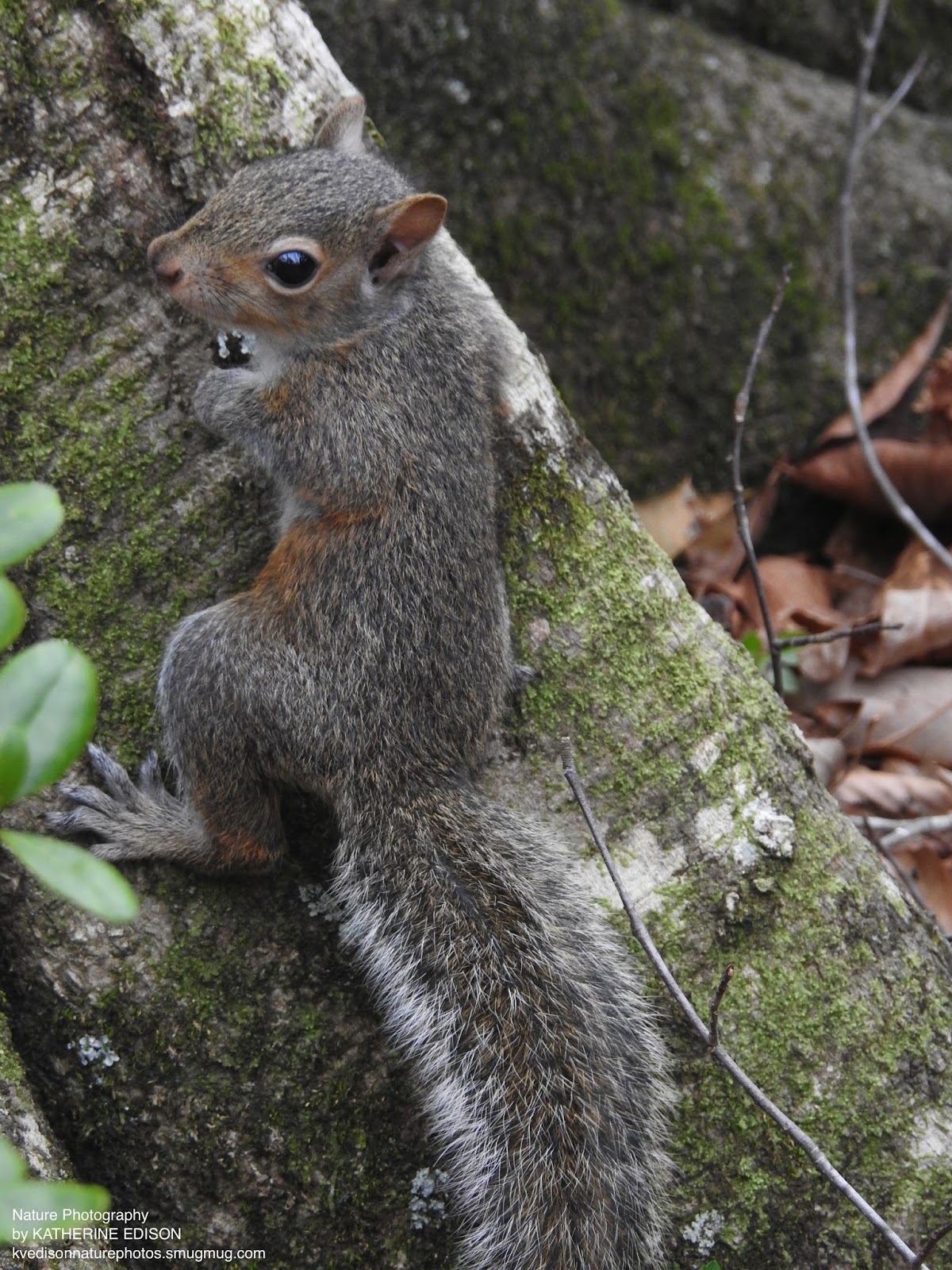
As I entered the garden, something small scurried up a tree up ahead of me. It seemed too big for a chipmunk but too small for a squirrel, so I followed it and found, to my surprise, that it was a squirrel after all, just a very tiny one. A baby squirrel!

Cute little guy

I wondered if it had fallen out of a nest, but it seemed fully able to climb and scurry away, however awkwardly. It was young enough that it really didn't know what to do when faced with danger. First it froze. Next it scuttled maniacally around in the leaves at the base of a tree, like it had no idea where to go. Then it climbed just a little higher up on the trunk and stared at me. I looked around for upset parent squirrels and didn't hear or see anything. Usually, when I startle squirrels, they scamper to a high branch and screech and bark at me. But this baby was new to the whole stranger thing. He moved to the back of the tree trunk and peeked at me from first one side and then the other. It was adorable. I was having so much fun with this tender baby animal encounter.

So curious!

Right then, the loud kids arrived at the garden gate and were soon rumbling up the path toward me and the baby squirrel. Surely the quiet, tender moment was doomed. But thinking quickly, I stepped back and caught the attention of the three chattering teenage girls. I waved at them and made the "shhhh" sign while gesturing to come closer. They heeded my warning and quietly hurried over to me, intrigued. When I whispered, "baby squirrel" and they saw where I pointed, we became a nature observation team. The young humans and the young squirrel studied each other carefully for a long while. The little squirrel stayed on its tree, about 2 feet off the ground, peering from side to side as before. The encounter generated lots of "awwws" from the girls and parents. Definitely a good nature moment. As they were leaving, the parents and I discussed that it was unusual to see such a young squirrel out on its own and that it had better watch out for hawks. Indeed, there are plenty of hawks in the garden, and a pair of red-shouldered hawks have built a nest a short way up the path in this very section.

Red-shouldered Hawk with a freshly caught vole that I saw in the garden last week

I felt happy to have shared a sweet nature moment with the family, and to have salvaged my own photo op! Everyone was happy. Win! And the baby squirrel stuck around for me to take more pictures. He seemed wary but did not scamper away. I kept waiting for him to climb up high to his nest (wherever that was), but he seemed interested in me and would climb up a bit but then would come back down. Then up again, then down.

Climbing up

Then down

Then back up

Then back down again

After a few minutes curiosity got the best of him and he began inching closer and closer to me. And before I knew it, the little rascal was at my feet, and then climbing my leg! As cute as it was, I realized that this was not good for either of us, and I shouted. The baby squirrel scurried back to his tree, and I knew it was time to walk away. For 1 or 2 seconds afterwards, I entertained the idea of taking him home and rescuing him. But I quickly came to my senses and remembered: 1) wild animal, 2) illegal, 3) pets at home, and 4) squirrel. What was I thinking? So I finished off my afternoon with lots of fun photos and no new mouths at home to feed. Thank goodness reason prevailed. I hope my little furry friend gets a bit more wary of humans and that he doesn't climb the legs of any other people. I also hope that he quickly learns some hawk smarts. He'll need it--it's a wild world out there. But he sure was cute.

Inching closer

Closer still

Ready to jump on me!


Monday, February 12, 2018

Spring Cleaning

My shame: the filthy feeder

I took some photos of birds in our yard the other day, and when I was looking through them to pick the ones I wanted to post to Facebook, I realized how gross and dirty our bird feeders had gotten. I will admit now that before I posted it, I cropped one of the photos to hide the mildew that I was too embarrassed to show. My excuse was that the winter has been cold, and also there had been a lot of rain in the last couple of weeks and the bird seed had turned soggy and nasty. But in truth, it has also been a very long time since the last cleaning. After looking at the grime on the feeder, I felt very guilty. But no more! Today I rolled up my sleeves and tore into those filthy feeders.

Lots of opportunity to swap germs

Feeding birds is a great hobby. I love seeing what birds we can attract to the yard throughout the year. But it is important to keep the feeders clean, as well as filled. All those birds moving in and out can bring and share germs and disease. And wet or spoiled seed creates a breeding ground for bacteria that can make the birds sick. So, ideally, it is recommended that you give your feeders a good cleaning once every month. Or quarterly. Or at the very least, twice a year. I'd like to aspire to cleaning monthly, but I doubt I can be that diligent. But I know I need to step up my routine, because I don't want to attract birds just to make them sick or even kill them.

The Big Bucket and other tools

My personal feeder cleaning set up is not complicated. I use a large utility bucket, biodegradable dish soap, some bleach (to kill germs and viruses), a scrub brush, a plastic putty knife, rubber gloves, rubber boots, and the hose. It's a bit of a chore, because we have quite a few different kinds of feeders and several feeding stations. And some of the feeders are rather large. I think in the future I may pick up a small kiddie pool in order to soak the larger pieces.

Stripped down and scrubbed clean

First I strip the feeding stations down to the pole, removing attachable "branches". Then I take down and empty the feeders, using the putty knife to scrape out wet or caked on seed, and put the old food in the trash. I will spare you photos of the nasty wet seed today, but it was putrid. It can go bad in a fairly short time in rainy and warm conditions. Sometimes it even sprouts in the feeder trays. Today I was glad I had the rubber gloves.

A plastic putty knife is a wonderful tool for scraping out caked on bird seed

Next, I take apart all the tube feeders and clean out the inevitably clogged feeder ports. Good quality feeders will come apart to allow access to these places where water gets in and wet bird seed builds up and spoils.

Tube feeder taken apart

Then I scrub all the feeder surfaces with soapy water mixed with some bleach. I add about 1/4 cup of bleach to my big bucket. I scrub the tube feeders, suet feeders and remove and clean all the trays. Then, I scrub the poles, baffles and attachments, because the birds leave seed and waste residue on everything. After everything is scrubbed clean, then I rinse well and let the parts sit in the sun to dry. You do not want to put dry seed into wet feeders or you'll get mildew and caked food inside.

All clean and drying in the sun

While I'm waiting for the feeders to dry it is a good time to clean out the bird bath, scrubbing out algae and any old seed and bird poop.

Birdbath is clean, too

Then, everything goes back together again. The birds were annoyed with me while I was cleaning and then seemed confused by the missing and empty feeders while everything dried. But 5 minutes after I had set it all up again and refilled the feeders, they had forgiven me.

"Wait, where is everything?"

So now our yard has clean, sparkling feeders and I can rest assured that I am providing a wholesome and helpful environment for the birds I love. This will be especially nice for the Great Backyard Bird Count that starts this weekend. And I'll be able to post my photos with a clear conscience and no cropping.

Sparkling Clean and Ready for Visitors!