Showing posts with label Squirrel. Show all posts

Sunday, March 11, 2018

Wild Thing


Blossoms and tufts of green leaves are sprouting all over in our garden. I've got spring fever and want to be outside as much as I can be! I've been cleaning out last year's old growth from the front yard flower patch and realized that I needed to be sure that the seedlings I was thinning out were not from the Georgia Asters that I want to encourage. So yesterday I headed to the State Botanical Garden of Georgia, which is just a short trip from home, to take a look at their aster patch for reference. I'm so lucky to live close to one of my favorite places to hike and photograph, as well as a source for gardening and botanical advice!

I think these are the leaves I was looking for

I made my way to the garden and found and photographed what I believe to be the aster leaves so I could compare at home. And since I was already there, and it was supposed to rain in the afternoon, I took the opportunity to try to get some photos of birds and wildflowers. The woods are teeming with color and life, brought about by warmer temps and spring rains. I was just heading off toward a nice trail to catch a look at a heron rookery I had discovered last week, when I heard a wild ruckus from a group of people walking up from that area. Weekends at the gardens are very busy, which is both good and not so good. Good for lots of people to be out enjoying a wonderful nature area, and not so good for people (like me) who are hoping to quietly observe the wildlife. But it's a big place and there is room for all of us. I am always happy to see families who allow their children to explore and experience nature. Quiet observers and rowdy explorers can easily compromise and even share some teachable moments. The kids were hollering and having a great time, shouting "hup, two, three, four" at the top of their lungs as they marched. It was pretty clear to me that the birds and wildlife would scatter for a while in their presence, and I didn't want to lose time before the rain. So instead of heron hunting, I turned around a took a walk through the wildflower garden, which I wanted to visit anyway.

Common Blue Violets (Viola sororia)
Eastern Redbud popping out all over (Cercis canadensis)
Trillium trio (Trillium maculatum)

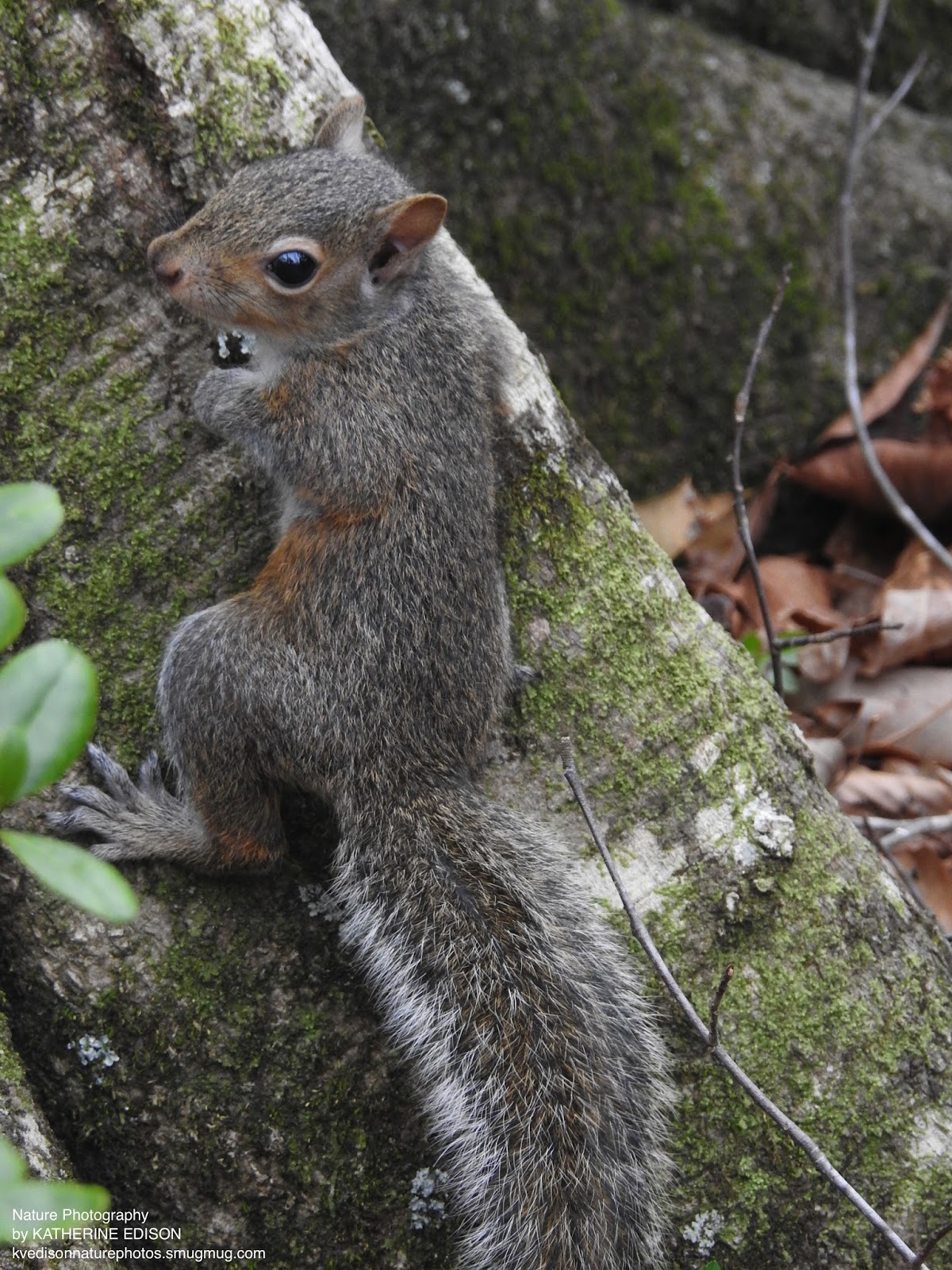
As I entered the garden, something small scurried up a tree up ahead of me. It seemed too big for a chipmunk but too small for a squirrel, so I followed it and found, to my surprise, that it was a squirrel after all, just a very tiny one. A baby squirrel!

Cute little guy

I wondered if it had fallen out of a nest, but it seemed fully able to climb and scurry away, however awkwardly. It was young enough that it really didn't know what to do when faced with danger. First it froze. Next it scuttled maniacally around in the leaves at the base of a tree, like it had no idea where to go. Then it climbed just a little higher up on the trunk and stared at me. I looked around for upset parent squirrels and didn't hear or see anything. Usually, when I startle squirrels, they scamper to a high branch and screech and bark at me. But this baby was new to the whole stranger thing. He moved to the back of the tree trunk and peeked at me from first one side and then the other. It was adorable. I was having so much fun with this tender baby animal encounter.

So curious!

Right then, the loud kids arrived at the garden gate and were soon rumbling up the path toward me and the baby squirrel. Surely the quiet, tender moment was doomed. But thinking quickly, I stepped back and caught the attention of the three chattering teenage girls. I waved at them and made the "shhhh" sign while gesturing to come closer. They heeded my warning and quietly hurried over to me, intrigued. When I whispered, "baby squirrel" and they saw where I pointed, we became a nature observation team. The young humans and the young squirrel studied each other carefully for a long while. The little squirrel stayed on its tree, about 2 feet off the ground, peering from side to side as before. The encounter generated lots of "awwws" from the girls and parents. Definitely a good nature moment. As they were leaving, the parents and I discussed that it was unusual to see such a young squirrel out on its own and that it had better watch out for hawks. Indeed, there are plenty of hawks in the garden, and a pair of red-shouldered hawks have built a nest a short way up the path in this very section.

Red-shouldered Hawk with a freshly caught vole that I saw in the garden last week

I felt happy to have shared a sweet nature moment with the family, and to have salvaged my own photo op! Everyone was happy. Win! And the baby squirrel stuck around for me to take more pictures. He seemed wary but did not scamper away. I kept waiting for him to climb up high to his nest (wherever that was), but he seemed interested in me and would climb up a bit but then would come back down. Then up again, then down.

Climbing up

Then down

Then back up

Then back down again

After a few minutes curiosity got the best of him and he began inching closer and closer to me. And before I knew it, the little rascal was at my feet, and then climbing my leg! As cute as it was, I realized that this was not good for either of us, and I shouted. The baby squirrel scurried back to his tree, and I knew it was time to walk away. For 1 or 2 seconds afterwards, I entertained the idea of taking him home and rescuing him. But I quickly came to my senses and remembered: 1) wild animal, 2) illegal, 3) pets at home, and 4) squirrel. What was I thinking? So I finished off my afternoon with lots of fun photos and no new mouths at home to feed. Thank goodness reason prevailed. I hope my little furry friend gets a bit more wary of humans and that he doesn't climb the legs of any other people. I also hope that he quickly learns some hawk smarts. He'll need it--it's a wild world out there. But he sure was cute.

Inching closer

Closer still

Ready to jump on me!


Thursday, September 29, 2016

Mindo, Ecuador

Welcome to Mindo!
If we had known how much we would love Mindo, we would have planned to stay longer. But our plans and schedule only allowed 24 hours, so we enjoyed as much as we could in a short time. We vowed to the hosts of our lodge that we will come back in the near future and stay a whole week!

Ochenta y Ocho Butterfly (Eighty-eight) at our Lodge

Mindo is a town in the cloud forest about 100 km to the NW of Quito. The difference between dry Quito and green and lush Mindo appears pretty early in the journey as you cross into the western slopes of the Andes, and according to Wikipedia, "where two of the most biologically diverse ecoregions in the world meet: the Chocoan lowlands and the Tropical Andes". We drove for about 2 hours, most of the time on narrow and winding roads up and down through heavily forested mountains and foothills. Occasional farms, clear cut with grass and cattle, stood out against the otherwise thick vegetation. We understood from conversations with our driver that development is being controlled now by the government, but that it had not been so much in the past. Farming would be difficult on steep hills, but is probably an attractive alternative in a tough economy. Hopefully the people can be convinced that there is some benefit in conserving the incredible biodiversity of this region. We saw many signs for Eco-Lodges and Birding Tours along the way, so perhaps there is money to be made in Eco-tourism.


Mindo Lago Lodge

Our lodge, Mindo Lago, was a great example of conservation tourism. The owners took what had previously been a cattle farm and built rustic but comfortable hut-like cabins around a man-made lake. Then they planted native plants and laid out a network of nature trails through the forest and around the perimeter. There is still work to be done, removing invasives and planting more native plants, but the results have been wonderful. They told us that where there had once been only cattle and one or two species of frogs, now their lake, ponds and forest plants support around 25 different species of frogs and numerous other animals. As we first walked into the open-air registration area from the parking lot, we saw dozens of butterflies and birds, including at least one giant Blue Morpho butterfly bobbing around the banana trees and bromeliads. It was beautiful. Several times a week the lodge hosts an evening "Frog Concert". People from hotels and lodges from around the area are invited for a short lecture explaining Mindo Lago's conservation story, followed by a walk to look and listen for frogs. They do not allow photos of the frogs so that the animals are not bothered by constant flashes. I appreciated their concern, though it would have been nice to document what we saw! The night we were there, it was raining steadily and the night walk had to be shortened a bit, but we saw numerous frogs, spiders, walking stick insects, interesting plants and a Rufous Motmot. I wish I had been able to take a photo, but it was raining. I had some difficulty even looking at the bird because every time I turned my head up, the water poured into my nose and eyes. But I did see it and its wonderful long tail.

Godart's Altinote Butterfly

Heliconia

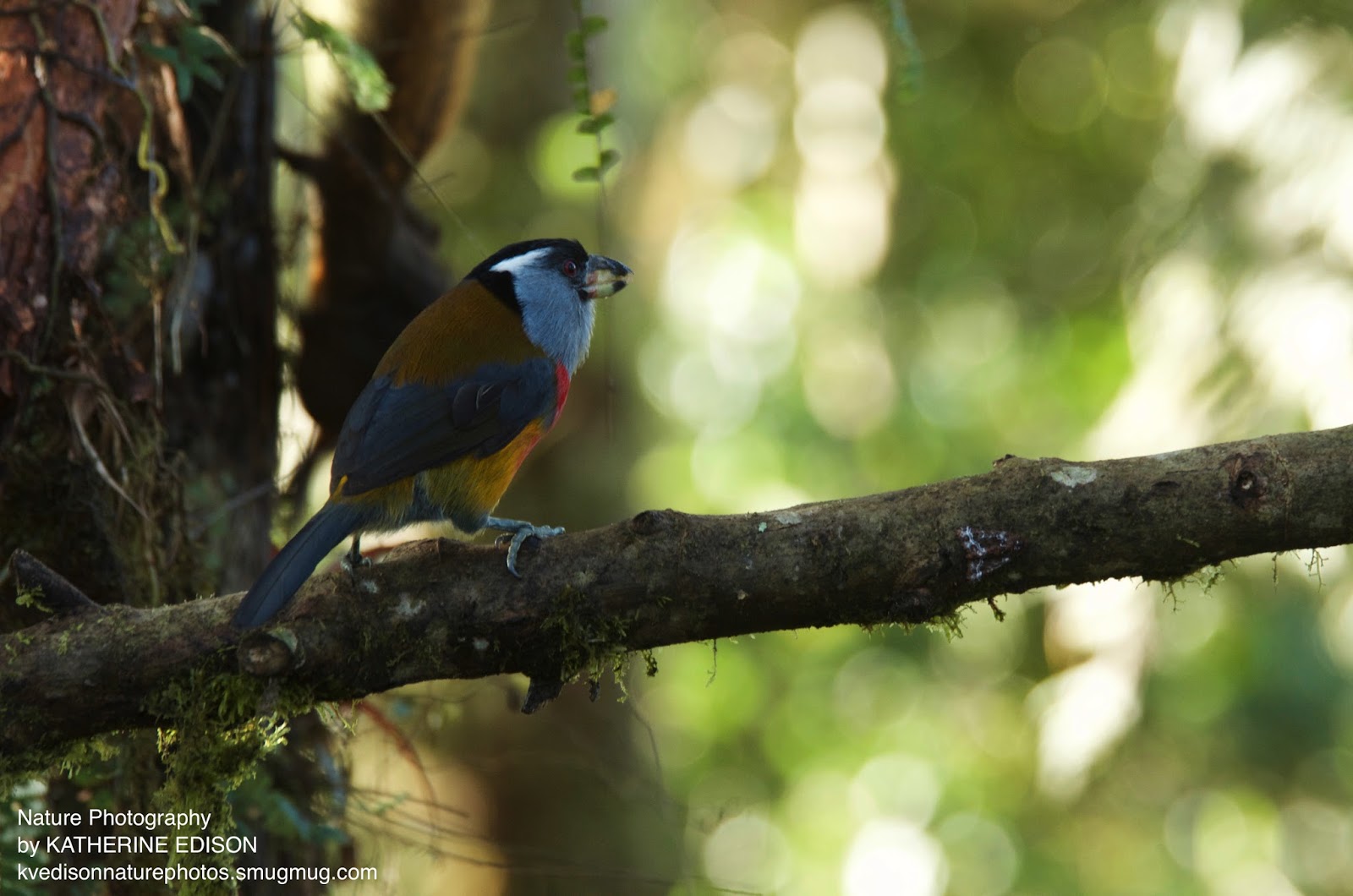
The next morning we got up very early and drove down the road to Las Cotingas Bird Reserve to see Tanagers, Toucans and Hummingbirds. We were still a little damp from the night before, but as soon as we saw the colorful birds, nothing else mattered. This locally owned reserve is another nice example of thoughtful eco-tourism in the area and is located just off the main highway on a tiered hill behind a modest house. The upper tier had benches in front of big trees festooned with bananas hung on nails. The lower tier had benches in front of an array of simple hummingbird feeders. It was a little past sunrise when we arrived and the owner had just put out fresh fruit. We sat for a couple of minutes and the birds started to appear. At first we saw a few colorful Tanagers and a Red-headed Barbet. The owner told us that the Toucans would show up a little while later, so we took a walk down to see the hummingbirds. They just blew my mind. I took a short video that doesn't do the experience justice. Click this link or visit my smugmug website and look at the Mindo photos. But I had a hard time even looking at the birds because there were so many and they were moving so fast. Many of my photos were blurry and grainy due to the low light, but I did get a few nice ones. I only identified a few of the hummingbirds because I couldn't see any obvious markers to help me. I think I need a hummingbird field guide.

Las Cotingas Bird Reserve

Feeding Station--Lots of Tanagers!

Golden-naped Tanager
Red-headed Barbet (M)

Blue-gray Tanager and Flame-rumped Tanager
White-necked Jacobin
Possibly a Sparkling Violetear

Back up to the banana station again, this time the light was better and more birds were arriving. Then came the Toucans! First the smaller green Crimson-rumped, then came the big, loud Collared Aracaris. Toucans are bossy and they chased away most of the other birds, but eventually they all came to a truce. We saw 2 species, and several individuals of each species. We also saw Toucan Barbets and a gang of Red-tailed Squirrels that had found that bananas were easy to come by at the Bird Reserve! I meant, but forgot, to ask the owner how many pounds of bananas and gallons of sugar water she had to put out every day. It must be a lot because they eat furiously.

Black-chinned Mountain Tanager

Crimson-rumped Toucan

Collared Aracari Toucan

Golden Tanager

Thick-billed Euphonia and Others
Toucan Barbet

Red-tailed Squirrel with a prize

Another trip back down to the hummingbirds. The light was a little better down there, too, and we saw big hummingbirds with long tails and tiny hummingbirds not much bigger than a bumblebee. There is great diversity of bill shape and size, too.
Beak Diversity

Tail Diversity

Velvet-purple Coronet

Another quick visit to the Toucans, and then our tour was over. If we had been able to spend more days we might have tried to see a "Cock of the Rock", a flamboyant crimson bird the region is famous for. That will have to wait until next time.

Wildflower that Looks Like a Rhexia. Not sure.

We spent the rest of the day exploring the nature trails and walking to the actual town of Mindo to see the waterfalls. On the trail I discovered a large woodpecker, about the size of a Pileated, and identified it as a "Powerful Woodpecker". We saw a few other birds on our walk and heard, but didn't see, parrots. At the waterfall, my eagle eyed husband caught view of an Owl Butterfly taking refuge from a light rain under the large leaves of a bush.

Powerful Woodpecker

Owl Butterfly

Mindo was a really nice change after 3 weeks in the busy and loud city of Quito. Next time we visit Ecuador, we will spend more time here. And in the Amazon. And at the coast. And in Cuenca. There is a lot to see in this small and beautiful country.

Mindo Toucan Mural

Sunday, June 14, 2015

30 Days in June: Day 11 and 12, Alfred Ring Park


Bluebird at the Ballpark

Day 11 was kind of a bust. I spent the morning at Northeast Park (a tree lined City recreation park in my neighborhood, with baseball diamonds, tennis courts, a playground and a dog park) trying to find a Northern Flicker that a friend had reported. I did not find the Flicker even after spending an hour and a half looking. I found lots of Red Headed Woodpeckers and Bluebirds, but no Flicker. It wasn't very fun and I was frustrated at the end of the morning. The problem was that I had forgotten my real purpose in my "30 Days in June" adventure, and had given into my competitive self, trying to collect bird sightings. Instead of experiencing and enjoying, I was acquiring, which is never satisfying because you never have enough. And since I hadn't acquired my desired item yet, I drove over to Morningside to see if I could scare up a Flicker there. I didn't see a Flicker there, either, but when I played Flicker sounds in the area where I'd seen them in the past, the Brown Headed Nuthatches got very agitated and I could see them fly around.

Yelloweyed Grass (Xyris sp.)

Tarflower (Bejaria racemosa)
Florida Plantain (Arnoglossum floridanum)
I spent another hour or so walking, and I realized I was so much happier doing that than standing next to the tennis courts at Northeast Park, or driving to the far edges of the county, trying to find a certain hard-to-get bird. I do this every year and I never enjoy myself when I go out with an agenda. I promised myself right then that the rest of the month would be spent visiting places I actually wanted to see before we leave Florida, and let the list happen as it will. When just I let myself just enjoy and explore at Morningside and it was much more satisfying. I was much more "in the moment" and thus open to serendipity. As a result, I found Tarflower and Xyris blooming in the flatwoods and happened on a large cluster of Florida Plantain in full bloom in the sandhill. I have only seen a couple Florida Plantains blooming ever and never seen so many at once. They are beautiful and remind me a little bit of Milkweed blooms, though they are members of the Aster Family. This plant is endemic to Florida.


With renewed purpose, the next day I went to visit Alfred Ring Park. I did not add any new birds to my June Challenge list, but I did add bugs and bark and squirrels. It was a great afternoon.

Hogtown Creek Runs Through the Heart of Gainesville

When we first moved to Gainesville we lived within (long) walking distance of Ring Park. We would sometimes take our dog Sadie on a long loop walk, from our house, through the park and back home again. My husband and daughter used to go on long runs that would take them through the park. When I taught environmental education at Morningside Nature Center, we would bring classes to Ring Park to teach how macro invertebrates can be an indicator of water quality and the importance of keeping our streams clean. One year we taught a camp all about Trees, and I spent a couple of wonderful hours learning about different types of Florida trees with my friend and co-teacher, Grace. She introduced me to Hophornbeam and American Hornbeam (or Musclewood, a name I like better).  There is such personality in the various textures of tree bark. I think it could be cool to put together a bark poster, organizing them like a patchwork quilt.

Hickory

Loblolly Pine

Maple

American Hornbeam (See the "muscles"? It looks like sinewy limbs.)

Hophornbeam

Southern Magnolia

Sweetgum

Ring Park is where I go if I want to find Ebony Jewelwing Damselflies or beetles and bugs. The wet, damp environment makes it a great place for fungi and for plants like Green Dragon, a relative of Jack in the Pulpit. It's a good place to find spiders and owls, and definitely for squirrels.

Ebony Jewelwing Damselfly

Millipede and Moss

Big, Camouflaged Spider

Purse Web Spider Web

Owl Feather?

Greendragon (Arisaema dracontium) --Look at the beautiful, logarithmic spiral!

Fungus

Noisy, Gnawing Squirrel

It's a popular park, located between neighborhoods, in the heart of Gainesville. People walk their dogs and exercise, look for shark's teeth and picnic. One of my friends, Merald, proposed to his wife at Ring Park. I love to walk on the boardwalks and paths and look out over the creek. It is a place full of life. When I think of Ring Park, I think of rich, wet greens. It feels like Gainesville.

Boardwalk

Oxbow

Green Sky