Showing posts with label hummingbird. Show all posts

Friday, February 24, 2017

Goodbye Winter

Star Magnolia in Bloom

I'm pretty sure that Winter is finished here in Athens. Sure, there could still be some more cold snaps coming, but the temperatures here are balmy, in the 70's and 80's. In fact, it almost feels like Spring will whiz past without giving us a chance to savor the "just right" temperatures between frigid and roasting. We may be in for another record breaking scorcher summer and drought. I sure hope not, but signs are pointed that direction. Meanwhile, though, it's a lovely Spring, and the camellia bushes and ornamental magnolias are blooming like mad and the daffodils are standing tall and dreamy yellow in patches all over the city. The Cedar Waxwings can still be seen bopping through the treetops, but they have polished off most of the choice winter berries and I expect that they will be leaving soon, along with the masses of Grackles and Robins. By the way, in case you were wondering, the collective noun for a group of Grackles is "Plague". They certainly do swarm in, like a plague of locusts, and eat everything in the feeders and throw the leaf mulch all over, but I still like them. I enjoy their raspy sounds and iridescent blue/black feathers. And it is amazing to watch hundreds of them launch in unison from the trees when they decide it is time to move on to the next yard. The celebrity Baltimore Orioles and the Rufous Hummingbird that have stuck around our yard all winter are still sticking around. Lots of people have come by to look at them, including some Ornithology Classes from UGA! Friends asked us why we had crowds of people with binoculars in our yard. It makes me smile every morning to see the hummer perched at our kitchen window feeder, guzzling away. And, as they did in Gainesville, the Orioles chatter at me when I refill their grape jelly feeders. They also like to drink from the hummingbird feeders, so it is a challenge to keep them all full. It was exciting to see 3 Orioles last week for the Backyard Bird Count.

Cedar Waxwing feeding on Ligustrum berries

Plague of Grackles

3 Orioles at the Feeder!

Rufous Hummingbird takes a rain bath

When I see the Hummingbird in his usual spot in the bushes, where he can keep a watch over the whole yard, I wonder what is going on in his mind. He is so far away from where he should be. Does he know it? Does he care? Does he miss being with his own species? He looks kind of lonely, but hopeful. Always on the watch. Is he looking for other hummingbirds? Does he miss having other birds to hang out with? Do hummingbirds even do that? I imagine that he'll decide to fly home one of these days soon. But where exactly is home? For summer breeding season, that would somewhere in the upper Northwest and into Canada and Alaska. Migration season they would mostly be in the Mountain West, California and Mexico. And for winter, mostly Mexico. That's a long way from Georgia for a tiny bird, but Rufous Hummingbirds are tough. I was reading more about Rufous Hummingbirds and found that they live 4-5 years and are one of the hardier species that can withstand some cold winter temperatures. In the Q&A section of one website, someone asked if it was true that hummingbirds migrated on the backs of geese. I really laughed at that one. The answer is no. But I do wonder when the hummer will go back to be with "his people" or if he'll stick around for a while longer. The Ruby Throated Hummingbirds are ready to begin their migration back north again and when they arrive, he'll have lots of competition at the feeder, if he stays that long. I wish him luck on his trip back home, wherever that may be, even though I will miss seeing his little silhouette through the bushes. He needs to get back to breed. I will miss all the winter visitors, but the seasons change and nature calls on them to move on. Now it's time to welcome the next seasonal guests.

Surveying the Yard

And speaking of the next season, the butterflies are here! I saw these Azures and my first Mourning Cloak at the Botanical Garden the other day. Spring is here for sure.

Spring Azures

Mourning Cloak (terrible picture but first sighting for me in Georgia!)


Tuesday, January 3, 2017

Winter Visitors

No More Cookies

January is here and people are returning to normal work and school schedules after a long holiday season. Our house was bustling this year with visiting family and happy celebrations for about 2 weeks. It was lots of fun and the house seems pretty quiet now as we put everything back in where it belongs and clean and tidy up. The cookies and treats are just about all eaten up, the tree has gone to be recycled into mulch, and the laundry is almost all washed and folded. Pretty much back to the old routine.

But one of our visitors decided to stay a while longer and so I've been making some accommodations. We were very lucky this year to find a Rufous Hummingbird in our yard in mid-December. I checked today and it is still here, and probably will be for the rest of the winter. It was pure luck that I even found it in the first place. On December 12 I stepped out on the front porch and a small bird zoomed past me and landed in a tree. I saw that it was a hummingbird, which is pretty unusual for winter here in Georgia. Little did I know that it was not one of our typical Ruby Throated birds, but at that moment I couldn't see it well enough to know. I had left out a nectar feeder hoping for this very possibility because I read that some birds will straggle behind during migration and need refueling stations. But I hadn't seen anyone feeding in our yard since fall and the nectar was old and yucky. I ran inside to brew up some fresh nectar (dissolve 1 part sugar into 4 parts water, cool and serve. No food coloring, please) and brought it out in a fresh, clean feeder. Then I proceeded to clean and refill all of our feeders.  I posted an excited message on Facebook that day and the next day I was rewarded with a beautiful view of a Rufous Hummingbird from my kitchen window. According to my Sibley Field Guide, Rufous Hummingbirds are rare in our area. They live in the Pacific Northwest, winter in the Gulf Coast and Florida, but don't really live in my part of the world. What a treat! If I hadn't seen him fly by and hadn't refilled the feeders, who knows if he would have stayed around?

Male Rufous Hummingbird from the Kitchen Window

I proudly reported my bird (note how protective I'm getting!) to the local Audubon group and on eBird and promptly had requests from other birders who wanted to know if they could come see him. We've had a regular stream of Rufous fans ever since. To make it even better, one of the groups of observers also noticed a pair of Baltimore Orioles in our bushes. I had no idea they were there and had given up all hope of hosting them the way we did in Florida. I had understood that they didn't winter here, and I left our jelly dishes behind in Gainesville when we moved. When I put out the hummingbird feeder, the Orioles came to drink from it and the Rufous was furious! He chased them away and chattered at them. But I found another dish, bought some grape jelly, and now there is peace once again. There are only 2 Orioles, not the jelly gobbling hordes that we had in Gainesville, and there are none of the older, brilliant orange males. But I'm happy, and maybe these 2 will bring friends.

Baltimore Oriole Eating Jelly

Truce

He's Awfully Pretty, Don't You Think?

Last weekend, after the Rufous had been with us for a few weeks, I noticed mildew on the feeders. I was hoping they'd stay clean longer in cold weather, but fungus loves sugar and sun so it was time to clean. On New Years Day, I pulled down all the feeders and gave them a good scrubbing with brushes, biodegradable soap and a vinegar water rinse. Then I filled them again with fresh nectar. The seed feeders probably need a good mid-winter cleaning, too, but I'll get to them when the rain clears up. I guess it's going to be a busy New Year!

All Taken Apart

Brushes to Clean the Gunk

Mini Brushes for the Small Spaces


Refilled with Fresh Nectar

Happily Feeding

I hope your New Year is filled with happy days, exciting discoveries, interesting visitors, plenty of food and very little mildew.

Mockingbird doesn't understand what all the fuss is


Thursday, September 29, 2016

Mindo, Ecuador

Welcome to Mindo!
If we had known how much we would love Mindo, we would have planned to stay longer. But our plans and schedule only allowed 24 hours, so we enjoyed as much as we could in a short time. We vowed to the hosts of our lodge that we will come back in the near future and stay a whole week!

Ochenta y Ocho Butterfly (Eighty-eight) at our Lodge

Mindo is a town in the cloud forest about 100 km to the NW of Quito. The difference between dry Quito and green and lush Mindo appears pretty early in the journey as you cross into the western slopes of the Andes, and according to Wikipedia, "where two of the most biologically diverse ecoregions in the world meet: the Chocoan lowlands and the Tropical Andes". We drove for about 2 hours, most of the time on narrow and winding roads up and down through heavily forested mountains and foothills. Occasional farms, clear cut with grass and cattle, stood out against the otherwise thick vegetation. We understood from conversations with our driver that development is being controlled now by the government, but that it had not been so much in the past. Farming would be difficult on steep hills, but is probably an attractive alternative in a tough economy. Hopefully the people can be convinced that there is some benefit in conserving the incredible biodiversity of this region. We saw many signs for Eco-Lodges and Birding Tours along the way, so perhaps there is money to be made in Eco-tourism.


Mindo Lago Lodge

Our lodge, Mindo Lago, was a great example of conservation tourism. The owners took what had previously been a cattle farm and built rustic but comfortable hut-like cabins around a man-made lake. Then they planted native plants and laid out a network of nature trails through the forest and around the perimeter. There is still work to be done, removing invasives and planting more native plants, but the results have been wonderful. They told us that where there had once been only cattle and one or two species of frogs, now their lake, ponds and forest plants support around 25 different species of frogs and numerous other animals. As we first walked into the open-air registration area from the parking lot, we saw dozens of butterflies and birds, including at least one giant Blue Morpho butterfly bobbing around the banana trees and bromeliads. It was beautiful. Several times a week the lodge hosts an evening "Frog Concert". People from hotels and lodges from around the area are invited for a short lecture explaining Mindo Lago's conservation story, followed by a walk to look and listen for frogs. They do not allow photos of the frogs so that the animals are not bothered by constant flashes. I appreciated their concern, though it would have been nice to document what we saw! The night we were there, it was raining steadily and the night walk had to be shortened a bit, but we saw numerous frogs, spiders, walking stick insects, interesting plants and a Rufous Motmot. I wish I had been able to take a photo, but it was raining. I had some difficulty even looking at the bird because every time I turned my head up, the water poured into my nose and eyes. But I did see it and its wonderful long tail.

Godart's Altinote Butterfly

Heliconia

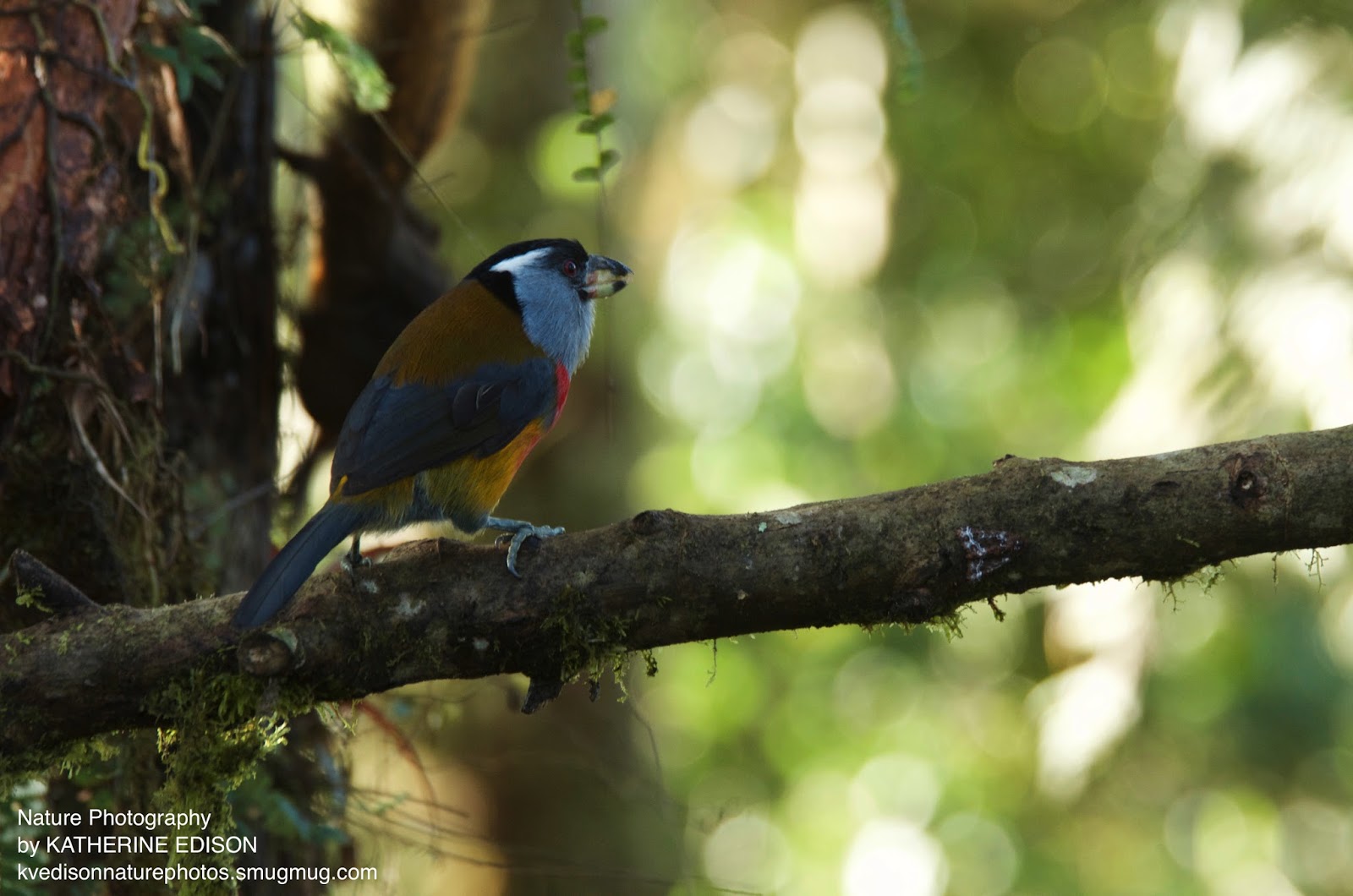
The next morning we got up very early and drove down the road to Las Cotingas Bird Reserve to see Tanagers, Toucans and Hummingbirds. We were still a little damp from the night before, but as soon as we saw the colorful birds, nothing else mattered. This locally owned reserve is another nice example of thoughtful eco-tourism in the area and is located just off the main highway on a tiered hill behind a modest house. The upper tier had benches in front of big trees festooned with bananas hung on nails. The lower tier had benches in front of an array of simple hummingbird feeders. It was a little past sunrise when we arrived and the owner had just put out fresh fruit. We sat for a couple of minutes and the birds started to appear. At first we saw a few colorful Tanagers and a Red-headed Barbet. The owner told us that the Toucans would show up a little while later, so we took a walk down to see the hummingbirds. They just blew my mind. I took a short video that doesn't do the experience justice. Click this link or visit my smugmug website and look at the Mindo photos. But I had a hard time even looking at the birds because there were so many and they were moving so fast. Many of my photos were blurry and grainy due to the low light, but I did get a few nice ones. I only identified a few of the hummingbirds because I couldn't see any obvious markers to help me. I think I need a hummingbird field guide.

Las Cotingas Bird Reserve

Feeding Station--Lots of Tanagers!

Golden-naped Tanager
Red-headed Barbet (M)

Blue-gray Tanager and Flame-rumped Tanager
White-necked Jacobin
Possibly a Sparkling Violetear

Back up to the banana station again, this time the light was better and more birds were arriving. Then came the Toucans! First the smaller green Crimson-rumped, then came the big, loud Collared Aracaris. Toucans are bossy and they chased away most of the other birds, but eventually they all came to a truce. We saw 2 species, and several individuals of each species. We also saw Toucan Barbets and a gang of Red-tailed Squirrels that had found that bananas were easy to come by at the Bird Reserve! I meant, but forgot, to ask the owner how many pounds of bananas and gallons of sugar water she had to put out every day. It must be a lot because they eat furiously.

Black-chinned Mountain Tanager

Crimson-rumped Toucan

Collared Aracari Toucan

Golden Tanager

Thick-billed Euphonia and Others
Toucan Barbet

Red-tailed Squirrel with a prize

Another trip back down to the hummingbirds. The light was a little better down there, too, and we saw big hummingbirds with long tails and tiny hummingbirds not much bigger than a bumblebee. There is great diversity of bill shape and size, too.
Beak Diversity

Tail Diversity

Velvet-purple Coronet

Another quick visit to the Toucans, and then our tour was over. If we had been able to spend more days we might have tried to see a "Cock of the Rock", a flamboyant crimson bird the region is famous for. That will have to wait until next time.

Wildflower that Looks Like a Rhexia. Not sure.

We spent the rest of the day exploring the nature trails and walking to the actual town of Mindo to see the waterfalls. On the trail I discovered a large woodpecker, about the size of a Pileated, and identified it as a "Powerful Woodpecker". We saw a few other birds on our walk and heard, but didn't see, parrots. At the waterfall, my eagle eyed husband caught view of an Owl Butterfly taking refuge from a light rain under the large leaves of a bush.

Powerful Woodpecker

Owl Butterfly

Mindo was a really nice change after 3 weeks in the busy and loud city of Quito. Next time we visit Ecuador, we will spend more time here. And in the Amazon. And at the coast. And in Cuenca. There is a lot to see in this small and beautiful country.

Mindo Toucan Mural

Monday, September 26, 2016

Collective Intelligence

My Reference Books
When I post photos from my travels I do my very best to identify what I've seen for my website and blog. It's a bit easier when I'm photographing or posting from home because I can just turn to my arsenal of Florida and Georgia Field Guides and helpful local experts and websites. But when I'm traveling it gets a bit more complicated. It's not really practical to carry field guides from around the world in my suitcase (though I do pick them up along the way from time to time). There are good apps, and I use them when I can, but I don't always have cell coverage (or an appropriate app). But what I do have, most of the time, is access to the internet, maybe from the hotel or the airport or somewhere along the way. The trick is finding good sources of info. I ask locals when I can. But often, I'm on my own, or the people around me don't know, or I don't speak the language well enough to ask or understand. So I often turn to Google and Wikipedia, and have been fairly successful. With birds, I reinforce the search by turning to e-Bird to see what birds have been reported at that location or nearby. When I'm in South America, I also look at the Neotropical Bird section of the Cornell Lab of Ornithology site. (I wish that the birds on an E-bird list had links to photos so I could easily look to see if the bird is what I'm looking for, and the Neotropical Bird site is a little clunky to navigate between species to identify and compare, but they're still both very useful.) I've had pretty good luck just Googling the name of the bird, or "Birds of ___" and checking Wikipedia or looking at photos. When we went to Iguazu Falls a few years ago I took hundreds of photos of butterflies that I'd never seen before. I found several helpful websites for identifying them, but sometimes I had to resort to just describing the butterfly and location and see what came up in the Google "images" section. For flowers, I'll often search for "wildflowers of (insert town/country/region)" and a local field guide may pop up. When I'm in a Botanical Garden, I take care to photograph the interpretive signs and ID tags to look at later. Some thoughtful locations, such as the bird refuge in El Calafate, Argentina, have signs with pictures of wildlife and plants that you may see along the way. I very thankful for these! And I always grab trail literature when it looks helpful. 

Helpful Sign in El Calafate, Argentina

Local Field Guides 

So you can see that a lot of work goes into this photography/blog business. Besides taking the photo and editing it, I also have to get the information right. Whew! It's probably not truly necessary, but I'm a bit obsessive about putting things in categories. Most readers or viewers don't really care what plant family the flower comes from, or whether the bird is a white phase or the striated version. But I like to know these things, so I seek out the information. And occasionally people will find one of my photos online and ask use it for a publication or illustration, and I want to be as helpful and accurate as I can. I report my own bird sightings to e-Bird and have been contacted once or twice when I reported something that was too rare to be true. After some investigation, the investigator and I determined that I had misidentified my bird, and I changed the report. Friends have contacted me, too, and let me know that I have misidentified a snake or turtle or flower and I really appreciate the help. I'm no expert and I love to learn. So if you see something I should change, let me know! I really do want to know. I understand that there are apps now where you can just submit a photo and have it identified for you, and I may look into it someday, but I admit that I enjoy the chase.

Butterfly from Iguazu Falls. Needs ID still!

This is all a long introduction to the tough time I had figuring out what I had seen while traveling in Ecuador. My bird, plant and insect knowledge in Florida and now Georgia came from years of following experts around. In Ecuador, I did much of my exploring on my own and much of it was new. But I searched and scoured the internet and did my best. In hindsight I realize that I probably should have just purchased a field guide to the birds of Ecuador. I may still do it, especially if we ever return, and I hope we will. Ecuador is an amazing country, with the most biodiversity per square kilometer of any other nation on earth. According to Wikipedia, there are 1600 species of birds, 4000 species of butterflies, and 16,000 species of plants. Really, it's an incredible place.

Hummingbird in Papallacta. Still Needs ID!
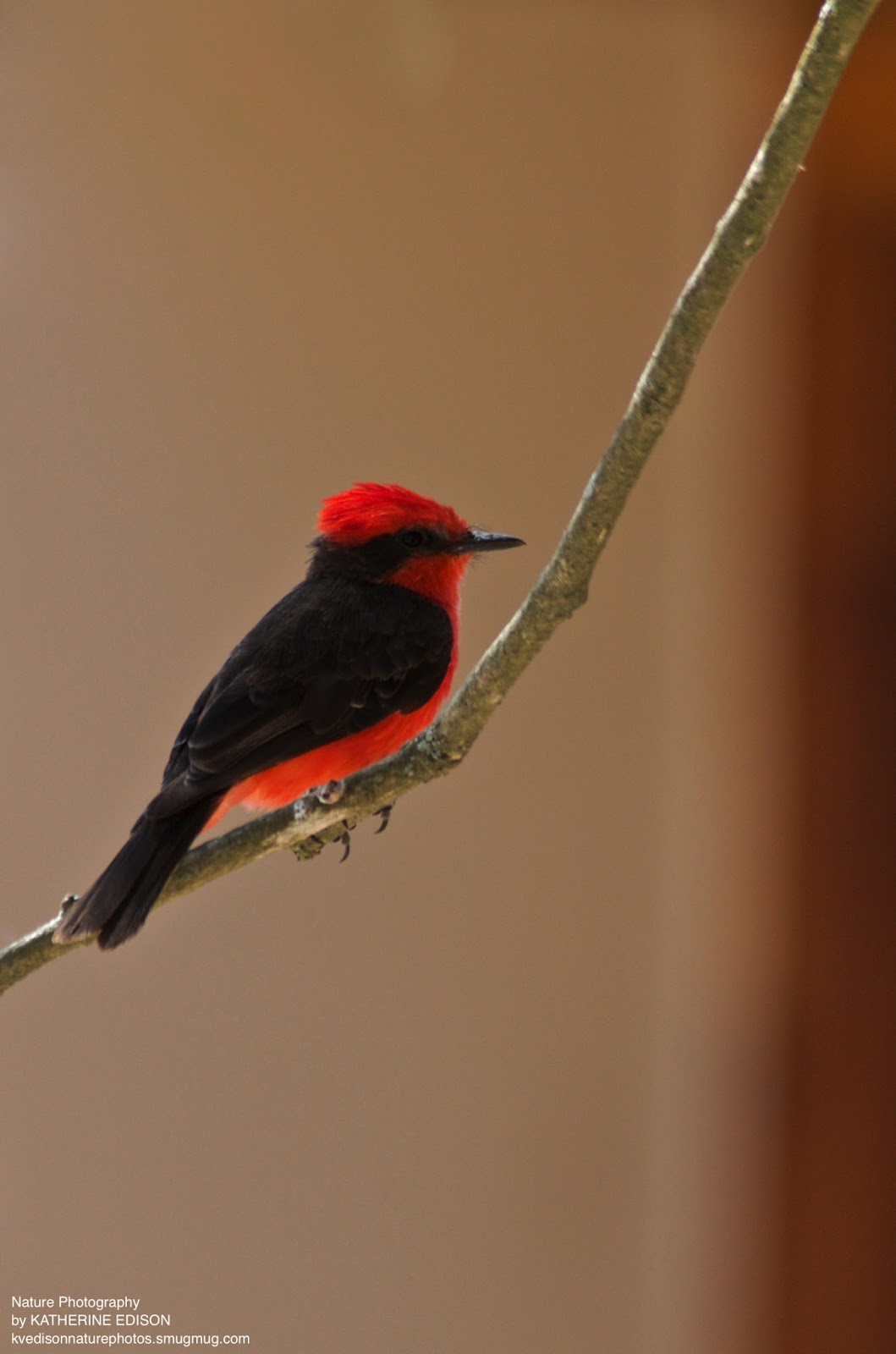
I spent an afternoon in a botanical garden on a hilltop in Yachay, a few hours north of Quito, while my husband met with university administrators. I had a great time and saw some cool birds and plants. Luckily for me, I was in a botanical garden and many of the plants had signs. The birds gave me a little more trouble. Vermillion Flycatchers were easy, and I was really excited when they started hopping out of the bushes, but actually grew tired of them after a while because they were so plentiful! (Such problems I have!) I was really hoping to see some fancy hummingbirds like the ones in Quito. I saw several not-quite-so-fancy hummingbirds, but they were always too far away to get a good ID photo. But back at the hotel, using my combination e-Bird hotspot report/Wikipedia technique, I was able to identify a Yellow-faced Grassquit that was photographed from far away and in the bushes. The American Kestrel was easy because I knew them from home. They are very plentiful in Ecuador.

One of Many Vermillion Flycatchers

Hummingbird, No ID Yet 
Yellow-faced Grassquit
Handy Signs at the Botanical Garden
American Kestrel and Prey

A week later, when our family went to the cloud forest in Papallacta, and again in Otavalo, I finally saw some fancy hummingbirds. I bought a small guide that was somewhat helpful for Papallacta, but 
e-Bird was the best resource. Friends on Facebook and the guide who took my family on a day hike helped identify some of the plants and flowers.

Cinereous Conebill

Black Crested Warbler

Pale-naped Brush Finch

Shining Sunbeam Hummingbird

Spectacled Whitestart

Sword-billed Hummingbird
(This one made me very happy! What a bill!)

Tawny Antpitta
(I heard this bird a long time before I was able to find it, and it took e-Bird to make an ID.)

Andean Gull
Turquoise Jay and Tasty Bundle

Tree Lungwort

Lepanthes Orchid
(I was so focused on the pretty heart-shaped buds that I missed the tiny orchid flower in the background!)

Scarlet Angel's Trumpet
(The Sword-billed Hummingbird uses its extra long bill on this flower!)
Next we spent a few days at a lakeside resort north of Quito, near Otavalo and it seemed like there were many species of hummingbirds in the gardens there, but later, after looking more carefully, I realized that I had seen only 3 or 4, but that they varied from male to female, and they moved around a lot! There is a lot of zipping in the hummingbird world. The Black-tailed Trainbearer hummingbird that I had tried to catch in Quito was more cooperative this time. 

Black-tailed Trainbearer (m)

Black-tailed Trainbearer (f)

Green Violetear Hummingbird

Not Sure. Emerald? Violetear?

Western Emerald Hummingbird?

A bigger challenge came when we visited a bird reserve in Mindo, a few days later. But that, my friends, is another blog post!