Showing posts with label gull. Show all posts

Monday, October 31, 2016

Galapagos Islands, Part 1

Map of the Galapagos Islands

When I was in elementary school in the early 1970's, my friend Willow's father came to our school to present a slide show about his journey to the Galapagos Islands. Keep in mind that the islands had only opened for tourism in the 1960's. I don't remember how much I knew about the Galapagos prior to his presentation, or much about the specifics of what he said, but I do remember ending the day with the understanding that this was a remote and very special place with wildlife and plants unlike any place else. Those magnificent and ancient Galapagos tortoises! Over the years I thought back to that day in school, especially when I heard mention of the islands in the news or TV or movies or literature, and they took on an almost mythical quality in my mind. The Galapagos Islands. And never, ever, did I think that I would actually go there. But sometimes opportunities present themselves, and in September, because we were already visiting Ecuador, I was able to go see some of the Galapagos Islands for myself. It was every bit as extraordinary as I had hoped it would be.

Blue-footed Booby on the Lava Rocks

When my husband and I first started exploring the possibility of a trip, I was concerned about whether my travel to the Galalpagos could be harmful to the islands. When I was a kid in the '70's, travel there was more of an ordeal and was fairly uncommon, but in the years since then cruises and hotels have made it so easy that just about anyone can get there. I was worried about contributing to pollution or overgrowth or too much contact with the wildlife. But our Ecuadoran friends insisted that we had to visit one of their most treasured places. We were directed to a tour company that was in line with our environmental ethic. So we booked a trip, and it turned out to be nothing like I had feared and was a fantastic experience.

Saddle-back Galapagos Tortoise

This is not to say that everything is perfect. I understand that there is increasing concern over huge cruise ships bringing large groups of people in for short visits (though we did not see any of them), with maximum impact on the natural areas, but with little benefit to the local economy. And as the popularity of the parks grows, the towns supporting the tourist economy grow. The population on the islands has grown dramatically in the last 50 years. Also, the park management has a difficult battle with invasive species brought in. There are plants, animals and insects that are displacing the native species. Over fishing and poaching on the islands is troubling and protecting the islands is an ongoing battle. But these are issues recognized by the Ecuadoran government and the park management and they are moving to address them.

Sea Lion by an Ice Cream Stand--Clash of Cultures

As I learned more about the past history of the management of the Galapagos, I came to believe that controlled tourism is really the best way to protect the islands. In the past the animals were exploited for food and lamp oil (the tortoises) and people tried to colonize and exploit the islands for their resources. The US saw the islands as a strategic location for a military base in WWII. They created what is now the airport in Baltra. Fortunately, the islands were so remote and the habitat was so difficult that relatively few areas were colonized. In 1935, the government of Ecuador designated part the islands as a wildlife preserve, and in 1959 they became Ecuador's first national park. In 1978 UNESCO recognized the Galapagos Islands as a World Heritage Site. There are some towns on some of the islands, and some private land, but for the most part, the islands are very carefully managed. Each visitor to the park pays a $100 entrance fee that goes to support the preserve. And every visitor must be accompanied by a Naturalist Guide who is responsible for the behavior of the guests. On our trip in the park, we saw no litter and everyone was respectful of the wildlife and of the trails and park. By sharing the wonder of the Galapagos Islands with the public, more and more people learn about the importance of protecting them. The people who live on the islands are learning that the health of the islands is important in order to bring tourists to support the lucrative tourist economy. People want to protect something that they understand.

"Don't Touch the Tortoises"--Sign at Private Ranch with Giant Tortoises

We ended up choosing an 8 day cruise on a small catamaran that held 16 passengers at maximum and a staff of 8-10 people. We visited about half of the islands and did much of our travel at night while we slept, leaving the days open for exploring. Our crew was friendly and knowledgable and many of them were locals. Our tours were led by a naturalist with 20 years experience in the islands. We had perfect weather with only one or two rocky, seasick periods. Being on the ocean with no internet was lovely and relaxing. The few times we were in port and could check email and the news felt harsh and jarring after days of nature walks, reading by natural light, early bedtimes and actual conversations.

Gorgeous, Quiet Beach
Most of our days consisted of a morning hike, a midday swim or snorkel, followed by an afternoon hike at a new island or section of an island. We parked our boat and traveled by dinghy to the shore or snorkeling site. We did some birdwatching from the deck of the boat and it was very exciting to watch the Frigatebirds, Albatrosses and Shearwaters that typically flew alongside as we moved through the water. We spotted a Humpback Whale the first day but didn't see others the rest of the trip. Sea turtles were common but we did not see any dolphins.


Frigatebird Follows the Boat

Our journey started at Santa Cruz island, where the Baltra airport is located. After boarding the ship around lunchtime, we traveled by boat, then by bus to the Santa Cruz Highlands where we visited a private ranch and tortoise preserve. There we saw dozens of giant tortoises. No one is really sure how old most of them are unless they were raised in captivity, but some are estimated to be 100-175 years old. It was incredibly moving to see these revered creatures just ambling along the side of the road. One even walked in front of our bus and just sat down. We waited in the road until it decided to move on. On the ranch, the giant tortoises chewed grass along side of the cattle. At the ranch we also saw several kinds of Darwin's finches, the most exciting (to me, at least) being the Woodpecker Finch that uses small sticks to fish insects out of holes in trees. Later we explored some of the volcanic features of the island and walked inside of a huge lava tube. It is interesting to keep in mind that these islands are geologically rather new. The Galapagos Islands are located over a magma hotspot between two tectonic plates. The plates have been moving very slowly for millions of years over the hotspot, forming new islands. The oldest islands are closest to the mainland and are estimated to be between 3 & 4 million years old. Some submerged islands are thought to be older, perhaps as much as 15 million years. The newer islands, further to the west, are only hundreds of thousands of years old and some are still volcanically active. We did not visit the western islands.


Giant Tortoise Blocks the Road

Giant Tortoises and Cattle

Woodpecker Finch (Darwin's Finch) with Stick

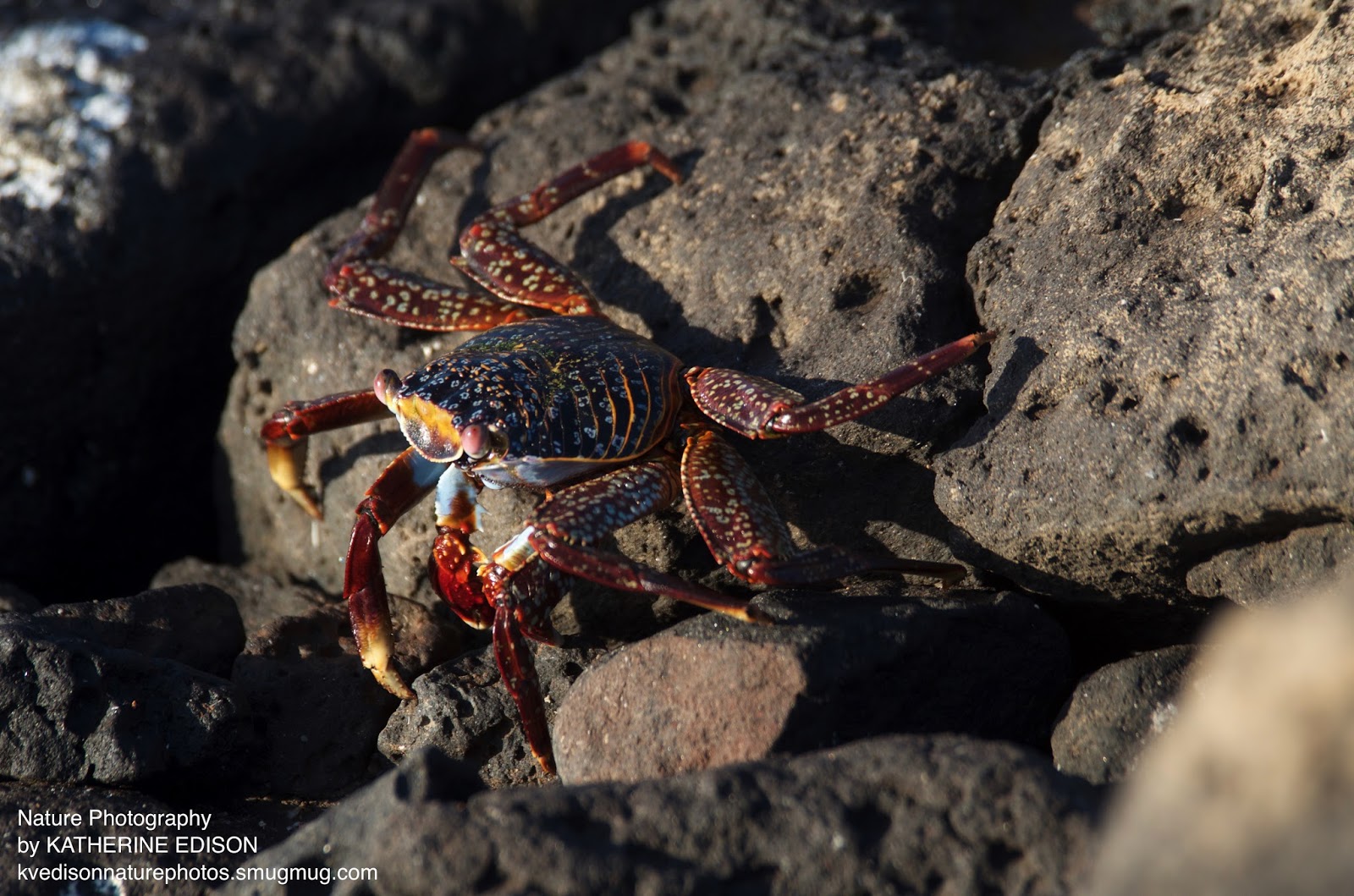
The next morning we explored Isla Plaza, just off of Santa Cruz, where we saw Sea Lions, Frigate Birds, Masked Boobies, Swallow-tailed Gulls, Shearwaters, a lost Galapagos Penguin, Brown Noddies, Red Billed Tropicbirds, Pelicans, Cactus Finches, Marine Iguanas, Land Iguanas, Lava Lizards and Sally Lightfoot Crabs. It was a full morning! The wildlife was abundant and very tame and unafraid of people and I was able to get some fantastic photos. Visitors are asked to stay 2 meters from the wildlife, but sometimes it is not possible to keep that distance, or the animals come near you. I used a telephoto lens, too, which made some of my encounters seem closer. Sometimes the telephoto didn't work because the animals really were that close! The landscape was strange and beautiful, with drought tolerant plants like cactus and carpetweed (a kind of succulent portulaca) growing over the volcanic terrain.

Carpetweed and Cactus

Swallow-tailed Gull

Sally Lightfoot Crab

Young Sea Lions Chasing a Galapagos Penguin (They don't eat penguins but they like to bother them)

One very interesting thing my husband and I noticed was that although there were large numbers of animals and plants, the number of species was relatively small. And different variations of those few species appeared on different islands. For example, there were 4 species of Mockingbird, but some only appeared on specific islands. Because there were so few species, I was able to identify many of them with a field guide specific to the islands. The Darwin Finches gave me some difficulty, though, because some of the distinctions were small. I couldn't always tell the difference between a small and medium tree finch or a small and medium ground finch and relied on our guide to point out a cactus finch.

Cactus finch

Tree Finch or Ground Finch; medium or small billed?
I finally went with Medium Ground Finch, but I'm open to corrections.

That afternoon we went to Santa Fe island and saw a land iguana specific to that island. They are yellow. We also saw Lava Lizards, Galapagos Mockingbirds, Galapagos Doves, Cactus Finches and Sea Lions. Afterwards, we snorkeled in the bay. I wish I had an underwater camera because the colors and number of ocean species were amazing. But we swam with playful Sea Lion pups, saw a Galapagos Green Sea Turtle and several other turtles, a big White Tipped Reef Shark (that gave me a start, but they are relatively harmless), an Eagle Ray and some other rays and hundreds of marvelously colored and shaped fish, including Puffers!

Santa Fe Land Iguana

The next day, day 3, we had traveled a long way overnight to San Cristobal where we dropped off some passengers at the airport and picked up a few more. My husband Art and I spent the morning exploring the Galapagos Information center and walked a trail that overlooked the beach where Darwin supposedly first set foot on the islands. We wandered around the small town and picked up a few supplies, like extra sunscreen (it is very sunny on the equator and especially so on the islands in the ocean) and extra photo memory cards (I took about 4000 photos!). That afternoon we snorkeled near Isla Lobos (just off of San Cristobal) in rather cold water. I was wishing we'd sprung for the wet suit rental, but after swimming a while we warmed up. The fish were amazing and it was neat to see colorful coral, urchins and clownfish. The loud clicking of the fish underwater was very strange and interesting. After the swim we dried off and hiked on the island where we saw colonies of Frigatebirds and their chicks and got our first good look at Blue-footed Boobies. They are the most endangered species of booby on the islands (we saw 3 species). Several of them made nests right on the path. Some of the juveniles objected to our presence and wouldn't allow us to pass, causing the group to walk up on the rocks out of the way. It was kind of funny to see our group of big humans back down to a flapping teenage booby. We also saw some very young Sea Lion pups, some of them still nursing. And we saw either a Lava Heron or a Striated Heron--it was hard to tell which.

Graffiti on San Cristobal Island

Frigatebird Colony with Fuzzy Chicks

Male Frigatebird

Blue-footed Booby Nest on the Ground. They poop away from the center to keep the nest clean, creating the ring.

Blue Feet

I'll break here to keep this post from being too long. Read part 2 for the rest of the story. You can see a full album of photos from the trip on my website by clicking here.


Monday, September 26, 2016

Collective Intelligence

My Reference Books
When I post photos from my travels I do my very best to identify what I've seen for my website and blog. It's a bit easier when I'm photographing or posting from home because I can just turn to my arsenal of Florida and Georgia Field Guides and helpful local experts and websites. But when I'm traveling it gets a bit more complicated. It's not really practical to carry field guides from around the world in my suitcase (though I do pick them up along the way from time to time). There are good apps, and I use them when I can, but I don't always have cell coverage (or an appropriate app). But what I do have, most of the time, is access to the internet, maybe from the hotel or the airport or somewhere along the way. The trick is finding good sources of info. I ask locals when I can. But often, I'm on my own, or the people around me don't know, or I don't speak the language well enough to ask or understand. So I often turn to Google and Wikipedia, and have been fairly successful. With birds, I reinforce the search by turning to e-Bird to see what birds have been reported at that location or nearby. When I'm in South America, I also look at the Neotropical Bird section of the Cornell Lab of Ornithology site. (I wish that the birds on an E-bird list had links to photos so I could easily look to see if the bird is what I'm looking for, and the Neotropical Bird site is a little clunky to navigate between species to identify and compare, but they're still both very useful.) I've had pretty good luck just Googling the name of the bird, or "Birds of ___" and checking Wikipedia or looking at photos. When we went to Iguazu Falls a few years ago I took hundreds of photos of butterflies that I'd never seen before. I found several helpful websites for identifying them, but sometimes I had to resort to just describing the butterfly and location and see what came up in the Google "images" section. For flowers, I'll often search for "wildflowers of (insert town/country/region)" and a local field guide may pop up. When I'm in a Botanical Garden, I take care to photograph the interpretive signs and ID tags to look at later. Some thoughtful locations, such as the bird refuge in El Calafate, Argentina, have signs with pictures of wildlife and plants that you may see along the way. I very thankful for these! And I always grab trail literature when it looks helpful. 

Helpful Sign in El Calafate, Argentina

Local Field Guides 

So you can see that a lot of work goes into this photography/blog business. Besides taking the photo and editing it, I also have to get the information right. Whew! It's probably not truly necessary, but I'm a bit obsessive about putting things in categories. Most readers or viewers don't really care what plant family the flower comes from, or whether the bird is a white phase or the striated version. But I like to know these things, so I seek out the information. And occasionally people will find one of my photos online and ask use it for a publication or illustration, and I want to be as helpful and accurate as I can. I report my own bird sightings to e-Bird and have been contacted once or twice when I reported something that was too rare to be true. After some investigation, the investigator and I determined that I had misidentified my bird, and I changed the report. Friends have contacted me, too, and let me know that I have misidentified a snake or turtle or flower and I really appreciate the help. I'm no expert and I love to learn. So if you see something I should change, let me know! I really do want to know. I understand that there are apps now where you can just submit a photo and have it identified for you, and I may look into it someday, but I admit that I enjoy the chase.

Butterfly from Iguazu Falls. Needs ID still!

This is all a long introduction to the tough time I had figuring out what I had seen while traveling in Ecuador. My bird, plant and insect knowledge in Florida and now Georgia came from years of following experts around. In Ecuador, I did much of my exploring on my own and much of it was new. But I searched and scoured the internet and did my best. In hindsight I realize that I probably should have just purchased a field guide to the birds of Ecuador. I may still do it, especially if we ever return, and I hope we will. Ecuador is an amazing country, with the most biodiversity per square kilometer of any other nation on earth. According to Wikipedia, there are 1600 species of birds, 4000 species of butterflies, and 16,000 species of plants. Really, it's an incredible place.

Hummingbird in Papallacta. Still Needs ID!
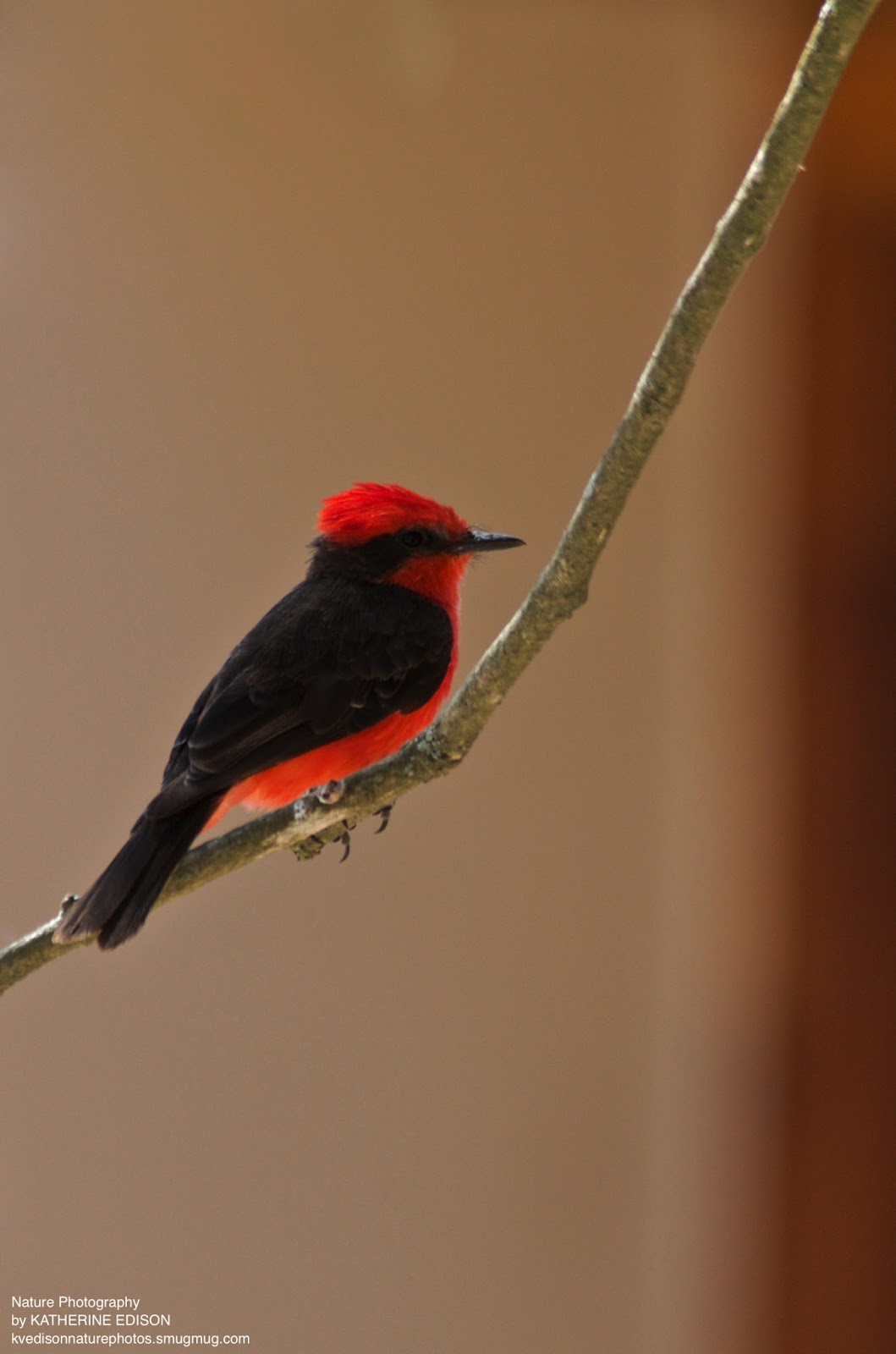
I spent an afternoon in a botanical garden on a hilltop in Yachay, a few hours north of Quito, while my husband met with university administrators. I had a great time and saw some cool birds and plants. Luckily for me, I was in a botanical garden and many of the plants had signs. The birds gave me a little more trouble. Vermillion Flycatchers were easy, and I was really excited when they started hopping out of the bushes, but actually grew tired of them after a while because they were so plentiful! (Such problems I have!) I was really hoping to see some fancy hummingbirds like the ones in Quito. I saw several not-quite-so-fancy hummingbirds, but they were always too far away to get a good ID photo. But back at the hotel, using my combination e-Bird hotspot report/Wikipedia technique, I was able to identify a Yellow-faced Grassquit that was photographed from far away and in the bushes. The American Kestrel was easy because I knew them from home. They are very plentiful in Ecuador.

One of Many Vermillion Flycatchers

Hummingbird, No ID Yet 
Yellow-faced Grassquit
Handy Signs at the Botanical Garden
American Kestrel and Prey

A week later, when our family went to the cloud forest in Papallacta, and again in Otavalo, I finally saw some fancy hummingbirds. I bought a small guide that was somewhat helpful for Papallacta, but 
e-Bird was the best resource. Friends on Facebook and the guide who took my family on a day hike helped identify some of the plants and flowers.

Cinereous Conebill

Black Crested Warbler

Pale-naped Brush Finch

Shining Sunbeam Hummingbird

Spectacled Whitestart

Sword-billed Hummingbird
(This one made me very happy! What a bill!)

Tawny Antpitta
(I heard this bird a long time before I was able to find it, and it took e-Bird to make an ID.)

Andean Gull
Turquoise Jay and Tasty Bundle

Tree Lungwort

Lepanthes Orchid
(I was so focused on the pretty heart-shaped buds that I missed the tiny orchid flower in the background!)

Scarlet Angel's Trumpet
(The Sword-billed Hummingbird uses its extra long bill on this flower!)
Next we spent a few days at a lakeside resort north of Quito, near Otavalo and it seemed like there were many species of hummingbirds in the gardens there, but later, after looking more carefully, I realized that I had seen only 3 or 4, but that they varied from male to female, and they moved around a lot! There is a lot of zipping in the hummingbird world. The Black-tailed Trainbearer hummingbird that I had tried to catch in Quito was more cooperative this time. 

Black-tailed Trainbearer (m)

Black-tailed Trainbearer (f)

Green Violetear Hummingbird

Not Sure. Emerald? Violetear?

Western Emerald Hummingbird?

A bigger challenge came when we visited a bird reserve in Mindo, a few days later. But that, my friends, is another blog post!


Saturday, July 20, 2013

Everywhere I Wander...

It's been a busy summer! So far this season I have journeyed to Salt Lake City, to Anastasia State Park on the northeast coast of Florida, all around Alachua County, and more recently, taken a train trip to New York City followed by a car trip to Prouts Neck, a little summer community south of Portland, Maine. Very different regions and very different experiences. One of the joys of leaving home is that I get to familiarize myself with a whole new place. Just a short drive from home puts me in the midst of birds and flowers that I vaguely recognize, but can't quite ID without help. And I'm just not all that familiar with their behavior or habit. Life at the seashore, for example. I've studied Florida's coastal systems, but I've never lived right there and just don't know that much about the habitat. But I love to learn, so I watch a lot, take lots of photos and spend hours afterwards poring over my field guides to figure out what I've seen. The trip to New York and Maine was no different.
View From the Cliff Walk
In Maine, it got light VERY early (at least compared to here in Florida). I was woken by the sun at the crack of dawn and took advantage of staying right at the water's edge to get out exploring every day as early as I could. When we first decided that we were going to Maine, I was hopeful about the possibility that I'd get to see some Puffins. But it turns out that they are quite a bit north of where we were staying, so no Puffins. I'll have to save them for the next, extended, visit. My first journey out took me along the rocky cliffs overlooking the sea. Access to the cliffs takes you right past Winslow Homer's studio. Imagine his painted seascapes and you will know how lovely the view was. I walked past hedges of wild roses and patches of forget me nots. I was alone with no sounds but the gulls and the roar of the waves for the first half hour or so, and then slowly the village stirred back to life.
Forget-Me-Nots
There were not many songbirds along the way, but I did see a few of the regulars: catbirds, robins, and song sparrows. There was no shortage of shorebirds, however. When I looked out over the cliffs I saw many large Herring gulls, busily catching crabs and dropping them onto the rocks to break their shells. I also saw a new bird. I forgot my binoculars, so couldn't tell what it was. A few more swam close. At first I wrongly guessed that they were Petrels, and later I decided that it was some sort of duck or goose, but had to talk to my sister-in-law to figure out that they were Eider Ducks!
Herring Gull Tossing a Crab in the Sand
Eider Duck
On subsequent trips to the Clam Flats and the swimming beaches I saw more Eider Ducks and Herring Gulls, as well as Ring Billed Gulls, Oystercatchers, Bonaparte Gulls, and Least Terns diving to catch fish. I watched a group of Ring Billed Gulls standing in knee high water and shuffling their feet to bring up goodies to eat. One of the gulls had orange tags on its wings and bands on its legs, but I couldn't tell much more about it to know if there is anyone to contact about the sighting.
Tagged Ring-Billed Gull, Doing the Shuffle
My family saw an eagle picking at a dead seal, but I was home napping and missed that one. Darn! I did catch sight of an Osprey with a Flounder in its claws and some Terns trying to steal it. Every evening there were Common Loons in the bay.
Osprey, Terns and Flounder
I only saw a couple butterflies when we were in Maine. I'm pretty sure I saw a Mourning Cloak butterfly in the yard, and there were some Sulphurs in the bushes at the side of the road. I can't say why there were so few--maybe it was too early in the season. What they did have a lot of was Japanese Beetles that were eating everything, including the wild roses. The beetles are actually quite pretty, but they lost their appeal in such great numbers.
Mating Beetles and Denuded Leaf
My walk up the road to the cliffs brought me close to the roadside wildflowers and weeds. Common Milkweed grows there, as does St. John's Wort, Goldenrod, Sumac and Queen Anne's Lace.
Common Milkweed

St. John's Wort

Sumac

Queen Anne's Lace (I never noticed the tiny black seeds in the center before.)
There is also a lot of Poison Ivy. Luckily, Jewelweed, nature's antidote to the Poison Ivy rash, grows there, too. Jewelweed often grows in the same habitat as Poison Ivy, which is rather convenient. (I learned about this plant when we lived in Wisconsin. Sadly, Jewelweed doesn't grow in North Central Florida, even though we have a healthy supply of Poison Ivy). There were blackberry bushes along the walkways with ripe berries there for the munching, and we harvested seaweed for a fabulous clam/lobster boil. Maine was wonderful!
Jewelweed

Bowl of Seaweed for Clam/Lobster Boil

Sun Rays over the Bay

Wonderful Maine Sunset
I love New York city, but this trip gave us quite a contrast compared to Maine. Where Maine was cool, New York was hot, hot, hot. Maine was quiet and peaceful and New York was noisy and chaotic. In Maine we saw lots of gulls and terns. In New York we saw lots of pigeons. But New York is about the greatest city experience ever, with restaurants, museums, stores, and people-watching. To make it even better, every few blocks you will find some sort of city park, with plenty of trees, benches and cooling greenery. Parks go a long way towards creating a more humane living space. On the last morning of our trip we took a walk through one of New York's most innovative parks, The High Line.
The High Line
The High Line is an elevated park, and I mean this both literally and figuratively. Genius residents and planners saw possibility in the abandoned elevated freight train platforms that criss-crossed the skyline of Chelsea and the Meat Packing District. Now, where once dilapidated rail lines loomed overhead, there are elevated greenways combining concrete, rail ties, trees, flowers, park benches, city views and public art.  Currently the High Line stretches for about 1.5 miles, but the city is in the process of expanding the park. It is a perfect combination of beautiful landscape architecture, recycling and urban renewal.  Even on the hottest morning there were people out walking and enjoying the views from above the street.
View up W. 23rd Street
Benches at various nooks and bends give opportunity for rest and contemplation. There is access via stairway from many streets, and elevator access at some entrances, too. Sculptures, paintings and poetry further redefine the old vision of a Park.
Motion Activated Sound Installation
(Here's a Youtube video/recording of "The Good Animals" part)

Mural From the Air

Park Sculpture

Another Sculpture and View

My Favorite Art Piece--A textured wall with a surface that reflects everything around it
The plant and flower beds are very interesting. At first I thought that they represented native plants of the area. But a friend told me that it is a specialized community of the self-seeded plants--weeds and whatnot, that grew on the old train tracks. I find the landscaping to be inspirational for my own garden.
Nectar for the City Bees in the Wildflowers

Color and Concrete

Plants growing through the "cracks"--recalling the originally self-seeded flora.

The High Line is very diverse and pretty. A refuge in the heart of the city. As if to make a point, a huge Tiger Swallowtail floated down to feed on some Echinacea flowers as we walked by.

Tiger Swallowtail Feeding in the Heart of the City
Manhattan and the coast of Maine. Both wonderful and full of surprises. Everywhere I wander, I find a new place to love and learn.