Showing posts with label Ocean. Show all posts

Monday, October 31, 2016

Galapagos Islands, Part 1

Map of the Galapagos Islands

When I was in elementary school in the early 1970's, my friend Willow's father came to our school to present a slide show about his journey to the Galapagos Islands. Keep in mind that the islands had only opened for tourism in the 1960's. I don't remember how much I knew about the Galapagos prior to his presentation, or much about the specifics of what he said, but I do remember ending the day with the understanding that this was a remote and very special place with wildlife and plants unlike any place else. Those magnificent and ancient Galapagos tortoises! Over the years I thought back to that day in school, especially when I heard mention of the islands in the news or TV or movies or literature, and they took on an almost mythical quality in my mind. The Galapagos Islands. And never, ever, did I think that I would actually go there. But sometimes opportunities present themselves, and in September, because we were already visiting Ecuador, I was able to go see some of the Galapagos Islands for myself. It was every bit as extraordinary as I had hoped it would be.

Blue-footed Booby on the Lava Rocks

When my husband and I first started exploring the possibility of a trip, I was concerned about whether my travel to the Galalpagos could be harmful to the islands. When I was a kid in the '70's, travel there was more of an ordeal and was fairly uncommon, but in the years since then cruises and hotels have made it so easy that just about anyone can get there. I was worried about contributing to pollution or overgrowth or too much contact with the wildlife. But our Ecuadoran friends insisted that we had to visit one of their most treasured places. We were directed to a tour company that was in line with our environmental ethic. So we booked a trip, and it turned out to be nothing like I had feared and was a fantastic experience.

Saddle-back Galapagos Tortoise

This is not to say that everything is perfect. I understand that there is increasing concern over huge cruise ships bringing large groups of people in for short visits (though we did not see any of them), with maximum impact on the natural areas, but with little benefit to the local economy. And as the popularity of the parks grows, the towns supporting the tourist economy grow. The population on the islands has grown dramatically in the last 50 years. Also, the park management has a difficult battle with invasive species brought in. There are plants, animals and insects that are displacing the native species. Over fishing and poaching on the islands is troubling and protecting the islands is an ongoing battle. But these are issues recognized by the Ecuadoran government and the park management and they are moving to address them.

Sea Lion by an Ice Cream Stand--Clash of Cultures

As I learned more about the past history of the management of the Galapagos, I came to believe that controlled tourism is really the best way to protect the islands. In the past the animals were exploited for food and lamp oil (the tortoises) and people tried to colonize and exploit the islands for their resources. The US saw the islands as a strategic location for a military base in WWII. They created what is now the airport in Baltra. Fortunately, the islands were so remote and the habitat was so difficult that relatively few areas were colonized. In 1935, the government of Ecuador designated part the islands as a wildlife preserve, and in 1959 they became Ecuador's first national park. In 1978 UNESCO recognized the Galapagos Islands as a World Heritage Site. There are some towns on some of the islands, and some private land, but for the most part, the islands are very carefully managed. Each visitor to the park pays a $100 entrance fee that goes to support the preserve. And every visitor must be accompanied by a Naturalist Guide who is responsible for the behavior of the guests. On our trip in the park, we saw no litter and everyone was respectful of the wildlife and of the trails and park. By sharing the wonder of the Galapagos Islands with the public, more and more people learn about the importance of protecting them. The people who live on the islands are learning that the health of the islands is important in order to bring tourists to support the lucrative tourist economy. People want to protect something that they understand.

"Don't Touch the Tortoises"--Sign at Private Ranch with Giant Tortoises

We ended up choosing an 8 day cruise on a small catamaran that held 16 passengers at maximum and a staff of 8-10 people. We visited about half of the islands and did much of our travel at night while we slept, leaving the days open for exploring. Our crew was friendly and knowledgable and many of them were locals. Our tours were led by a naturalist with 20 years experience in the islands. We had perfect weather with only one or two rocky, seasick periods. Being on the ocean with no internet was lovely and relaxing. The few times we were in port and could check email and the news felt harsh and jarring after days of nature walks, reading by natural light, early bedtimes and actual conversations.

Gorgeous, Quiet Beach
Most of our days consisted of a morning hike, a midday swim or snorkel, followed by an afternoon hike at a new island or section of an island. We parked our boat and traveled by dinghy to the shore or snorkeling site. We did some birdwatching from the deck of the boat and it was very exciting to watch the Frigatebirds, Albatrosses and Shearwaters that typically flew alongside as we moved through the water. We spotted a Humpback Whale the first day but didn't see others the rest of the trip. Sea turtles were common but we did not see any dolphins.


Frigatebird Follows the Boat

Our journey started at Santa Cruz island, where the Baltra airport is located. After boarding the ship around lunchtime, we traveled by boat, then by bus to the Santa Cruz Highlands where we visited a private ranch and tortoise preserve. There we saw dozens of giant tortoises. No one is really sure how old most of them are unless they were raised in captivity, but some are estimated to be 100-175 years old. It was incredibly moving to see these revered creatures just ambling along the side of the road. One even walked in front of our bus and just sat down. We waited in the road until it decided to move on. On the ranch, the giant tortoises chewed grass along side of the cattle. At the ranch we also saw several kinds of Darwin's finches, the most exciting (to me, at least) being the Woodpecker Finch that uses small sticks to fish insects out of holes in trees. Later we explored some of the volcanic features of the island and walked inside of a huge lava tube. It is interesting to keep in mind that these islands are geologically rather new. The Galapagos Islands are located over a magma hotspot between two tectonic plates. The plates have been moving very slowly for millions of years over the hotspot, forming new islands. The oldest islands are closest to the mainland and are estimated to be between 3 & 4 million years old. Some submerged islands are thought to be older, perhaps as much as 15 million years. The newer islands, further to the west, are only hundreds of thousands of years old and some are still volcanically active. We did not visit the western islands.


Giant Tortoise Blocks the Road

Giant Tortoises and Cattle

Woodpecker Finch (Darwin's Finch) with Stick

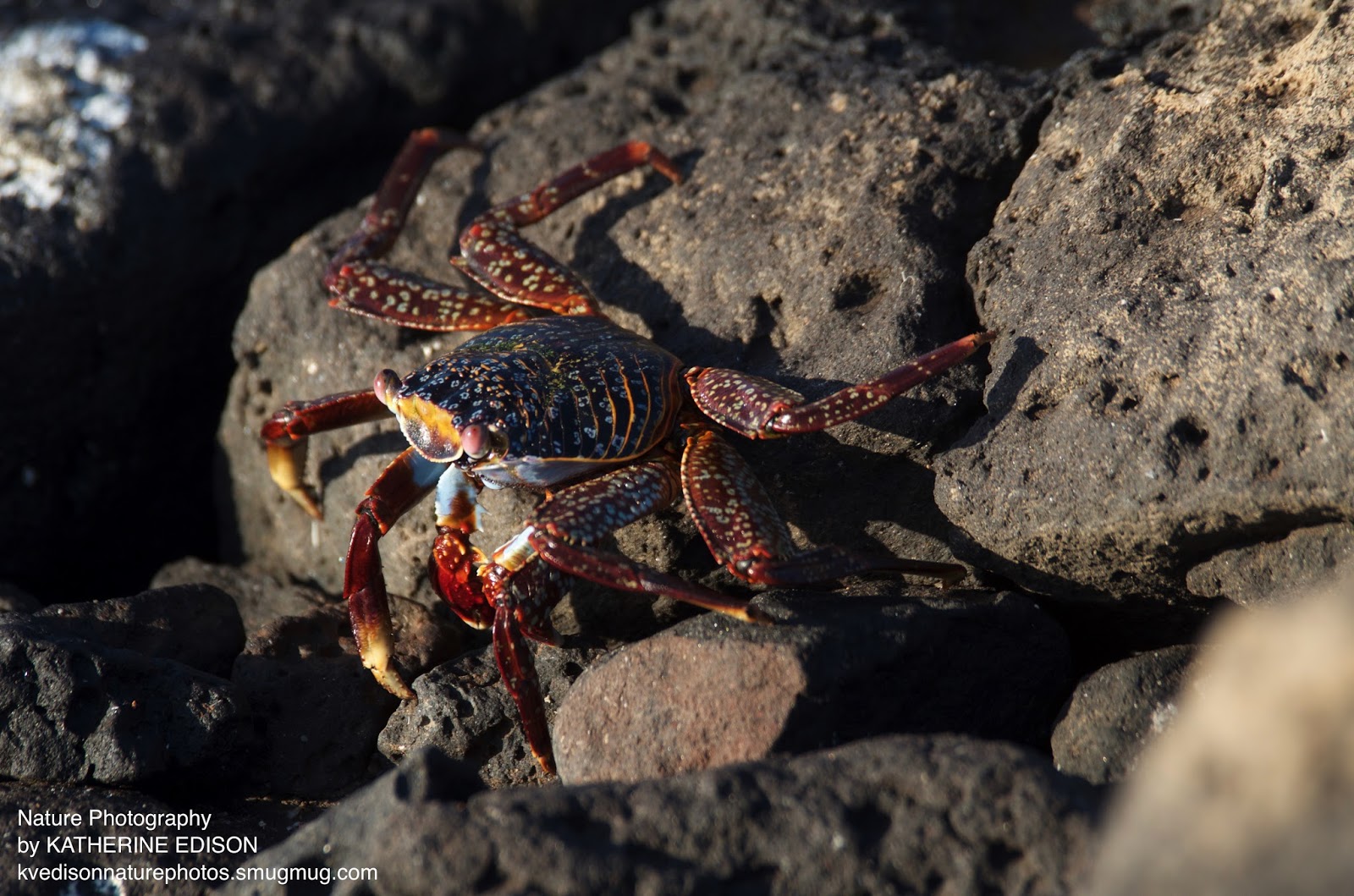
The next morning we explored Isla Plaza, just off of Santa Cruz, where we saw Sea Lions, Frigate Birds, Masked Boobies, Swallow-tailed Gulls, Shearwaters, a lost Galapagos Penguin, Brown Noddies, Red Billed Tropicbirds, Pelicans, Cactus Finches, Marine Iguanas, Land Iguanas, Lava Lizards and Sally Lightfoot Crabs. It was a full morning! The wildlife was abundant and very tame and unafraid of people and I was able to get some fantastic photos. Visitors are asked to stay 2 meters from the wildlife, but sometimes it is not possible to keep that distance, or the animals come near you. I used a telephoto lens, too, which made some of my encounters seem closer. Sometimes the telephoto didn't work because the animals really were that close! The landscape was strange and beautiful, with drought tolerant plants like cactus and carpetweed (a kind of succulent portulaca) growing over the volcanic terrain.

Carpetweed and Cactus

Swallow-tailed Gull

Sally Lightfoot Crab

Young Sea Lions Chasing a Galapagos Penguin (They don't eat penguins but they like to bother them)

One very interesting thing my husband and I noticed was that although there were large numbers of animals and plants, the number of species was relatively small. And different variations of those few species appeared on different islands. For example, there were 4 species of Mockingbird, but some only appeared on specific islands. Because there were so few species, I was able to identify many of them with a field guide specific to the islands. The Darwin Finches gave me some difficulty, though, because some of the distinctions were small. I couldn't always tell the difference between a small and medium tree finch or a small and medium ground finch and relied on our guide to point out a cactus finch.

Cactus finch

Tree Finch or Ground Finch; medium or small billed?
I finally went with Medium Ground Finch, but I'm open to corrections.

That afternoon we went to Santa Fe island and saw a land iguana specific to that island. They are yellow. We also saw Lava Lizards, Galapagos Mockingbirds, Galapagos Doves, Cactus Finches and Sea Lions. Afterwards, we snorkeled in the bay. I wish I had an underwater camera because the colors and number of ocean species were amazing. But we swam with playful Sea Lion pups, saw a Galapagos Green Sea Turtle and several other turtles, a big White Tipped Reef Shark (that gave me a start, but they are relatively harmless), an Eagle Ray and some other rays and hundreds of marvelously colored and shaped fish, including Puffers!

Santa Fe Land Iguana

The next day, day 3, we had traveled a long way overnight to San Cristobal where we dropped off some passengers at the airport and picked up a few more. My husband Art and I spent the morning exploring the Galapagos Information center and walked a trail that overlooked the beach where Darwin supposedly first set foot on the islands. We wandered around the small town and picked up a few supplies, like extra sunscreen (it is very sunny on the equator and especially so on the islands in the ocean) and extra photo memory cards (I took about 4000 photos!). That afternoon we snorkeled near Isla Lobos (just off of San Cristobal) in rather cold water. I was wishing we'd sprung for the wet suit rental, but after swimming a while we warmed up. The fish were amazing and it was neat to see colorful coral, urchins and clownfish. The loud clicking of the fish underwater was very strange and interesting. After the swim we dried off and hiked on the island where we saw colonies of Frigatebirds and their chicks and got our first good look at Blue-footed Boobies. They are the most endangered species of booby on the islands (we saw 3 species). Several of them made nests right on the path. Some of the juveniles objected to our presence and wouldn't allow us to pass, causing the group to walk up on the rocks out of the way. It was kind of funny to see our group of big humans back down to a flapping teenage booby. We also saw some very young Sea Lion pups, some of them still nursing. And we saw either a Lava Heron or a Striated Heron--it was hard to tell which.

Graffiti on San Cristobal Island

Frigatebird Colony with Fuzzy Chicks

Male Frigatebird

Blue-footed Booby Nest on the Ground. They poop away from the center to keep the nest clean, creating the ring.

Blue Feet

I'll break here to keep this post from being too long. Read part 2 for the rest of the story. You can see a full album of photos from the trip on my website by clicking here.


Tuesday, June 23, 2015

30 Days in June: Day 22, Guana Tolomato Matanzas National Estuarian Research Reserve

GTM Beach
What do you do when your friend texts you at 9:30pm and asks if you want to go to the beach in the morning? If you're me, and you are trying to get in all the Florida nature experiences and time with friends that you can before you move, you say "heck yeah"! So my friend Grace and I loaded all our gear into the car (it takes an amazing amount of stuff to just sit on the beach for an afternoon) and drove off for the Atlantic coast.

Pelican on Azure Seas
Grace had a favorite beach in mind, at Guana Tolomato Matanzas National Estuarian Research Reserve (GTM for short). Quite a mouthful. I visited the reserve only once before when I was taking the Coastal unit of the Florida Master Naturalist course. The name is so long and complicated that I can never remember it and have to Google it every time. But it's a really great place! GTM Research Reserve is a protected area of 73,000 acres of coastal habitat south of Jacksonville. There is an education center and nature trails and miles of undeveloped beaches and natural dunes. It was blazing hot by the time we got there and so we decided not to walk any of the nature trails and to just enjoy the beautiful beach.

Willett
We sat in the shade of the umbrella and ate a delicious lunch while we watched Terns, Gulls and Pelicans diving and fishing. Terns are such graceful flyers and divers. It's wonderful to watch them hover and flap before they tuck their wings and zoom down to snatch a fish. Periodically we could see Dolphins surfacing in the distance. The water closer to shore was brown and murky from the sand stirred up in the surf. Further back it was a deep azure, reflecting the clear sky. Sea breeze and the sounds of sea birds completed the picture of perfection.

Laughing Gull

Lucky Royal Tern with Fish

Ready...

Set...

Dive!
A fisherman set up just down the beach from us and within the first 5 minutes he had caught something. To our surprise it was a baby shark! We watched him carefully unhook it and throw it back. Then the other line tugged and he reeled in another shark! We ran over to get a closer look and he unhooked it and handed it to Grace to hold and throw back. Both were Black Tipped Sharks. It was a beautiful little thing. The profile looks funny because of the way Grace had to hold its head so it couldn't bite her. She tossed it in the water and we watched it make its way out past the surf.

Black Tip Shark

Hooked, but Released
Back in our comfy chairs, we watched our neighbor catch 5 or 6 more little sharks and throw them back. They just couldn't resist the raw bait fish. More amazing, though, were the full sized sharks that we saw breaching and splashing, in the very area where we had just been wading and swimming! Apparently it was shark week. Kind of scary and sobering until you realize that there are always sharks in the water and that you are statistically much more likely to be killed by car crashes or the flu or food contamination than by sharks. Sharks, on the other hand, should be very worried about humans. We kill an estimated 100 million sharks every year. So, think about that when you are scared to get into the water!

Fishing Boat
We had a great day and came home sunburned and sandy. I am only sorry that I learned about this beach just before we are moving away, but we have added it as a good place to visit when we come back in the future. I'm so thankful for my free schedule right now that gives me the chance to act on impulse invitations, and especially thankful for the friends who invite me!

Saw several new birds but they don't count because they were out of the county. 26 natural areas visited.


Tuesday, June 9, 2015

30 Days in June: Day 7, Anastasia State Park Beach


Railroad Vine (Ipomoea pes-caprae)
One of my goals in June is to visit as many of my special Florida places as I can before our move to Georgia next month, so this weekend my husband and I decided we needed a trip to the beach. We picked our favorite beach in Anastasia State Park, near St. Augustine. While we hear that Georgia also has nice beaches, when we move we will live about 5 hours away, making future impromptu trips unlikely. Over the years in Florida we have come to love having that freedom. You don't have to do much planning. Just toss your towels and umbrella into the car, grab some snacks and sunscreen, and off you go. An hour and a half in either direction and you're there. It's pretty wonderful. After July, though, we'll just choose the mountains instead of the beach, another excellent option.

Laughing Gulls

Growing up in landlocked Utah, I considered a visit to the beach to be a real treat. And after 19 years in Florida, I can't shake that feeling. As soon as we near the intercoastal waterway, the landscape changes. Pine trees open to sea grasses. You catch glimpses of the water over the dunes. Pelicans fly over. The sky is amazingly blue. Then you arrive at the actual beach and it's even better. Long flat sand as far as you can see, with ocean on one side and dune on the other. The roar of the waves drowns out almost everything else. Just smelling the ocean air makes me feel like I've had a vacation. It's Paradise.

Water and Sky

We like Anastasia State Park because, among other things, you can't drive on the beach there. Many other beaches in Florida allow cars on the sand. I think they're annoying and silly because the cars often get stuck in the sand and they make a lot of noise and smell. People also get run over occasionally, and the cars and trucks run over nesting birds. I much prefer the State Park.

Dunes. The tire trucks are from Park maintenance vehicles.

It was a very busy day at the beach on Sunday. The weather was great, and it was also the first weekend after school let out for the summer. But the nice thing about beaches is that they can fit a lot of people and not feel too crowded. The air was filled with the sounds of waves, gulls, and happy people.

Happy Beach Day

We found a nice spot for our umbrella and chairs and I just sat and watched the hypnotic waves sweep back and forth while my husband, Art, took a run on the sand. Pelicans, Seagulls and Terns flew over and I didn't even try to take their picture! I watched a couple of Grackles running in the surf trying to pick up clams and coquinas. Very relaxing.

After sitting for a while, I took a walk up the beach to look for shells. In a short time I made a little collection and was reminded of the first year we lived in Florida. We took a camping trip to Cayo Costa State Park with some Wisconsin friends.  Cayo Costa is a small island on the Gulf, and you get there by boat. There are no stores or supplies other than water and there are cabins and tent camping. We spent Christmas Eve and a few days after on the island and swam and hiked and found tons of beautiful shells. We also had our one and only encounter with an endangered Indigo Snake, and saw a Magnificent Frigate Bird and a dead Sea Turtle. It was quite the introduction to Florida. Later that Spring, our younger daughter did a 4th Grade project on the Shells of Florida. I still remember the names of a few of them.

Shells and Seaweed

A little way up the beach I came across this Sea Turtle nest. Summer is nesting season. I like to think that these little turtles will have a good chance. No disorienting lights on this beach.

Sea Turtle Nest, Protected from Predators

I didn't add any June Challenge birds to my list but we had a glorious day on a Florida beach.

Beach Selfie

Tuesday, January 13, 2015

New Year's Resolve


2015 is brand new and all full of promise for positive change. Most years I make a list for myself of resolutions for the coming year. As with most people, my resolutions have mixed results. I usually do ok on the easy ones like "get outside more" and "travel to interesting places". I don't do as well with "eat fewer sweets" or "exercise regularly", probably because my conviction is lacking. But this year I have just one resolution, and I'm serious about it. I am going to double down on my efforts to reduce my harmful impact on the environment. I've been working on this already for many years. I already try to cut back on driving and walk or bike when I can, I keep the thermostat low in the winter and high in the summer, I bring my own shopping bags to the store, carry my own water bottles, conserve water and don't use many chemicals around the house. But I had an eye-opening experience this week that has made me want to concentrate on reducing the amount of waste, specifically plastic, that we produce in our household. I have to give you a little background first.

My husband and I traveled a lot after Christmas this year. First we visited Santa Cruz, California. (I'll have a post about that soon.) Immediately following that trip, Art attended a conference in West Palm Beach, Florida, and I tagged along so I could see some South Florida nature, so we flew from coast to coast (a blog post about that will follow, too.) On the last day of his meeting, I decided to go visit John D. MacArthur State Park, which was about a half hour from our hotel. It's a barrier island and because it has a long stretch of undeveloped beach, it is a good place for sea turtles to nest in the summer months.
Old sea turtle egg shells from a summer hatching that I found on the beach.
But this was January and there was little hope that I would see a wild sea turtle, although I hoped I might. I turns out that they do have some rescued baby turtles in tanks that the park holds for a few years before being released. It's hard to photograph turtles swimming behind glass, but here is a baby loggerhead:

Tiny Loggerhead Turtle
I walked along the beach for a while, watching the waves and scanning for dolphins. It was a gorgeous day with blue skies and water. I saw some gulls, osprey and pelicans and a few beachcombers. Kind of a quiet and peaceful spot.

Miles of Undeveloped Beach
Then I spotted something rolling in the surf and went to investigate. It was hard to tell what I was looking at for a while, but then I saw the shell. A sea turtle! I was so excited and waited and watched to see what it would do. But the turtle kept rolling in the surf and didn't change position much. Occasionally I saw a flipper or its head and I hoped that it was just concentrating on eating something.
Sea Turtle?

Not Looking Good
It soon became clear that there was something wrong with this turtle and I decided to call the ranger station. (What did we do before cell phones?) I found my park map, made my call, and soon two Park Rangers showed up carrying a plastic bin in case the turtle could be rescued.

Ranger Rob swam into the water and reached the turtle in just a minute.
Retrieving the Turtle

Looking for injuries or signs of life

The turtle didn't make it.
I kept thinking that I could see some movement from the flippers, but it was wishful thinking. After looking at it in the water, Rob indicated that the turtle was dead. He brought it back to shore and placed it in the plastic bin and I was able to get a closer look. The rangers told me that it was a Green Sea Turtle that appeared to be a couple of years old. It had no obvious injuries and was pretty freshly dead. They noted barnacles on the shell which could indicate that it was a weak swimmer before it died. They thought that a necropsy would be done to determine the cause of death. Then conversation turned to one of the greatest hazards to sea animals--plastics. There was always the chance that the turtle had ingested plastic and may have choked, or its stomach maybe have become filled with plastic bits that could cause it to starve because it couldn't fit any food in. This turtle did not look malnourished, though.


Ranger Art talking about the sea turtle
I spent a few minutes looking at this beautiful animal, with its perfect shell, shiny brown scales and sad eyes, and felt like crying. All of us were sad. And then the rangers solemnly carried the turtle away in the plastic bin.
It was so special to be this close to the turtle

Sad, beautiful eyes

Carrying the turtle back to the ranger station
I stood on the sand for a while, soaking in the enormity of the tragedy. It was too early for me to head back home, so I planned to walk along the beach for a while more in the peace of the park. Then something blue caught my eye. There was a large tangle of rope and fishing line lying in the sand, where any critter in the surf could get stuck in it. I couldn't believe I was seeing this right after finding the dead turtle and felt so angry at humanity for creating this garbage. I went over to pull it out of the sand and carry it to the trash, but it turned out that it was stuck in the rocks and I couldn't get it out.
Rope stuck in the rocks under the sand
It was a defeating feeling. Even though I didn't know what had killed my green sea turtle, I felt protective of it. It felt to me that if I left this rope in the sand, there was no way I could protect the rest of the sea turtles. But right next to the rope I found an old shoe. And a plastic bag. And then a can. I remembered that I carried a plastic bag in my camera bag "just in case", and so I loaded up the trash I had collected. Suddenly I could see bits of trash all around me. Somehow I had just been blind to it as I walked up the beach, but now I had "trash vision", and a mission--Save the Sea Turtles! I picked up every bit of trash I could see between there and the boardwalk. It felt therapeutic.

What's wrong with this picture? Little plastic pieces everywhere.

Don't get me started on balloons. I hate them. This one was caught in the protected dune plants so I didn't go in after it. I'm sure the park staff will take care of it.
Another beach walker stopped and thanked me for cleaning up and invited me to the beach cleanup on the weekend. I told him that I wasn't from the area, but after finding the dead sea turtle, felt moved to do my part to help that day. He told me that people clean up the beach all the time, but more trash washes up every day. I asked about the rope stuck in the sand and he said there were a lot of things like that on the beach, including a huge ship's engine that had been stuck in the rocks for years. Sometimes there is only so much you can do. And yet there is so much that needs to be done.

When I got back to the trash can, I had planned to lay out all my collection and take a photo to show how many small plastic bags, plastic shoes and bits of styrofoam I had found in my half hour of cleaning, but I was afraid the wind would blow it away. This is my bag, pretty much full:

Just a small assortment.
I couldn't help but feel that we humans must do a better job with our stewardship. I've read about trash islands the size of Texas floating in the ocean, and dead sea birds that when autopsied are so stuffed with bits of colorful plastic that they starved. Sea turtles gobble plastic bags and balloons that look like their favorite food, jellyfish, and they choke and die. There are microscopic bits of plastic in the bellies of most sea animals. This is absurd. Here's an interesting chart from Mote Marine Laboratory that shows how long it takes for various kinds of ocean debris to degrade:

So where does the trash come from? Some is probably just carelessly dropped by visitors to the beach. But some washes off of boats, blows off of piers, out of trash cans, and even flies out of garbage trucks on the way to the dump. I witnessed trash blowing out of a garbage truck as I drove away from the park down A1A later in the day. So even if you put your trash in the can, it might blow out and end up in the environment. Some people are careless, but sometimes accidents happen. You can read an interesting article about ocean trash from National Geographic News by clicking here.  It seems like the best solution is just to create less waste. But it's not that easy. I'm all for measures like banning plastic bags and plastic water bottles, but they are just a small part of the immense problem. In our disposable society, there is plastic packaging on almost everything and our products are not made to last. When something breaks, we just throw it away and buy another. The coasts and parks and ditches are loaded with old tires, TV's, and other crap that people didn't want any more and just tossed. I was surprised and sad to find trash in the Peruvian Amazon when we visited a few years ago. The importance of reducing my impact isn't new news to me. I've been aware of it for much of my life. But somehow seeing that beautiful turtle made it more real and urgently important. I don't even know if it was trash that killed it, but I want to work harder to make the world a better place for other turtles and other creatures, including myself. It's important to me to be able to someday see a free, healthy sea turtle in the wild, and not only through the glass of an aquarium. So I resolve to do my part to cut back, to reduce, re-use and recycle with a vengeance, and keep my crap from ending up in the ocean and the environment. This is for the sake of the turtles and for the world we all live in.
We all have to do our part.