Showing posts with label Orchid. Show all posts

Monday, September 26, 2016

Collective Intelligence

My Reference Books
When I post photos from my travels I do my very best to identify what I've seen for my website and blog. It's a bit easier when I'm photographing or posting from home because I can just turn to my arsenal of Florida and Georgia Field Guides and helpful local experts and websites. But when I'm traveling it gets a bit more complicated. It's not really practical to carry field guides from around the world in my suitcase (though I do pick them up along the way from time to time). There are good apps, and I use them when I can, but I don't always have cell coverage (or an appropriate app). But what I do have, most of the time, is access to the internet, maybe from the hotel or the airport or somewhere along the way. The trick is finding good sources of info. I ask locals when I can. But often, I'm on my own, or the people around me don't know, or I don't speak the language well enough to ask or understand. So I often turn to Google and Wikipedia, and have been fairly successful. With birds, I reinforce the search by turning to e-Bird to see what birds have been reported at that location or nearby. When I'm in South America, I also look at the Neotropical Bird section of the Cornell Lab of Ornithology site. (I wish that the birds on an E-bird list had links to photos so I could easily look to see if the bird is what I'm looking for, and the Neotropical Bird site is a little clunky to navigate between species to identify and compare, but they're still both very useful.) I've had pretty good luck just Googling the name of the bird, or "Birds of ___" and checking Wikipedia or looking at photos. When we went to Iguazu Falls a few years ago I took hundreds of photos of butterflies that I'd never seen before. I found several helpful websites for identifying them, but sometimes I had to resort to just describing the butterfly and location and see what came up in the Google "images" section. For flowers, I'll often search for "wildflowers of (insert town/country/region)" and a local field guide may pop up. When I'm in a Botanical Garden, I take care to photograph the interpretive signs and ID tags to look at later. Some thoughtful locations, such as the bird refuge in El Calafate, Argentina, have signs with pictures of wildlife and plants that you may see along the way. I very thankful for these! And I always grab trail literature when it looks helpful. 

Helpful Sign in El Calafate, Argentina

Local Field Guides 

So you can see that a lot of work goes into this photography/blog business. Besides taking the photo and editing it, I also have to get the information right. Whew! It's probably not truly necessary, but I'm a bit obsessive about putting things in categories. Most readers or viewers don't really care what plant family the flower comes from, or whether the bird is a white phase or the striated version. But I like to know these things, so I seek out the information. And occasionally people will find one of my photos online and ask use it for a publication or illustration, and I want to be as helpful and accurate as I can. I report my own bird sightings to e-Bird and have been contacted once or twice when I reported something that was too rare to be true. After some investigation, the investigator and I determined that I had misidentified my bird, and I changed the report. Friends have contacted me, too, and let me know that I have misidentified a snake or turtle or flower and I really appreciate the help. I'm no expert and I love to learn. So if you see something I should change, let me know! I really do want to know. I understand that there are apps now where you can just submit a photo and have it identified for you, and I may look into it someday, but I admit that I enjoy the chase.

Butterfly from Iguazu Falls. Needs ID still!

This is all a long introduction to the tough time I had figuring out what I had seen while traveling in Ecuador. My bird, plant and insect knowledge in Florida and now Georgia came from years of following experts around. In Ecuador, I did much of my exploring on my own and much of it was new. But I searched and scoured the internet and did my best. In hindsight I realize that I probably should have just purchased a field guide to the birds of Ecuador. I may still do it, especially if we ever return, and I hope we will. Ecuador is an amazing country, with the most biodiversity per square kilometer of any other nation on earth. According to Wikipedia, there are 1600 species of birds, 4000 species of butterflies, and 16,000 species of plants. Really, it's an incredible place.

Hummingbird in Papallacta. Still Needs ID!
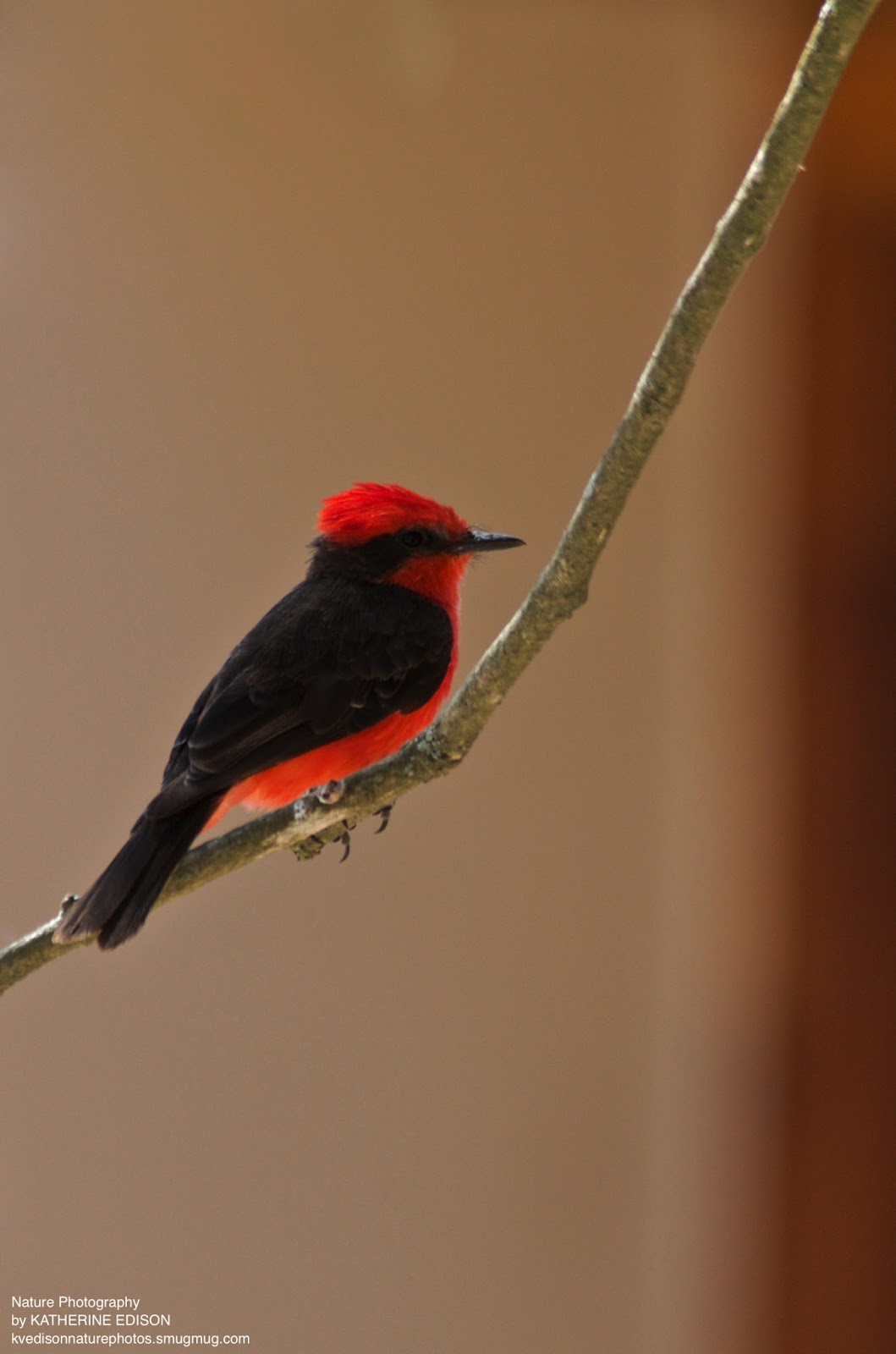
I spent an afternoon in a botanical garden on a hilltop in Yachay, a few hours north of Quito, while my husband met with university administrators. I had a great time and saw some cool birds and plants. Luckily for me, I was in a botanical garden and many of the plants had signs. The birds gave me a little more trouble. Vermillion Flycatchers were easy, and I was really excited when they started hopping out of the bushes, but actually grew tired of them after a while because they were so plentiful! (Such problems I have!) I was really hoping to see some fancy hummingbirds like the ones in Quito. I saw several not-quite-so-fancy hummingbirds, but they were always too far away to get a good ID photo. But back at the hotel, using my combination e-Bird hotspot report/Wikipedia technique, I was able to identify a Yellow-faced Grassquit that was photographed from far away and in the bushes. The American Kestrel was easy because I knew them from home. They are very plentiful in Ecuador.

One of Many Vermillion Flycatchers

Hummingbird, No ID Yet 
Yellow-faced Grassquit
Handy Signs at the Botanical Garden
American Kestrel and Prey

A week later, when our family went to the cloud forest in Papallacta, and again in Otavalo, I finally saw some fancy hummingbirds. I bought a small guide that was somewhat helpful for Papallacta, but 
e-Bird was the best resource. Friends on Facebook and the guide who took my family on a day hike helped identify some of the plants and flowers.

Cinereous Conebill

Black Crested Warbler

Pale-naped Brush Finch

Shining Sunbeam Hummingbird

Spectacled Whitestart

Sword-billed Hummingbird
(This one made me very happy! What a bill!)

Tawny Antpitta
(I heard this bird a long time before I was able to find it, and it took e-Bird to make an ID.)

Andean Gull
Turquoise Jay and Tasty Bundle

Tree Lungwort

Lepanthes Orchid
(I was so focused on the pretty heart-shaped buds that I missed the tiny orchid flower in the background!)

Scarlet Angel's Trumpet
(The Sword-billed Hummingbird uses its extra long bill on this flower!)
Next we spent a few days at a lakeside resort north of Quito, near Otavalo and it seemed like there were many species of hummingbirds in the gardens there, but later, after looking more carefully, I realized that I had seen only 3 or 4, but that they varied from male to female, and they moved around a lot! There is a lot of zipping in the hummingbird world. The Black-tailed Trainbearer hummingbird that I had tried to catch in Quito was more cooperative this time. 

Black-tailed Trainbearer (m)

Black-tailed Trainbearer (f)

Green Violetear Hummingbird

Not Sure. Emerald? Violetear?

Western Emerald Hummingbird?

A bigger challenge came when we visited a bird reserve in Mindo, a few days later. But that, my friends, is another blog post!


Monday, May 27, 2013

A Sense of Place

I visited my favorite ditch yesterday and it was as full of life as ever. As we ease into summer, it is hotter and more humid and the afternoon rains have started again. The plant life is changing with the heat. The Skullcaps have finished blooming and now all that remains are the seed pods that give them their common name. The Lady's Tresses Orchids seem to be gone, but I found 2 Grass Pink Orchids, which is a marvel to me because I'd never seen them prior to this year. The carnivorous plants are enjoying the moisture and bugs. The tiny Sundews still cover the ground, although I didn't see any of their flowers. I cannot avoid stepping on them and I feel like a huge monster, leaving destruction in my wake. The Hooded Pitcher Plants were still blooming. One of these days I'll have to remember to look and see if there are any bugs or frogs inside. Pale Meadow Beauties have popped up in the last 2 weeks and there will be other varieties by the end of summer. The grass is pretty with splashes of pink throughout. There are still a few holdout Yellow Colic Root flowers and Oakleaf Fleabane. The Yellow Eyed Grass is blooming, now, and the ground is covered with teeny tiny Eryngium flowers, that I would have probably missed if it hadn't been for the heads up from my friend Bubba. There is an abundance of Blackroot blooming and the butterflies are very attracted to this strange flower with its winged stems. You can smell the strong aroma of Vanilla Leaf as you walk through the Flatwoods. The plants are growing tall and should bloom any day. The Little Metalmark Butterflies were there, as I knew they would be. I can always count on them. Rosettes of the Deertongue plants are growing everywhere on the ground and they should soon be sprouting taller with purple flowers that the swallowtails won't be able to resist. And I'll be watching all summer for signs of big orange Catesby's Lilies and hope that the county mowers won't come by and disrupt the whole scene. I'll have to be realistic and acknowledge that it may still happen, though, whether it's out of concern for fire danger, road visibility, or just force of habit. We'll just hope not.

Skullcap Seed Pods (Scutellaria integrifolia)

Grass Pink Orchid (Calopogon multiflorus)

Tip of My Boot Near the Tiny Sundews (Like Godzilla!)

Hooded Pitcherplant (Sarracenia minor)

Pale Meadow Beauty (Rhexia mariana)

Yellow Eyed Grass (Xyris difformis)

Eryngium baldwinii

Blackroot (Pterocaulon virgatum)

Little Metalmark on Polygala lute
It's great to have a place that you can watch and get to know really well. I have a few of those kinds of places around here in Gainesville, and I try to visit them as often as I can because I can't wait to see what will happen next. I've been visiting them for a while now and have a photo almanac of sorts that I can draw upon to compare year to year. I'd like to keep a journal. When did this flower first sprout last year? Where was I when I saw a certain butterfly? I know when I can see Bluebirds and Nuthatches at Morningside and Cranes and Glossy Ibises at Paynes Prairie, or when I can find hummingbirds at Kanapaha Botanical Gardens, and Poppy Mallow at San Felasco. I love going back over and over again, because they make me feel like I know these places.
Hatpins and Polygala in the Ditch
Every year at Memorial Day, for as far back as I can remember, my grandma would make the trip down to her home town, Moroni, Utah. She called it "Decoration Day" and she would visit relatives and bring flowers to the cemeteries in Mt. Pleasant and Nephi where her family and my grandpa's family were buried. It was an important time for her and when she got older she had my aunt and uncle or cousins take her. Somehow, I never made the trip with her, even though it was only a few hours from Salt Lake, where I grew up. But when she died, I finally did go to the cemetery in Nephi. It was a very moving experience, not just because I was burying my beloved grandmother, but because as I looked around at the headstones, I realized that I knew all the names. I've done a little genealogical work and was very familiar with the names of my grandparents, great-grandparents, and great-great-grandparents. The ancestors born in the harsh environs of pioneer Utah, and their parents and grandparents born in England and Denmark, Scotland and Sweden, who left their families behind, sailed across the ocean and made the arduous trek across the country by wagon train and hand cart to this new land. Here they were, right next to me. And these were actually only part of the family. This was where my grandfather's family was buried. Relatives in my grandma's family were in the cemetery in nearby Mt. Pleasant. My grandma often referred to family in Central Utah as "my people". And that is where she rests, surrounded by her people. My people. As I stood there in the cemetery, I felt this confusing rush of emotions. If these were my people, this must be my place. The names were familiar, and the town was a source of family stories, but it was also unfamiliar to me. I was connected through family but I did not know the place.

I've lived here in Florida, far away from "my people" for going on 17 years, which is getting to be a long time. But no matter how long I've been here, I do not have the ancestral claim to the land that  Florida Natives have. My ancestors came to Utah in the 1850's. My roots go back 5 generations. I don't have that in Florida. I still struggle to mentally place cities and towns because I don't have the geography of Florida in my personal folklore. The family stories we have here are limited to the ones my husband, my daughters and I have made in those 17 years.  But I have made a connection to the nature of Florida. I know that when I need to feel refreshed and rejuvenated, all it takes is a mere whiff of the ocean air. In the summers I crave the cool of the freshwater springs with their deep blues and greens and cypress knees.  When I've been away, returning to the heavy, humid air and buzzing cicadas feels familiar and comforting now. I have become enchanted by the world of Florida's wildflowers, insects, birds and mammals. As I have learned more about them I have also come to appreciate the complexity of their ecosystems, their variety and the changes brought about by seasons, drought, storms and fire. I am getting to know them. Knowing a place makes one feel grounded and connected. You get the inside references. You understand the jokes. You know what's happening. You know what to expect.

We are a nation of nomads who leave our histories and connections behind as we seek new lives--jobs, school, love and adventure. Change is exciting and good, but can also leave you adrift. I imagine that my great-great grandparents experienced this when they left everything they knew behind and started a new life in the desert of central Utah. But they came to that strange land with a purpose--building a religious paradise on earth. Some of them eventually brought their parents and other relatives and settled in. That focus and determination gave them connection. I too have settled in a new place and left behind my ancestral roots. But I have found connection to Florida by learning about its nature, and in the knowing, I feel my own purpose and sense of place.
Southern Hairstreak on Blackroot (Pterocaulon virgatum)

Monday, April 29, 2013

It Just Keeps Getting Better...

You'll have to indulge me a bit longer. I'm now obsessed with my ditch. (Notice how I've taken ownership!) I went back yesterday to get some more photos of the Sundews. I also wanted to get back to get a few more pictures of a Grass Pink Orchid that I had found in the preserve last week. (Probably the prettiest flower I've ever seen in the wild). I got one last Orchid shot (they don't last very long, so I'm glad I went back).

Grass-pink Orchid (Calopogon multiflorus) 

Last Blossoms and a Friend (Taken 4 days after the first picture. Flowers almost done!)
Then I turned my attention to the ditch. This time I walked a little further down the fence line to explore. What a difference 100 yards makes! I found more Ladies Tresses Orchids, Yellow Colic Root and Blue Flowered Butterwort (both new ones for me!), Rough Skullcap, Tiny Duck Potatoes, an abundance of Wild Onion, White Lobelia, and best of all, Hooded Pitcher Plants in flower!

Yellow Colic Root (Aletris lutea)

Blue Butterwort (Pinguicula caerulea)

Rough Skullcap (Scutellaria integrifolia)

Duck Potato (Sagittaria graminea) and Katydid

Wild Onion (Allium canadense)

White Lobelia (Lobelia paludosa)

Hooded Pitcherplants in Flower (Sarracenia minor)
Hooded Pitcherplant
The simple beauty of this unassuming stretch is astonishing.
Quiet Roadside Ditch
The Sundew pictures didn't turn out so well, but who cares? I felt so lucky out there at the side of the road, surrounded by carnivorous plants and listening to the roar of the wind as it blew through the pine trees.  An occasional sprinkle caused the Spring Peeper frogs to strike up a chorus. As always, the Little Metalmark Butterflies were there fluttering and basking in the sun when the clouds broke, and little Bee Flies that resemble flying Kiwi Fruit buzzed around the Betony. Even the spring wave of Love Bugs seemed magical at that moment.
Little Metalmark

Bee Fly and Betony

Lovebugs on Heartwing Dock (Rumex hastatulus)
I love this place! There is rain in the forecast this week, and soon we'll be entering the rainy season. I can't wait to see what else pops up. I'll be sure to keep you posted.

Yellow Hatpins,  Extreme Closeup (Syngonanthus flavidulus)