Showing posts with label environmental education. Show all posts

Monday, September 4, 2023

Fall Favorites

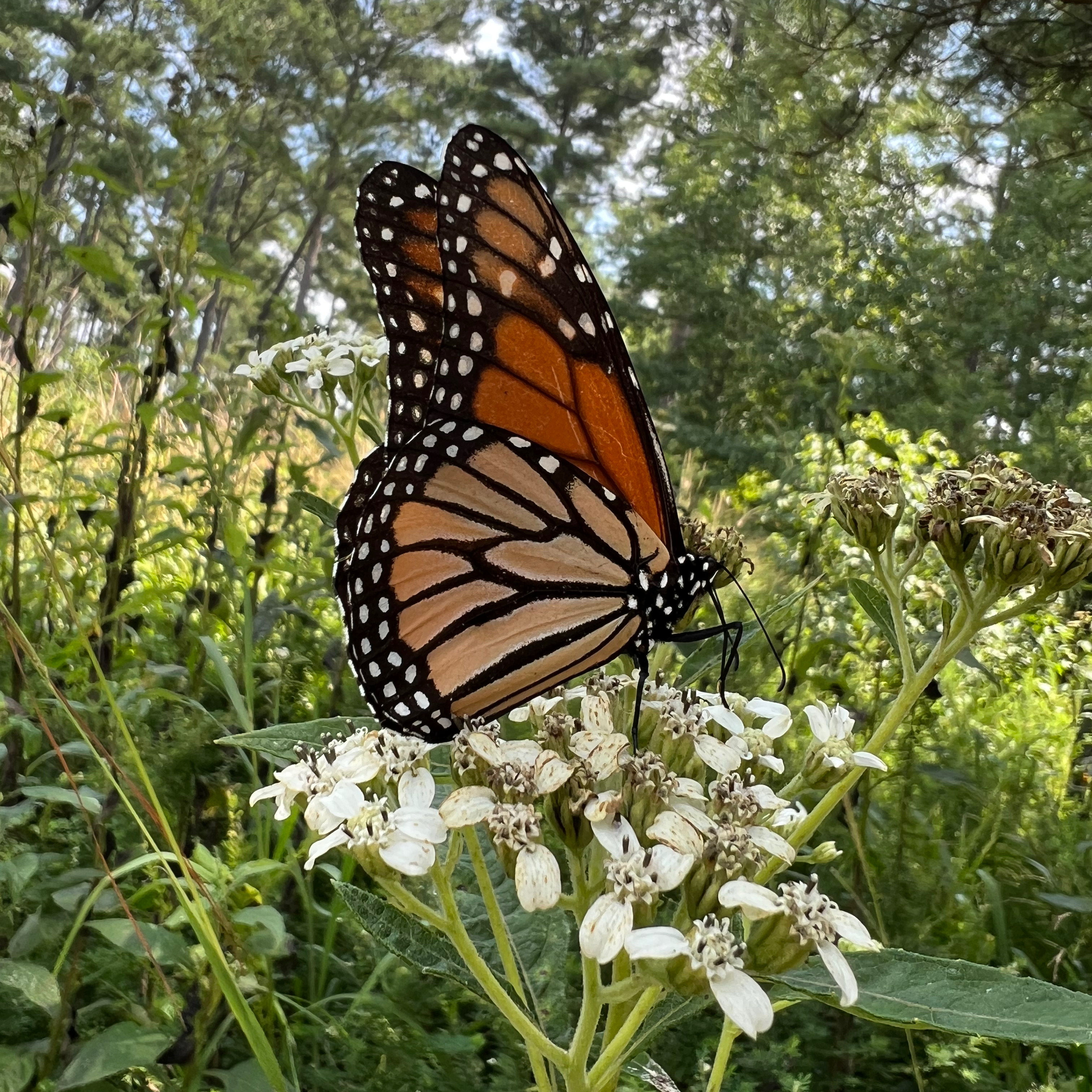
Monarch

There are miles of trails to walk at Sandy Creek Nature Center, a wonderful nature park in Athens, Georgia, where I like to spend a lot of time, and where I also volunteer. I find that each trail there is special for different reasons. Some are just peaceful and beautiful. Others are good for finding certain birds, or flowers or fungi, or to hear the whack of a beaver tail at dusk. Some trails have good logs to roll and look for salamanders, some trails lead to the creek, and others have good loops to walk with school kids. I like them all. But in the fall, my favorite trail is also the shortest, the loop that runs through the restored Piedmont Prairie--a small and sunny, open space, filled with wildflowers and tall grasses. A haven for insects and spiders, birds, snakes, frogs, rabbits and rodents. This trail can take you two minutes or two hours, depending on how much time you want to spend looking and listening. I find that it is a perfect element to include in a hike with 4th Grade classes who have come to learn about the solar system and see a planetarium program. On our trail hike, I like to talk to the kids about the changing seasons and how the living things are preparing for winter. The leaves on the trees are changing color. Fruit on the trees and vines and grasses and flowers are ripening. Birds are feeding on the flowers and grass seeds as they prepare for migration. Spiders that hatched in the spring are now reaching maturity, their webs stretched across paths and loaded with insects. Their egg sacs will appear as the weather cools. There's always a lot to see. I think that the kids have a good time, and hopefully they learn a lot. I try to share my enthusiasm, too, because I love it all. But I also have a special love for butterflies, so I hype that up a lot. And, the Prairie in the fall also happens to be a great place for seeing butterflies, which makes it one of my favorite places to visit and share. 


Leaf footed bugs and nymphs on Passion Vine

Poke Berries

Empty Cicada shell

Green Lynx Spider

Robber Fly

The loop through the Prairie is a different experience every year. One year you will find Praying Mantises hiding in the tops of the tall plants. In another, Bird Grasshoppers pop every which way across the trail and over the tall grasses. Or the Orbweaver Spiders may have staked out stations along the entire trail, hiding behind the zigzags in their webs. This year, Passion Vines grew in profusion, attracting Gulf Fritillary butterflies in large numbers, and growing so robustly that they covered the path. Passion Vine is the host plant for the Gulf Fritillary butterfly, and they come to lay their eggs on this particular plant. The park naturalists closed the loop for a few weeks to give the tiny Fritillary caterpillars a chance to eat and grow and go through their metamorphosis. Left undisturbed, butterflies of all kinds busily fed on the Passion Flowers, Frostflowers, Milkweed, Thistles, and other nectar plants. 

Gulf Fritillary, drinking nectar

Gulf Fritillary caterpillar on Passion Vine tendril

Passion Flower

Mating Fritillaries next to empty Chrysalis

Fruit from Passion Vine

Last week I took 2 groups of energetic 4th graders on a larger loop through the woods that ended with a walk through the Prairie. As we cleared the shady forest and entered into the sunny and grassy area with its tall flowers, I prepped the kids by telling them how that they were about to experience something spectacular. And both times, as we came near, I knew that they were suitably impressed. I could tell by all the squeals and wows! I get it, because I feel the same way, every time. There is something magical about walking into a butterfly meadow.  We saw dozens of yellow and black Eastern Tiger Swallowtails, (the state butterfly of Georgia, by the way) and many, many Gulf Fritillaries, as well as a Monarch, a Viceroy, various Skippers, Satyrs, Azures, Hairstreaks, and a Red Spotted Purple. It was a great show and gave me a chance to fit in my standard message about how important it is to have green spaces--sanctuaries for nature, as well as for people. This is an important lesson for preparing the way for the next generation of environmental stewards. You protect the things you know. And who wouldn't want to protect a magical place like this? 


Silver Spotted Skipper

American Painted Lady and Ailanthus Web Worm Moth

Clouded Skipper

Eastern Tiger Swallowtail (female, dark form)

Red-spotted Purple

Eastern Tiger Swallowtail (male)


Saturday, April 21, 2018

Hug a Tree

Tall Water Oak

A group of 1st graders and I were walking up the path back to the nature center yesterday. We had been on the trail for nearly an hour and they were happy but tired and hungry and ready to get back. We were almost there when we noticed something interesting on the trunk of a water oak tree just past the trailhead. There was some sort of circular blob on the trunk, and from a distance it appeared to be about the same color as the tree. As we got closer to examine we realized it was a cluster of caterpillars! Being first graders, many of them wanted to touch the wriggling shape. But I held them back and we watched for a couple of minutes, noticing the hairs that could irritate the skin and the pretty bright blue color that was not as noticeable from a distance. One of the kids said that it was the neatest thing she had seen on the walk. (Actually, she said it was the only neat thing she saw on the walk, but I didn't believe her!)

Nothing to see here?

The Cluster

After the children were reunited with their teachers and heading off to lunch, I walked back to the tree to have another look. I had never seen this behavior in caterpillars before. Up close, they were also incredibly beautiful. The blue color with white diamonds reminded me of fiber art and weaving patterns. I took a lot of photos.

Gorgeous colors and patterns

As always happens to me in situations like this, the more I looked, the more I saw. A pair of mating Milkweed Bugs crawled by just above my head. Right next to the caterpillar circle, a stream of ants was traveling up the tree from the ground, following cracks in the bark. A different kind of caterpillar moved down the trunk from above. This one was twice the size of the individuals in the caterpillar bunch, and had a very different pattern. The children and I had seen quite a few of these caterpillars in the park that day. When I got home I looked up both species in my "Caterpillars of Eastern North America" book and learned that the clustering caterpillars are Forest Tent Caterpillars, and are known for clustering like this. Despite their name, they do not make web tents. The other caterpillar was an Eastern Tent Caterpillar, and they are do make the web tents.

Milkweed Bugs

Ants

Two species of Tent Caterpillars on the same tree

There was so much going on right in front of me in this little area of the tree that I decided to investigate the rest of it and see if I could find anything else. But the tree was tall, so I could only look closely at my own eye level and below, which was only a tiny portion of the whole. It was a big and old tree, so there was a lot of moss and lichen on the bark in an assortment of colors and patterns. Some of the lichen looked to me like it had writing on it (I like to think they are hidden forest messages). A few feet away, a firefly climbed over lichen and moss, and seemed to be searching, though I don't know what for. Google tells me that adult fireflies eat pollen and nectar.

Lichen

Forest Messages

Firefly

As I made my way around the tree trunk I looked up and saw a row of holes, perhaps made by a sapsucker or some other woodpecker. Down below I saw the lumpy bark of the base of this mighty tree. Below that the frilly green of a tiny pine sprout peeked out from behind one of the big roots. In another root crotch I found a pink redbud blossom, probably one of the last left from this spring's blooms. On the other side, an Eastern Tent Caterpillar tiptoed by the star-shaped leaf of a sweet gum.

Holes

Craggy Base

Pine Sprout

Redbud Blossom

Sweetgum leaf with an Eastern Tent caterpillar photobomb in the upper corner


Just when I was starting to think I knew that trail pretty well, all it took was a closer look to see how much more there was to see and know. It reminded me of an activity we used to do when I worked at the nature center in Florida. We gave each of the kids wire coat hanger that had been pulled into a square shape and had them lay it on the ground. Then they were given a magnifying lens and a paper and pencil and were instructed to observe what happened in the square for a specified amount of time. At first some of the children balked. They said, "there's nothing here but dirt and some leaves".  But we told them to keep looking and to try to count everything they saw. Pretty soon even the most skeptical ones were hooked. An ant would walk through the square, or a grasshopper or a spider. They might see a seed, or a sprout, or a feather or a tiny flower. Then they used the hand lens and saw the shiny bits of sand and shell and rocks and broken insect wings. The more you look, the more you see.

Caterpillar Silk

I am also reminded of a book I recently read called "The Forest Unseen", by David Haskell. The author visited a square meter area in a forest weekly for a year and observed what happened in that space. He wrote about animals large and small, wildflowers, seasons and ecosystems. Its a lovely book that encouraged me to look closer, and made me think about what can be learned by observing one place again and again over time. As much as I like to travel and explore, there is a lot to be said for getting to know one place really, really well.

Tree Bark Wrinkle

So when was the last time you took a good close look at a tree? Looked deep down into a knothole or under bark, or felt a newly unfolded leaf? When was the last time you hugged a tree? Have you ever wrapped your arms around the trunk and felt the texture and sturdiness of a massive oak? Or buried your nose in a Ponderosa pine bark crevice and breathed the sweet vanilla scent? If it's been a while, I hope that you can take a few moments in honor of Earth Day and get to know a tree. There is a lot they can tell you if you just watch and listen.

Fresh Leaves

Sunday, March 11, 2018

Wild Thing


Blossoms and tufts of green leaves are sprouting all over in our garden. I've got spring fever and want to be outside as much as I can be! I've been cleaning out last year's old growth from the front yard flower patch and realized that I needed to be sure that the seedlings I was thinning out were not from the Georgia Asters that I want to encourage. So yesterday I headed to the State Botanical Garden of Georgia, which is just a short trip from home, to take a look at their aster patch for reference. I'm so lucky to live close to one of my favorite places to hike and photograph, as well as a source for gardening and botanical advice!

I think these are the leaves I was looking for

I made my way to the garden and found and photographed what I believe to be the aster leaves so I could compare at home. And since I was already there, and it was supposed to rain in the afternoon, I took the opportunity to try to get some photos of birds and wildflowers. The woods are teeming with color and life, brought about by warmer temps and spring rains. I was just heading off toward a nice trail to catch a look at a heron rookery I had discovered last week, when I heard a wild ruckus from a group of people walking up from that area. Weekends at the gardens are very busy, which is both good and not so good. Good for lots of people to be out enjoying a wonderful nature area, and not so good for people (like me) who are hoping to quietly observe the wildlife. But it's a big place and there is room for all of us. I am always happy to see families who allow their children to explore and experience nature. Quiet observers and rowdy explorers can easily compromise and even share some teachable moments. The kids were hollering and having a great time, shouting "hup, two, three, four" at the top of their lungs as they marched. It was pretty clear to me that the birds and wildlife would scatter for a while in their presence, and I didn't want to lose time before the rain. So instead of heron hunting, I turned around a took a walk through the wildflower garden, which I wanted to visit anyway.

Common Blue Violets (Viola sororia)
Eastern Redbud popping out all over (Cercis canadensis)
Trillium trio (Trillium maculatum)

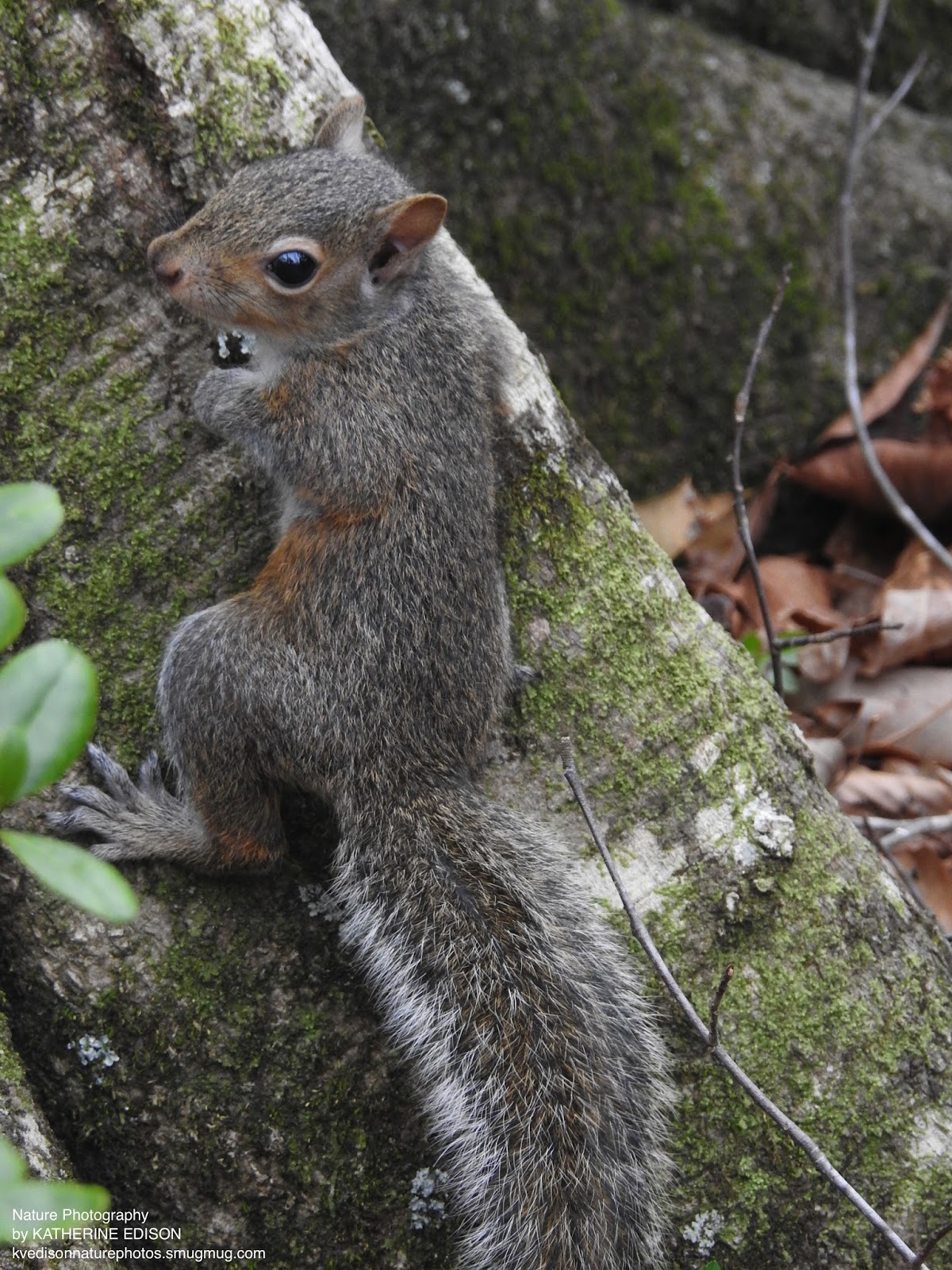
As I entered the garden, something small scurried up a tree up ahead of me. It seemed too big for a chipmunk but too small for a squirrel, so I followed it and found, to my surprise, that it was a squirrel after all, just a very tiny one. A baby squirrel!

Cute little guy

I wondered if it had fallen out of a nest, but it seemed fully able to climb and scurry away, however awkwardly. It was young enough that it really didn't know what to do when faced with danger. First it froze. Next it scuttled maniacally around in the leaves at the base of a tree, like it had no idea where to go. Then it climbed just a little higher up on the trunk and stared at me. I looked around for upset parent squirrels and didn't hear or see anything. Usually, when I startle squirrels, they scamper to a high branch and screech and bark at me. But this baby was new to the whole stranger thing. He moved to the back of the tree trunk and peeked at me from first one side and then the other. It was adorable. I was having so much fun with this tender baby animal encounter.

So curious!

Right then, the loud kids arrived at the garden gate and were soon rumbling up the path toward me and the baby squirrel. Surely the quiet, tender moment was doomed. But thinking quickly, I stepped back and caught the attention of the three chattering teenage girls. I waved at them and made the "shhhh" sign while gesturing to come closer. They heeded my warning and quietly hurried over to me, intrigued. When I whispered, "baby squirrel" and they saw where I pointed, we became a nature observation team. The young humans and the young squirrel studied each other carefully for a long while. The little squirrel stayed on its tree, about 2 feet off the ground, peering from side to side as before. The encounter generated lots of "awwws" from the girls and parents. Definitely a good nature moment. As they were leaving, the parents and I discussed that it was unusual to see such a young squirrel out on its own and that it had better watch out for hawks. Indeed, there are plenty of hawks in the garden, and a pair of red-shouldered hawks have built a nest a short way up the path in this very section.

Red-shouldered Hawk with a freshly caught vole that I saw in the garden last week

I felt happy to have shared a sweet nature moment with the family, and to have salvaged my own photo op! Everyone was happy. Win! And the baby squirrel stuck around for me to take more pictures. He seemed wary but did not scamper away. I kept waiting for him to climb up high to his nest (wherever that was), but he seemed interested in me and would climb up a bit but then would come back down. Then up again, then down.

Climbing up

Then down

Then back up

Then back down again

After a few minutes curiosity got the best of him and he began inching closer and closer to me. And before I knew it, the little rascal was at my feet, and then climbing my leg! As cute as it was, I realized that this was not good for either of us, and I shouted. The baby squirrel scurried back to his tree, and I knew it was time to walk away. For 1 or 2 seconds afterwards, I entertained the idea of taking him home and rescuing him. But I quickly came to my senses and remembered: 1) wild animal, 2) illegal, 3) pets at home, and 4) squirrel. What was I thinking? So I finished off my afternoon with lots of fun photos and no new mouths at home to feed. Thank goodness reason prevailed. I hope my little furry friend gets a bit more wary of humans and that he doesn't climb the legs of any other people. I also hope that he quickly learns some hawk smarts. He'll need it--it's a wild world out there. But he sure was cute.

Inching closer

Closer still

Ready to jump on me!


Sunday, April 23, 2017

Earth Day 2017

Luna Moth found on nature walk with a school group

I usually love the hope and energy of Earth Day, but this year I was feeling pretty discouraged. Every day I read the news in horror and dread, seeing the slashed budgets, eliminated programs, reversed regulations. It's hard to think that so many important ecological and conservation gains made over my lifetime may be undone. I fear for our health, our wildlife, our clean air, clean water, clean oceans and public lands. I can't believe that we're fighting these battles all over again. I mean, really, who is against a clean and healthy planet? I'm not that old and I remember when our national symbol, the Bald Eagle, was endangered because of DDT and habitat loss and how populations were brought back. And I have traveled enough to know that clean water and air are not something to take for granted. I have been on board with ecology and conservation and environmentalism since I was a kid. But somehow, the message has not gotten to everyone.

Bee exhibit at Sandy Creek Nature Center. The day before Earth Day I was able to talk to the children about bees, habitat, pollination and recycling all in one lesson!

Earth Day 2017 was perfect and beautiful. The skies were clear blue, the temperature was warm and the trees were green. A cool breeze dried my sweat as my husband and I walked to the Athens Science March on this glorious Saturday. We joined a crowd of like-minded people, concerned but happy to be alive, watching the birds and butterflies as we listened to speakers talk about the reasons we need science. Again, it's hard to believe that we have to fight for these things--the tools, verifiable information, inventions that help us understand our world and maybe make our lives better along the way. Who is against science? It just seems crazy. I know who does support science--millions of people who gathered and marched in cities all over the US and all over the world. On Earth Day it felt especially important to stand up for the environment and this planet, the only one we have.

Praying Mantis Egg Sac spotted by children on nature hike

Later in the afternoon I heard Bill Nye (the Science Guy) on NPR talking about the main march, the March for Science in Washington, DC. The interviewer asked if Bill was worried about the future. He said, "First of all, as I say to everybody, if you like to worry about things, you are living in a great time. But you've got to be optimistic people, you've got to think that you're going to solve these problems or you're not going to solve them. And we can do this people--it's cool! The future's going to be exciting!"

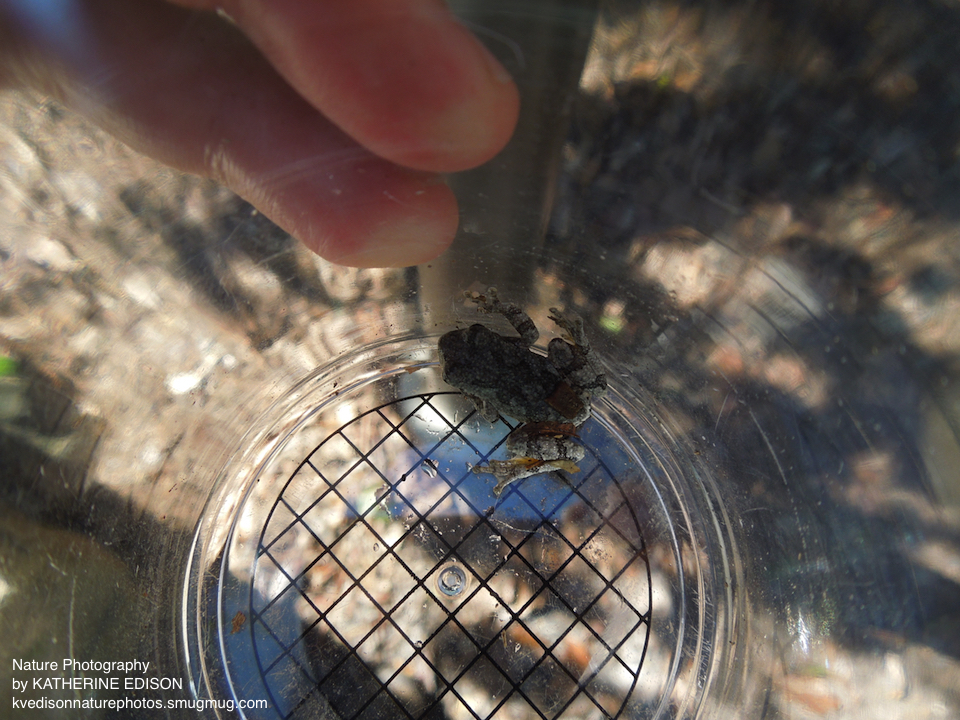
Gray Treefrog--temporary pet

Bill Nye was right--there is still reason for optimism. It gives me hope to remember that I have a special opportunity when I work with children and with the general public teaching about nature. The groups of school children that I walk through the woods may or may not have spent much time in the woods before, but when they are with me, I try to calm their fears and to spark an interest in the processes around them. I try to teach them something, while at the same time having fun and exploring with all their senses, sharing and challenging. We watch for movement and colors and look at tiny things with hand lenses, smell wild onions and flowers, feel rotting wood and slimy fungus and hug trees, and listen to the sounds of birds and insects and the wind in the trees. Some kids love it, some can't wait for lunch and to get back to school. But at least they've been exposed to the ideas. And many will return and learn more. Senegalese conservationist, Baba Dioum, said "In the end we will conserve only what we love; we will love only what we understand; and we will understand only what we are taught." I hope that I am helping people to understand and appreciate nature, and in the future they will grow up to love and conserve it.

A child shows his treasure--a pine cone covered with tiny mushrooms


Black Rat Snake spotted in the woods. We had the opportunity to talk about how snakes are helpful and that you don't need to fear them. What do they eat? Rats and mice! Who wants rats and mice around the house? Not me!

Witches' Butter Jelly Fungus--fun to see and touch


Carrion Beetle in dog poop on the trail. A great opportunity to talk about decomposers, and trail etiquette.

"It's a great day for cocoons!" We found several that day.

You can see the mental gears turning when the children see this flower and learn that hummingbirds and butterflies use it for a nectar source. Long flowers, long bill, long mouthpart. Hmmm...

Looking at this giant and memorable Cherry Millipede is a good way to reinforce what the children are learning about insects and spiders. 6 legs, 3 body parts = insect. 8 legs, 2 body parts = spider. With all those legs, this is definitely not an insect or spider! Arthropod is a great vocab word.

This boy had the Copperhead Snake at the nature center following his every move. 

We stopped our walk to watch these termites erupting from the soil and flying away to form a new colony. We discussed their role as decomposers and observed their part in the food web as the birds and lizards feasted.

So, don't give up. Keep working. Change takes time. There will be inevitable set backs. But we are making incremental progress. Regardless of what any political administration does, millions of people have learned to care about the environment and they won't change back to the old ways now that they understand. Other nations and growing numbers of businesses see that Green is the future. Solar energy is mainstream, people drive electric cars that get better mileage every year and don't pollute, and there are charging stations in our public parking garages and bike lanes and better mass transportation. Scout groups clean trash from creeks, classrooms adopt manatees and plant butterfly gardens, and college sports events have recycling bins and aim to be carbon neutral. Big changes since when I was a kid. Bit by bit, with education and ever increasing numbers of supporters, and with good scientific principals and innovations, I have to believe that we'll keep moving towards a more sustainable future. Happy Earth Day.