Showing posts with label ecology. Show all posts

Saturday, April 21, 2018

Hug a Tree

Tall Water Oak

A group of 1st graders and I were walking up the path back to the nature center yesterday. We had been on the trail for nearly an hour and they were happy but tired and hungry and ready to get back. We were almost there when we noticed something interesting on the trunk of a water oak tree just past the trailhead. There was some sort of circular blob on the trunk, and from a distance it appeared to be about the same color as the tree. As we got closer to examine we realized it was a cluster of caterpillars! Being first graders, many of them wanted to touch the wriggling shape. But I held them back and we watched for a couple of minutes, noticing the hairs that could irritate the skin and the pretty bright blue color that was not as noticeable from a distance. One of the kids said that it was the neatest thing she had seen on the walk. (Actually, she said it was the only neat thing she saw on the walk, but I didn't believe her!)

Nothing to see here?

The Cluster

After the children were reunited with their teachers and heading off to lunch, I walked back to the tree to have another look. I had never seen this behavior in caterpillars before. Up close, they were also incredibly beautiful. The blue color with white diamonds reminded me of fiber art and weaving patterns. I took a lot of photos.

Gorgeous colors and patterns

As always happens to me in situations like this, the more I looked, the more I saw. A pair of mating Milkweed Bugs crawled by just above my head. Right next to the caterpillar circle, a stream of ants was traveling up the tree from the ground, following cracks in the bark. A different kind of caterpillar moved down the trunk from above. This one was twice the size of the individuals in the caterpillar bunch, and had a very different pattern. The children and I had seen quite a few of these caterpillars in the park that day. When I got home I looked up both species in my "Caterpillars of Eastern North America" book and learned that the clustering caterpillars are Forest Tent Caterpillars, and are known for clustering like this. Despite their name, they do not make web tents. The other caterpillar was an Eastern Tent Caterpillar, and they are do make the web tents.

Milkweed Bugs

Ants

Two species of Tent Caterpillars on the same tree

There was so much going on right in front of me in this little area of the tree that I decided to investigate the rest of it and see if I could find anything else. But the tree was tall, so I could only look closely at my own eye level and below, which was only a tiny portion of the whole. It was a big and old tree, so there was a lot of moss and lichen on the bark in an assortment of colors and patterns. Some of the lichen looked to me like it had writing on it (I like to think they are hidden forest messages). A few feet away, a firefly climbed over lichen and moss, and seemed to be searching, though I don't know what for. Google tells me that adult fireflies eat pollen and nectar.

Lichen

Forest Messages

Firefly

As I made my way around the tree trunk I looked up and saw a row of holes, perhaps made by a sapsucker or some other woodpecker. Down below I saw the lumpy bark of the base of this mighty tree. Below that the frilly green of a tiny pine sprout peeked out from behind one of the big roots. In another root crotch I found a pink redbud blossom, probably one of the last left from this spring's blooms. On the other side, an Eastern Tent Caterpillar tiptoed by the star-shaped leaf of a sweet gum.

Holes

Craggy Base

Pine Sprout

Redbud Blossom

Sweetgum leaf with an Eastern Tent caterpillar photobomb in the upper corner


Just when I was starting to think I knew that trail pretty well, all it took was a closer look to see how much more there was to see and know. It reminded me of an activity we used to do when I worked at the nature center in Florida. We gave each of the kids wire coat hanger that had been pulled into a square shape and had them lay it on the ground. Then they were given a magnifying lens and a paper and pencil and were instructed to observe what happened in the square for a specified amount of time. At first some of the children balked. They said, "there's nothing here but dirt and some leaves".  But we told them to keep looking and to try to count everything they saw. Pretty soon even the most skeptical ones were hooked. An ant would walk through the square, or a grasshopper or a spider. They might see a seed, or a sprout, or a feather or a tiny flower. Then they used the hand lens and saw the shiny bits of sand and shell and rocks and broken insect wings. The more you look, the more you see.

Caterpillar Silk

I am also reminded of a book I recently read called "The Forest Unseen", by David Haskell. The author visited a square meter area in a forest weekly for a year and observed what happened in that space. He wrote about animals large and small, wildflowers, seasons and ecosystems. Its a lovely book that encouraged me to look closer, and made me think about what can be learned by observing one place again and again over time. As much as I like to travel and explore, there is a lot to be said for getting to know one place really, really well.

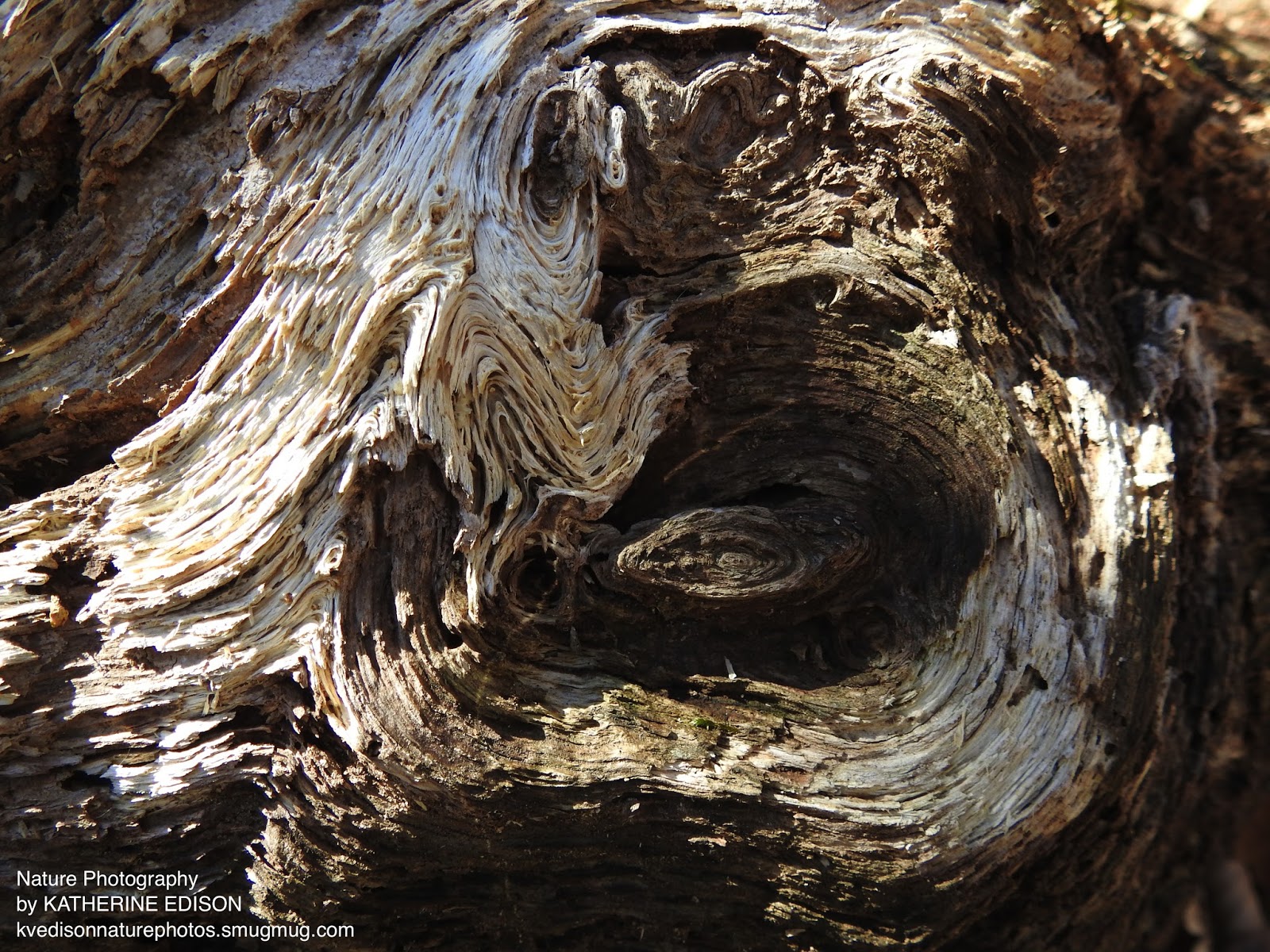
Tree Bark Wrinkle

So when was the last time you took a good close look at a tree? Looked deep down into a knothole or under bark, or felt a newly unfolded leaf? When was the last time you hugged a tree? Have you ever wrapped your arms around the trunk and felt the texture and sturdiness of a massive oak? Or buried your nose in a Ponderosa pine bark crevice and breathed the sweet vanilla scent? If it's been a while, I hope that you can take a few moments in honor of Earth Day and get to know a tree. There is a lot they can tell you if you just watch and listen.

Fresh Leaves

Saturday, February 11, 2017

We All Need a Little Green

Path Through the Woods

In my mind, one of the most important gauges of the livability of a community is whether or not there are greenspaces within easy walking or biking distance. Greenspaces are open patches of undeveloped land within an urban area, with trees and/or grass and minimal structures, and are generally open to the public. Parks, playgrounds, botanical gardens and nature parks come to mind. It takes some vision to create and maintain greenspaces. They are often on land that could be developed into something that could make lots of money, like a subdivision or an apartment building or a strip mall or a parking garage. Imagine how valuable the land in Central Park could be, located right in the middle of Manhattan. But, luckily, there are people out there who have understood the importance of having communal space available for connecting with nature. They understand the need for people to breathe fresh air, to walk in the beauty of trees, flowers and bugs, the need for children to run and play outside, for people to exercise and walk their dogs, to ride bikes, to watch birds, and to take nature photographs. Countless studies tell us that being in nature is good for us. Spending time in nature calms our jangled nerves, lets us keep healthy through exercise, and even helps our children concentrate better in the classroom. Imagine New York City without all its city parks, small and large, where people can go to escape from small apartments and crowded streets and subways. Without them people would go nuts. It's the same in every city. In addition to everything else, trees and plants in greenspaces clean our air, and the natural areas themselves provide critical habitat for urban wildlife. It is really important to me that nature is accessible to other people in my community, too. And this is one reason that I am involved on the board of Sandy Creek Nature Center where I also volunteer as a trail guide.

Cedar Waxwing 

But this is not about Sandy Creek. I consider myself very lucky to live in a lovely, livable community with greenspaces all around. I live a short walk from another pretty great greenspace--Oconee Forest Park and Lake Herrick on the UGA campus. Oconee Forest Park is a 60 acre wooded area that is managed by the school of forestry. It serves as a teaching area for foresters, biologists, ecologists and other natural scientists, but is also open to the public as a recreation area with trails for walkers, bikers, dog owners and nature lovers. Located next to Lake Herrick, there are benches, picnic tables, docks, outdoor exercise equipment and even a ropes course for teambuilding, as well as a beautiful ADA compliant boardwalk. It's a great place to be in and observe nature. I have seen deer, squirrels, snakes, turtles and beaver. And it is full of birds! The forest and lake area are birding hotspots. On a recent walk I counted 26 species without trying very hard. A sunny, cleared utility easement under the power lines is a superb place to find butterflies and other insects in the summer and fall. There are even labels on some of the trees to help people like me learn about Piedmont dendrology. All in all it's a pretty great place.

Turtles

Crow

Power Easement

Lake Herrick at the Bottom of the Hill

Lots of Recreation and Healthy Activities

Helping Me to Learn My Trees!

ADA Boardwalk Bridge Across the Lake

Forestry Students

Unfortunately, the park and lake suffer somewhat from misuse and neglect. There is a lot of litter from careless hikers or just blown in from the road. And like many other natural areas around town, sections of the woods are overgrown with exotic plants like English Ivy and Privet. The lake itself has been closed for swimming and boating since 2004 because of poor water quality due to factors such as storm runoff and bacteria from dog feces. The park is a very popular place to walk dogs, but it has been difficult to convince owners to clean up after their pets. (I think it would help to have more garbage cans and poop bag dispensers, but that may already be in the works.) Another problem is erosion caused by unofficial bike and running paths. Renegade paths may give a fun and fast ride down a steep hill, but it also gives a quick channel for storm runoff. Properly designed paths minimize erosion. But the University is acting to address the problems, with mitigation projects starting as soon as this spring, which is great news. It will be nice when the lake can be used for recreation again. I read that a small lake on the far side of the property that has become filled with silt from runoff may be developed as an improved wetland and I find this very exciting. I've had great experiences viewing nature in manmade wetlands around the country and have become a big fan.

Small Lake that Could Be Turned into a Wetland

Creek Runs Through the Forest to the Lake

Entrance to the Forest

Our family gets a lot of pleasure from using this resource. My husband likes to run through Oconee Forest Park, and we sometimes bring our dogs there. I love living close enough to just walk over to the park when I feel like birdwatching or taking photos. Some times, like weekends and evenings, the place is packed. But during the day it can be fairly quiet. I can easily spend hours there, wandering the meandering trails. Every visit I notice something new. This past time I found a big beaver lodge. Last visit, I heard and saw an unseasonably early White Eyed Vireo. Most times I see interesting fungi, plants or wildflowers. One day I hope I can roll a log or lift a rock and find a salamander. (I still haven't found one in the wild yet.) And as I get to know the park better, I get lost a lot less often. Or maybe I worry less about it. Being on campus, it is fairly well used and safe. And since it is in northern Georgia, I don't have to be afraid of being trapped on a trail by an alligator or a cottonmouth, as happened to me sometimes in Florida.

Beaver Lodge in the Water (Middle Right)

Eastern Phoebe

Texture on a Rotting Log

This unusual Deer Sculpture is the only deer I have actually seen here in the park, although I have seen tracks.

I guess the point here is to encourage everyone to seek out your own local greenspaces. Spend time outdoors and commune with the trees and the rocks and the bugs. Even in winter, go enjoy the snow and the muffled silences. Even in the sweltering heat of summer, go listen to the cicadas while you lie on the grass, watching the clouds roll by. Get out often enough to see the changing seasons. Learn those places as well as you know the plots of your favorite TV shows and you will not have wasted your time. Share them with children. We all need a little green.

Great Blue Heron Enjoys the Small Pond


Sunday, April 10, 2016

New Neighbors!

Get Ready! 
I'm so excited! I have been waiting for the new neighbors to show up since we arrived in Athens this past summer and saw a sign about them on a wooded lot just down the street. For weeks afterward, then months I kept checking for them, then found their Facebook page and read articles online to learn more about the project that was bringing them here. And at long last, on April 1 (no joke!) the Chew Crew arrived! The Chew Crew is a UGA project that is enlisting the services of a group of goats to eat invasive bushes, weeds and vines in 2 natural areas on campus, Tanyard Creek and Driftmier Woods.

Welcome Party at Driftmier Woods

Eating Oak Leaves With Gusto!

Chewing...

Goat at Work
The goats were everything I had hoped for in new neighbors--friendly, helpful and fairly quiet. There was a big party when they arrived and UGA students and staff and people in the neighborhood turned out to greet them. The crew at our neighborhood site (Driftmier Woods) consists of a big white Billy Goat and 7 smaller (female?) goats. I know they all have names, but I haven't learned them yet. (I think there may even be a mama and baby, but I'm not sure--I have some detective work to do!) They will stay at Driftmier for 3 weeks, then move back to Tanyard Creek for some touch up work. When they're not eating at UGA, they clear residential property. They are very busy goats! Their first day here the goats were already working hard on improving their wooded lot. Driftmier Woods is a small old growth Piedmont Forest on the UGA campus that over the years has become overgrown with invasive plants. Underneath and behind all the invasives there are huge white oaks (probably 150 years old), beeches, sweet gums and other hardwoods and pines. It is a wonderful hilly spot with hiking trails and picnic tables and a small creek that runs along a low area. It is tucked between the engineering building and graduate housing apartments and people use it to hike, cut through to campus and even ride mountain bikes. I've seen hawks, songbirds, insects, ferns and pretty wildflowers. I've heard that owls, deer and foxes have been spotted in the evenings.

Tall White Oaks

Forest Path

Cranefly Orchid Leaves
Right now the woods remind me of those jungle movie scenes where someone with a machete chops away a clump of vines and uncovers the lost kingdom. There is a lot of work to do here to remove the tons of Chinese Wisteria, Japanese honeysuckle, English Ivy, privet, nandina, lyriope, ligustrum, and a host of other invasive species that are literally covering the forest. The proximity to campus buildings and homes makes the area a poor candidate for prescribed fire, but it is perfect for prescribed grazing. The goats can get into rough terrain and eat and clear vegetation where it might be tough to bring in machinery (though something will need to be brought in to take care of larger bushes and trees). So the goats chew the forest back to health. And volunteers pull, chop, dig and saw. After the site is rehabilitated, it has the potential to be a fabulous small nature area, providing important green space and urban habitat. The project is a collaboration between several UGA departments and involves faculty, students and interested citizens (like me!) Project organizers secured a $25,000 grant to fund the operation and many people are volunteering time to make it a success. They have done such great work with the other site, Tanyard Creek, that I'm sure this will be successful, too.

Overgrown with Invasives

Hidden Jungle Ruins

The Chinese Wisteria that Ate the Woods

The project coordinators are carefully measuring and documenting the effect that the goats are having on the natural areas. At Tanyard Creek, where the goats have been clearing since 2012, the Chew Crew has done a great job and there are not many invasive woody shrubs left. I spent a lovely morning there last month helping to identify and measure herbaceous plants within defined grids. At Driftmier Woods, in addition to clearing the invasives, the concern is that the goats will eat the oak seedlings and will have an adverse effect on the regeneration of the forest when the invasive cover is cleared, so I spent an afternoon tagging and measuring oak seedings. Now that the goats have arrived, it is pretty clear that they LOVE to eat oak seedings, so I imagine that lots of wire cages will be needed to protect them to ensure new forest growth. It is a huge project and only one section of the woods have been fenced for goat foraging so far. Much more work is yet to come. It makes me appreciate how much effort has gone into all the existing natural areas that I enjoy so much.

Tanyard Creek Plant ID

The Grid for Counting Plants

Cages to Protect Baby Oaks

As a new person to town, I have been looking for ways to get involved and find my niche. I think this is a good fit. I have only pitched in a little so far, but they will need a lot more help over the coming years, clearing, pulling, counting and measuring. Independent of the Chew a Crew project, I'm making a personal project of observing and photographing birds, plants and other wildlife in Driftmier Woods and have added it to eBird as a birding location. It would be nice if over the years I could document an increase in the diversity of species. I hope that I can become as intimately acquainted with these woods as I did with the Ditch and Morningside and La Chua Trail in Gainesville. I've already met some friendly and interesting people and it feels great to be part of a big community project. This one is perfect for me, given my interests in native wildflowers, invasive plants, wildlife and environmental education. It will be exciting to see the changes and I'm really happy to be part of it. Chew on, goats!

Chew On, Goats!