Showing posts with label toad. Show all posts

Thursday, February 18, 2016

Winter State of Mind


Frozen Thistle Leaves
And just like that, winter doesn't seem so bad. Last fall I joined a nature group (the "Nature Ramblers") and we had our first walk of the season today. It was chilly at 8:30am when we gathered and folks were dressed in winter coats and hats. But there was a giddy excitement in the air as we headed out as a group for the first time since November "seeking what we find" (the group motto). As we walked I realized that today was not unlike so many other sunny, chilly days this winter when I felt cold and unable to peel myself away from my warm house.  The difference was the sense of purpose and desire to learn and be with friends.  During the season, we meet every week, guided by wonderful leaders, knowledgable in botany, biology and anything else. There is so much to see and learn that I don't want to miss anything! With morning temperatures still in the 30's, many low growing leaves were wilted or covered with frost. Frozen Trillium sent out hopeful buds. We strolled along the shady garden path, spending time to learn about Witches' Broom, a growth on Hop Hornbeam trees caused by fungus, and the Medieval medicinal origins of some common plant names. Then we beelined to the prairie and found a few tufts of Frost Flowers that had not quite melted as the sun rose and warmed. And in the process kicked up the biggest Puffball Mushroom I've ever seen!

Wilted Trillium

Frosty Leaves

Frost Flower

Ginormous Puffball

Down in the lowlands we discovered great gobs of amphibian eggs, which we initially believed to be from salamanders. (Several days later one of the Ramble leaders identified the eggs as most likely coming from Southern Leopard Frogs.) Some had hatched and were immobilized by cold but moved a little when held in a warm (and brave) hand. On the other side of the ephemeral pond we found coils of toad eggs, probably from American Toads. Small hatchlings next to the curlicues waited patiently for the day to warm up.

Amphibian Eggs--Probably Southern Leopard Frogs

Warmed by a Hand

American Toad Eggs


Hepatica, Bloodroot and other early spring flowers brought excited shouts and we all gathered in for a closer look. Robins, bluebirds and nesting hawks provided the soundtrack. Bare trees reached up into brilliant blue skies.

Bloodroot

Spotting the Hawk's Nest

Bare Trees, Blue Skies

Driving out of the Botanical Gardens I passed swaths of green Daffodil leaves, the first sunny blooms just beginning to pop out. They made me smile. Winter in Georgia is a state of mind.

Sunny Daffodil


Monday, June 15, 2015

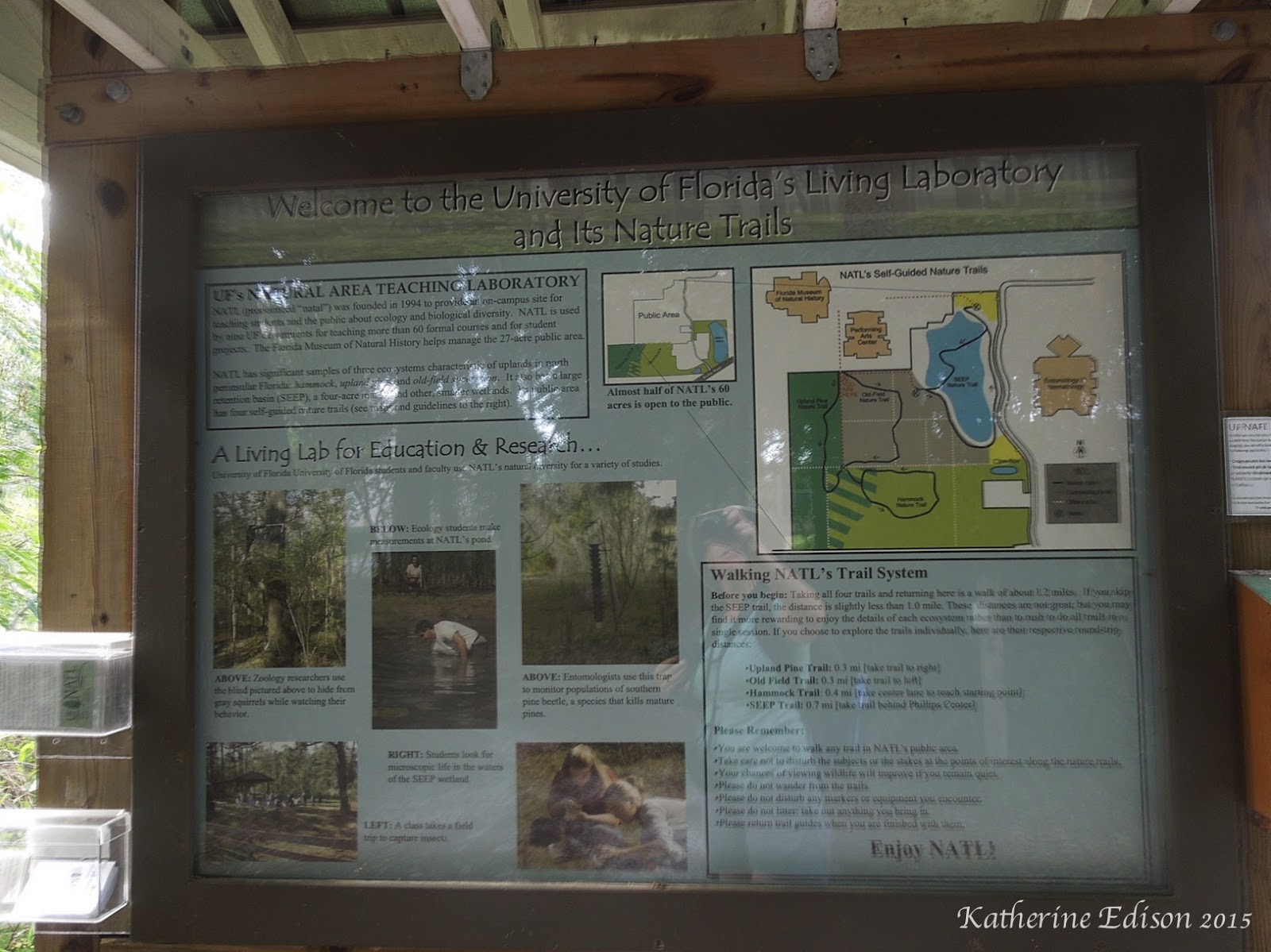
30 Days in June: Day 13, Natural Area Teaching Lab (NATL)

NATL
My relationship with the Natural Area Teaching Lab (NATL) on the University of Florida campus goes back to 2002 when I responded to an ad in the paper looking for Volunteer Docent Naturalists for the Florida Museum of Natural History. I can't remember if I had ever been to NATL before that, but after I discovered it, this special outdoor classroom quickly became an anchor for me. I wrote about this in a previous post ("Just Be"), so I won't go into the history much here, except to say that I am deeply thankful for the role NATL played in my development as a naturalist.

Four Ecosystems to Explore

Back when I started as a Docent Naturalist, NATL was much more bare bones. There were several basic paths, a picnic pavilion, PVC pipes for Treefrogs, some insect traps set out by entomologists and a kiosk where the kids could dig for ant lions. We still got a lot of use out of it with the school groups and summer camps. We caught insects in the fields, peered into the PVC pipes, peeked under logs, and played "The Thicket Game" (a Project Wild game about predators and prey) in the woods. We almost always saw or heard something wonderful. But since then it has gotten even better.

Tiny Southern Toad on the Trail
Over the years NATL has undergone some terrific changes. Interpretive signs and trails were added with very helpful labels on plants and trees. Signs with QR signs for smart phone add another educational dimension. There is a trail now around the entire SEEP Area (Stormwater Ecological Enhancement Project) with a boardwalk, where previously we could only walk to the edges of the retention pond. The staff and students who run NATL are working hard to promote the area to the whole community as a nice place to walk and learn about the environment. Social media alerts fans to new nature sightings or changes such as prescribed burns. There are scavenger hunt pages available to encourage families to visit, too.

Boardwalk through SEEP Area

Sign with QR Code for Smartphones

Welcome to NATL, from the Other Entrance

Interpretive Signs Along the Upland Pine Nature Trail

I go to NATL when I want to take photos of butterflies or other flying insects. The open, sunny fields and well maintained pine sandhill provide an excellent source for wildflowers. It's a good place to see Red Headed Woodpeckers and Bluebirds, and I have seen Pileated Woodpeckers building nests on several occasions. In the winter, the pond is a good place to see Hooded Mergansers.

Retention Pond

The wetlands around the boardwalk are teeming with dragonflies, frogs and butterflies. Occasionally I have seen turtles and snakes, and even an alligator.

Dragonflies

Snake Shed in the Forest

A few years ago an owl box was placed in a big pine tree to attract Barn Owls. I don't think they have moved in yet, but one can hope. I don't believe that I have seen an owl in NATL, but I have seen hawks and kites. There have been several interesting structures to study the habits of Native Bees. The latest one is so attractive that I think I will borrow the design and make one for our new yard in Georgia.

Owl Box

Native Bee Structure

One of my prized butterfly sightings was at NATL. I had read a Facebook post about Harvester Butterflies on the Hammock Trail, and so I went looking for them. Not only did I see one, but I also found some Harvester Caterpillars eating Wooly Aphids on a Smilax vine (Harvester Caterpillars are insectivores!). When I visited this week, I was very happy to find and photograph another Harvester. I saw Wooly Aphids, but did not find caterpillars this time. I also saw a Question Mark Butterfly, but it flitted off before I could get a photo.

Harvester Butterfly

Question Mark

I spent about 3 hours in the heat on Saturday morning walking all the trails and reliving my happy memories of NATL. I was drenched with sweat and tired when I got home, but I feel like I could have walked all day. I love this place and hope I can visit again before we leave. I am encouraged because there is a teaching forest on the University of Georgia campus, not too far from our new home and I hope it is similar to NATL. Stay tuned for further reports.

Day 13 Total: 83 (no new birds) and 17 Natural Areas

Tread-Softly (Cnidoscolus stimulosus)

Showy Milkwort (Asemeia violacea)

Man of the Earth (Ipomoea pandurata)

Butterfly Pea (Centrosema virginianum)

Green Lynx Spider on Paleleaf Woodland Sunflower (Helianthus strumosus)

Florida Milkvine (Matelea floridana)

A Walk in the Woods Always Makes Me Feel Happy


Friday, July 4, 2014

June Challenge

The June Challenge Trophy!

Another June Challenge has come and gone, and as usual, I did not win. This comes as no big surprise or disappointment to me because I am not a particularly knowledgable birder, and that's ok. I'm interested and enthusiastic about birding, but I'm also interested in flowers, butterflies and other animals. I don't know the intricacies of Empidonax Flycatchers, Sparrows and Warblers, but I do recognize the usual, obvious birds. My list is growing each year, so I am learning and getting better. A friend reassured me by quoting renowned birder Kenn Kaufman, who said “Birding is something we do for enjoyment; so if you enjoy it, you’re a good birder. If you enjoy it a lot, you’re a great birder.” I do enjoy it a lot, so I must be a great birder! But by that measure, I'm a great botanist, lepidopterist and herpetologist. But seriously, there are people out there who know so much more than I do and spend so much more time birding that I will always be in the middle to back of the pack, and I don't mind a bit because the June Challenge gives me so much more than the challenge. 


Green Heron All Stretched Out
A little background on the June Challenge: this is a friendly competition created by a member of our local Audubon chapter to keep birders busy and engaged in the hot, quiet summer when the migrants have passed through and there is little going on. The challenge is to see as many species of free-flying birds as possible in the month of June. The birds must be seen within the boundaries of our county and they must actually be seen to be counted. Hearing is not enough! (Damned Bobwhites.) On June 1st some of our most experienced birders usually lead a birding field trip that helps get our lists off to a good start. And then for the rest of the month people text, email, and call about daily excursions to look for rare and difficult to find birds. It takes a lot of stamina to win, but everyone is eager to share a special sighting. This is a very congenial group. For example, I usually have White Winged Doves at my bird feeders, and a Cooper's Hawk often hangs around the pine trees in the yard. I told a few friends and saw more than one car slow drive by slowly, checking for other birds on the list. I think it's all a lot of fun. And it's been so popular that people outside of our county have started their own June Challenge!
Great Blue Heron
In the end, the 2 winners (both are my friends, and one was my photo buddy, Maralee!) each counted the phenomenal number of 116 birds of the total 128 birds reported. I saw 77, which I don't think was too bad considering that I wasn't able to attend the kickoff event and took a trip out of town for a week. I missed some of the easier birds, but I saw some special ones, too. There were some rare off-season American Robins nesting just up the street from me, but I never saw them. And several people spent an astonishing amount of time camped out hoping to see a Broad Winged Hawk. I didn't see it either. But I did see 3 Burrowing Owls (first time! Yay!) and finally got a Bobwhite to show itself. I see Bobwhites all the time, but for some perverse reason, never in the month of June. 
It's too bad that you can't count feathers because I saw several from birds I didn't get on my list
But for me, the June Challenge is about so much more than seeing and counting birds. It pushes me to get outside and explore as often as I can. It helps me get out of the rut of visiting the same old places, and it helps me meet new friends who are also out and about and of like mind. In the course of my month of bird searches, I woke up before dawn, hiked in the blazing mid-day sun, and hunted for owls at dusk. I walked by Lakes, Ponds and Creeks, through Sandhills, Flatwoods, Wet Prairie, a Cow Pasture and Cypress Swamp. I staked out parking lots, bird feeders and a medical park in the rain. Each day out was an adventure and I felt more alive with every excursion. 
Early Morning in the Cow Pasture, in Pursuit of the Burrowing Owls

Pine Flatwoods

Cypress Swamp at the End of a Trail

Red Tailed Hawk in the Rain at a Medical Park
Because I was out so often, in addition to my 77 birds, I was able to see lots of flowers, insects, mammals and herps. I saw Sandhill Crane colts (that's what  their chicks are called), baby Grackles, Gallinules and a Fish Crow chick. 
Sandhill Crane and Colt

Boat-Tailed Grackle Chick

Common Gallinule Chicks

I crossed paths with Rabbits, Raccoons, Wild Horses and their colts (the 4 legged kind), Feral Hogs, White Tailed Deer, a Bobcat (!) and a Fox Squirrel! 
Eastern Cottontail Rabbit

Raccoon

Wild Horses and their Colts

White Tailed Deer

Flying Fox Squirrel
I saw a Corn Snake, Water Moccasins, Lizards, Alligators, Soft Shell Turtles and numerous Toads and Frogs, including a Gopher Frog--another first for me! 
The Corn Snake Stuck Around Even After Being Stepped On!

Alligator Tracks and Skid Marks

Florida Soft-Shelled Turtle, Perhaps Laying Eggs

Little Southern Toad

Gopher Frog and its Many Admirers!
I saw huge Regal Darner Dragonflies and tiny Damselflies, Spiders and Grasshoppers. 
Regal Darner

Jumping Spider
Walking along those trails, we saw numerous butterflies: Buckeyes, Monarchs, Sulphurs, Giant Swallowtails, Gulf Fritillaries, Zebra Longwings and a Red Spotted Purple sunning in the parking lot. 
Red-Spotted Purple Butterfly
I found a new wildflower, the Largeflower Rosegentian (Sabatia grandiflora), found Tarflowers blooming in the flatwoods, and was thrilled to see a stunningly beautiful display of Pickerelweed on Paynes Prairie. No one around here has seen the Prairie covered like this for years. It's really been a fabulous month.
Largeflower Rosegentian (Sabatia grandiflora)

Tarflower (Bejaria racemosa)

Pickerelweed (Pontedaria cordifolia) As Far as the Eye Can See
Now that the challenge is over, I am looking for new adventures to get me out in the field. Sometimes it's hard to motivate myself. I get tired after a work week and my tendency is to just blob out at home in my free time. But I feel so much better when I get out and battle the chiggers and heat. All it takes is a seeing a raft of frog eggs floating in an ephemeral pond on a trail, or a perfect Hooded Pitcher Plant and I forget all about itching and sweating. At those times I am exhilarated and feel completely alive. 
Egg Shell Under the Pines
At the June Challenge celebration on July 1st, I heard someone suggest that we do a July Challenge, too! As fun as it sounds, I don't know if most of us can keep up the grueling pace for 2 months. Especially in the heat and humidity of Florida in July. But I'll be looking for opportunities wherever I can. Butterflies and Hummingbirds like this hot weather, and as I walk the trails, I can already see signs of fall wildflowers to come. It's going to be a good fall. And winter. And spring. It's always good!
Happy Trails in My Future