Showing posts with label garden. Show all posts

Tuesday, October 1, 2024

Fall-ing in Love Again

American Lady with Blue Mistflowers and Rudbeckia

I am so happy that Fall is here. I'm not talking about pumpkin spice or sweater weather. I love fall because this is when the wildflowers are at their peak and the butterflies arrive in force. The bees and wasps will have been busy all summer, but the butterflies like to wait until the flowers are at their tastiest and most beautiful. It's my favorite time to lead kids on hikes at the Nature Center. We see so much! Spiders, caterpillars, butterflies, stick bugs, mantises. Fall is full of life. I learned to love fall wildflowers when we lived in Florida and I worked at Morningside Nature Center. I got to know the flowers of the Longleaf Pine Sandhill there, which is one of the most beautiful things ever. Click here to read my blog about it: https://earthteachme.blogspot.com/2013/09/morningside.html I started my flower garden at home to attract butterflies when I saw how they loved the wildflowers in the sandhill. The flower show in our garden starts small in the spring with welcome but small sprouts of green and flashes of yellow and pink. But by fall it is a mad burst of purple and gold, tall stems tumbling over each other. I could barely walk the path through the middle of the garden today because it had grown so thick. But the result is a moving carpet of rainbow colors, buzzing, fluttering, and chirping. The birds, rabbits, squirrels and deer love it too. 

Katydid

Fall is the time that I get to step back and just admire and enjoy the fruits of my labors. It's my reward for the sweaty work planting, watering and weeding that I do in the spring and summer, though admittedly, nature does most of the work. It's a joy to just step out the front door and be surrounded by such beauty. I take far too many pictures. It makes me happy to see other people pass by the yard and stop for a picture of their own. A runner yesterday waved and said "¡Que Rico!" and blew kisses to the flowers. It makes me feel good to provide a nature sanctuary on a busy corner where campus buses drive by every few minutes and commuters line up at the beginning and end of their day. I love this garden.

On the Bus Route--Goldenrod and Asters Abound

American Lady, Blue Mistflower, and the Commuters

Fall is also hurricane season. It's been a wild week. On Thursday we watched the destruction in Florida as hurricane Helene grew to a category 4 storm.We anxiously waited for it to roar over the top of Athens during the night. I took pictures of the garden on Thursday, fully expecting that it would all be smashed flat by the storm the next day. But Friday morning we woke to light rain and some wind gusts and found that we had come through mercifully unscathed. The storm had taken a more easterly path. But then we saw the terrible damage as it tore through up the eastern half of the state and up to the Carolinas, Tennessee and Kentucky. There was some damage in our town, but nothing like what happened all around us. We feel very lucky--the devastation and loss is shocking. Some of those communities will never be the same again. Our garden was untouched.

The Day Before the Storm 

Then on Sunday we started getting reports of a toxic chemical fire in Conyers, about 40 miles to the west, and to be prepared to stay inside with windows closed if the chemical cloud started to drift our way. Luckily the fire seems to be under control and the cloud has not made it here yet, though it looks like the toxicity would be diluted by the wind by the time it got here if it did. But 17,000 people were told to evacuate, many to Athens. Crazy. What's next? An asteroid? Volcano?

Not smelling any chlorine because the toxic cloud was far away, I took a walk around Lake Herrick, where I used to walk all the time and in January had started writing about for an exercise in exploring place. I've been avoiding going there--it just makes me sad since the nursing student was murdered there in February (see previous blogs). I hadn't been there since June. I decided to go see if I could find any of the birds that had been reported after the hurricane (I didn't). It was nice to walk the trails again, but it still felt sad. This summer the university installed numerous emergency call boxes throughout the woods as a safety measure. I understand why they put them in, but for me, seeing the bright red light in the woods just reminds me that it is a sad place. I'm just not sure I can write about my connection to the place any more. I get distracted by the misery. So I am letting that "Journey in Place" project go. I'll certainly go back to Lake Herrick over and over again. But reflecting on my feelings there is too sad, and I feel like having the project hanging over me has been a burden that kept me from being able to write at all. I've been stuck. But walking home from Lake Herrick, I saw my garden up ahead in the distance, all full of movement and life, and I felt relief, and the urge to write about it. Just the nudge I needed. Thank you, garden, for giving me joy, beauty, and peace.

Pearl Crescent on Rudbeckia

Cabbage White on Blue Mistflower

Yellow Collared Scape Moth on Blue Mistflower


Fiery Skipper on Blue Mistflower

Buckeye on Blue Mistflower

American Snout on Blue Mistflower

Ocola Skipper on Blue Mistflower

Swamp Sunflower

Leafcutter Bee on Blue Mistflower

Ailanthus Webworm Moth on Blue Mistflower


Georgia Aster

First Monarch of Fall


Thursday, July 6, 2023

The Long Hot Summer (Yeehaw!)


Every July about this time I find myself thankful for the heat of summer. Steam and heat aside, this is a great time to be in the yard. Our wildlife garden is almost at full peak, producing flowers and leafy shelter that attract the pollinators and the rest of the food web that I garden to provide habitat for. The swamp sunflowers in the front yard have grown tall, giving a quiet place for a baby deer to sleep while mom is out looking for food. The bushy Muhly grass, Mountain Mint and Black-eyed Susans are a refuge for fireflies that emerge in the evening. Tiny spiderlings set up their webs, hidden in the thickening greenery, where they hunt for prey that increases in size as they do. Caterpillars silently munch on plant parts, leaving specks of frass and chewed up leaves in their wake. Thrashers and Towhees scurry through the flower beds, grabbing caterpillars and spiders as they forage for spilled seed from the feeders. Mature vines and tube-shaped flowers are food for the hummingbirds. By July, at least one brood of newbies are out foraging for themselves. They visit the sugar water feeders, but they also spend a lot of time sucking out of flowers, especially the ones with long stems that they can sit on and rest between hovering and being chased off by older birds. Hovering is tiring.


This time of year, my glasses and camera lenses that are cool from the indoor A/C fog up immediately upon stepping out of the house or from a cool car. I can wipe the glasses, but have to wait for the camera to warm up because merely wiping the external glass is not enough. The camera will keep fogging up until the temperature has equalized. I've learned to keep my camera case in the back of the car, away from the A/C when I'm driving somewhere to take photos. I also take the camera out of its case right away when I get outside so it can start warming up, and sometimes face the glass into the sun to quick-start the process. 


Today I went out into the back yard just as it started to get hot, around 10am. The plan was to photograph some bees. My camera was cold, so I needed to give it time to acclimate, and so I walked over to one of the Black-eyed Susan patches in the yard to see what insects might be flying around. Before I knew it, an hour had passed and I had taken dozens of photos just with my phone. It's quickly becoming my go-to camera. They say that the best camera is the one you have with you. This one takes decent enough photos, and doesn't fog up! I never did pull out the other camera.

But the reason I spent an hour in the flower patch was that there was so much going on just on this single species of flower that I couldn't stop searching for more. As the morning warmed and the sun moved higher and brighter, the insects became more active, and new ones showed up. Butterflies, for example, were late arrivals. It was great fun and I had forgotten from last year just how much I love spending time crawling around in the flowers. I couldn't help but think that if there is this much life in a small flower patch, just imagine a prairie or a forest or a jungle. And this was just what I could see with my naked eye. So exciting--hello summer! 

Here are some images from my morning in the Rudbeckia as I waited for my other camera to thaw. 

Ant

Caterpillar

Sleepy Scoliid Wasp

Sleepy Leaf-cutter Bee

Leafhopper

Tiny Wasps

Planthopper Nymph

Some sort of Nectar Feeding Fly

Lacewing Egg (circled)

Ladybeetle

Carpenter-mimic Leafcutter Bee

Assassin Bug

Crab Spider

Stink Bug Nymphs

Red Cocklebur Weevil. They feed  "primarily on Asteraceae species, including sunflowers, ragweed, thistle, cocklebur, joe-pye weed, ironweed, and rosinweed"

Green Lynx Spider

Honey Bee

Not sure!

Small Leaf Cutter Bee

Fiery Skipper


Thursday, April 29, 2021

My Wonderful Garbage


Delicate Pink Worm Strings


Feeding the Worms

by Danusha Laméris

Ever since I found that earth worms have taste buds

all over the delicate pink strings of their bodies, 

I pause dropping apple peels into the compost bin, imagine

the dark, writhing ecstasy, the sweetness of apples

permeating their pores. I offer beets and parsley,

avocado, and melon, the feathery tops of carrots.


I'd always thought theirs a menial life, eyeless and hidden,

almost vulgar--though now, it seems, they bear a pleasure 

so sublime, so decadent, I want to contribute however I can,

forgetting, a moment, my place on the menu.


I'll admit it right now. I'm a pretty lazy composter. We have a bin in the backyard, and have for years. But I don't do much to help it along. And I haven't pulled any finished compost out of the door at the bottom since I set it up in 2015. I don't crush my eggshells, and I never peel off the plastic tags from the produce. I have a special tool for stirring up and turning the compost, but I forget about it for months or years. We used to have 2 bins, before we moved, but only kept one to save space. And since I set it up, oh so many years ago,  I have done precious little besides pouring in the kitchen scraps and tossing in the occasional armful of dry fall leaves when it gets too wet. I could feel guilty about my shortcomings, but I don't. It's compost. And lucky for me, the compost bin basically runs itself.

The Bin


About 2 1/2 months ago, the compost bin was getting close to overflowing. We had some painters coming to work around the house and I was self-conscious about the strong smell of coffee grounds and orange peels that would waft off the top of the un-turnable pile for a few days after dumping, right next to their work area. I knew it was time to empty it out, and even move it to a new and better place. But I was not in the mood to do that. Besides everything else, a large contingent of winged ants had amassed on the outside of the bin, preparing for mating flights. They were there for days. This wasn't a good time to dig in. So I just stopped using the bin for a while. It felt strange putting all the kitchen trimmings in the trash, after making a habit of saving scraps for composting. Our trash bags were suddenly wet and smelly, and the outdoor garbage bin filled faster. 

Inside the bin: Stickers, shells, avocado pits. Note large ant pile of humus on lower left.
(I took out the stick--don't know what that was doing there)

One day, about 6 weeks later (painting took a long time), I got curious and opened the lid of the bin. To my amazement, the pile had sunk a good 6 inches. It smelled gorgeous--fresh and earthy. A large colony of ants had settled in and had fluffed up a pile of the rich, dark humus--the result of the composted plant matter. It turns out that ants do a lot of work in a compost bin, turning over the detritus and bringing in fungus and bacteria that help break everything down. I read that turning the pile can deter them. Good thing I never maintain my compost bin! (Little joke.)

Tiny flies and spider webs

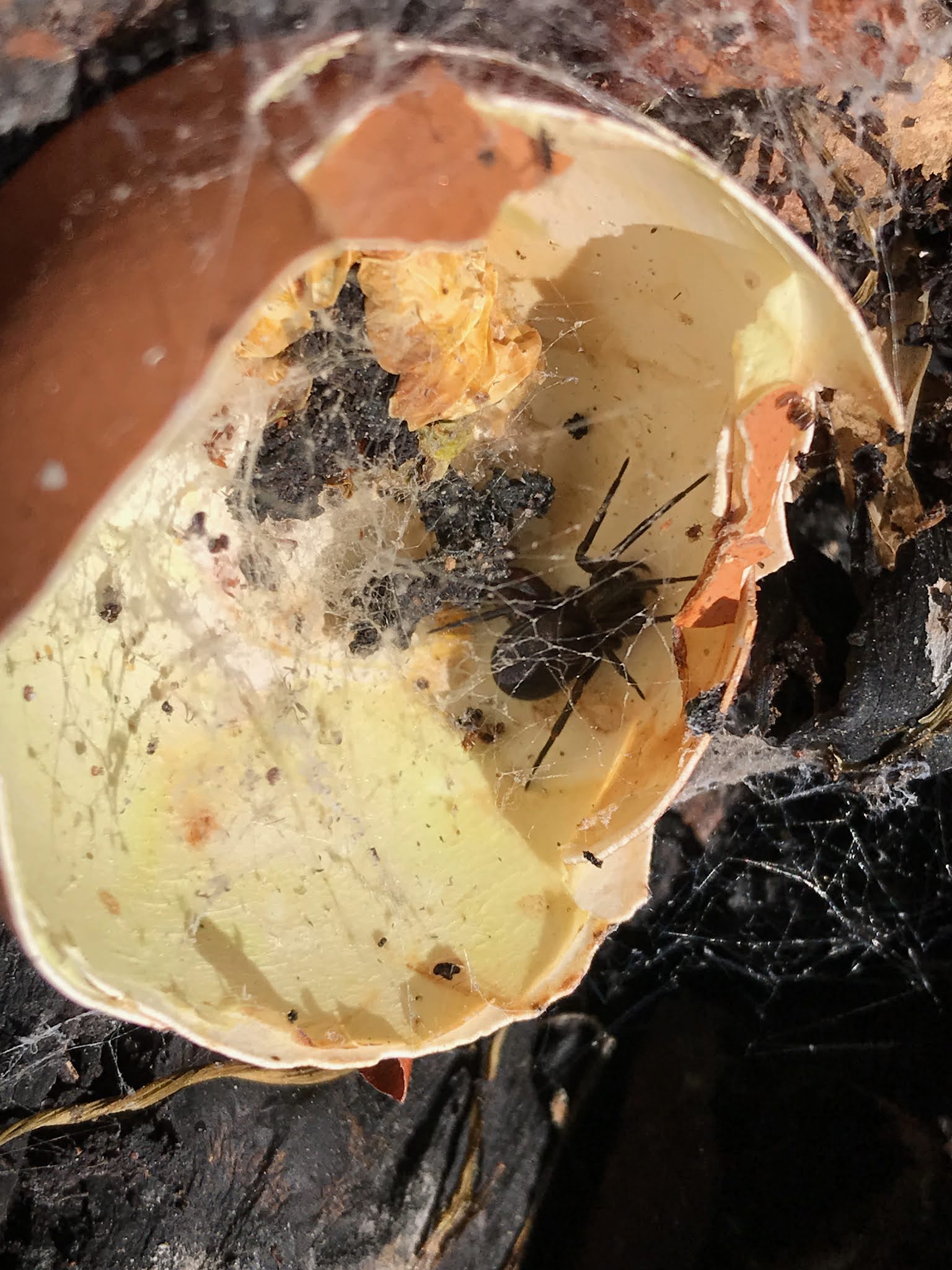
Special Spider Habitat in an Eggshell

Potato Bugs

Roaches Dive for Cover

Earwig Among the Ants (I don't know if this is a peaceful encounter)


As I examined the shrunken heap, I was fascinated to see the many arthropod inhabitants. I saw tiny flies and flying insects on the walls, and figured that they must eventually end up as food for the dozens of spiders who had each inhabited her own eggshell. Potato bugs (or roly-polys or pill bugs) scurried out of sight when I lifted the lid, as did the numerous, large cockroaches and earwigs--the detritus eating A-Team! Sometimes when I opened the lid, a lucky fly would land on the decaying produce (or maybe they were unlucky if they got shut in and eaten by the spiders). 

Free Range Spider

Fly on the Ant Mound

False Blister Beetle Seems Out of Place Here--Usually Found on Flowers

Egg Casings--not sure species

Green Bottle Fly

Checking on the goings on in the compost bin has become my latest hobby. I find something new every time I look. I enjoy quickly lifting the lid to see if anything surprising is happening in the darkness. The sunlight and my movement causes quick dives for cover. Many of my photos of the scurriers are blurry or partial because of that mad dash for shelter! This week when I looked, I noticed a new, larger species of ant patrolling the rim of the bin. I don't know my ants well, so I can't be sure they were not just the soldiers of the ones I'd seen before, but it would not surprise me to know that there were several species living inside. I also found large clusters of ants tending eggs. Some had even taken over the egg shells that had previously been occupied by spiders. 

Ants, Eggs and Larvae in an Onion

Ants Have Evicted the Spider


I guess the point of this all is that there is wonder to be found everywhere, if you just look. Even in the compost. After seeing the multiverse that exists in my compost pile, I feel a bit hesitant to move it or stir it up, because it's so marvelous. But I also know that my garden can always use some nice rich soil, and I'm tired of throwing away all those valuable veggie scraps. And the worms and ants and spiders and roaches will all get back to work again about as fast as I can set up the bin in the new location. They're self starters. 

Fresh, Sweet Humus, with some Cantaloupe Seeds Tossed in for Fun