Showing posts with label California Nature. Show all posts

Monday, May 4, 2015

Santa Cruz, Part 2--Giants

I keep getting distracted! What with moving, spring, wildflowers and baby birds, it's hard to stay focused. Now, where was I? Oh yes, back to California and the Giants.

Our next adventure was one I had been nervously excited about for months. My mom booked us a cruise on a Whale Watching boat on the Monterey Bay! The thought of being out where the whales were moving and feeding was thrilling and I was really excited about getting some good photos. What made me nervous was that I had gone whale watching once before (in Hawaii) and it was a disaster. I got incredibly seasick. Every time the catamaran stopped to watch the whales, I got sick. The rest of the passengers oohed and ahhed at whale antics, but I didn't see anything. I'm sure my fellow passengers just loved having this person retching off the back of the boat for an entire afternoon. It makes me queazy just recalling. Anyway, I had mostly avoided ocean adventures since then. So as cool as this trip sounded, you can understand my trepidation. But it seemed like an opportunity of a lifetime, one I would really regret missing, so I followed all the preparatory instructions and I am happy to report that I felt nothing but elation! In fact, it was one of the neatest experiences I've ever had. So I'm going to take a lesson from this and try not to avoid things in the future because of a past bad experience.

Away we drove, onward to our great adventure. The ocean air was brisk and cool as we passed Sea Lions and Otters in the harbor. Pelagic Cormorants, with amethyst blue eyes perched on the piers. Seabirds like Rhinoceros Auklets, Ancient Muralettes and Murres swam and flew alongside of the boat. The crew told us that they were following reports from other boats of whale sightings as we headed out into the bay. About 20 minutes away from shore we saw large flocks of seagulls and pelicans circling and landing on the water. Suddenly, we saw huge pods of dolphins in the distance. There were hundreds of them and they were so active and excited that the water looked like it was boiling! There must have been a huge school of fish and lots of great food below. Some of the dolphins swam alongside the boat. They were so fast and sleek! I had a very hard time trying to aim my camera. The boat was moving forward, as well as rocking with the waves, and the dolphins were all over the place. I never knew just where to focus, so I just told myself, keep snapping! I filled an entire memory card and had to toss about half of the photos.

Sea Lions Soaking up Sun

Sea Otters, Holding Flippers

Pelagic Cormorants (See the Eyes?)

Rhinoceros Auklets

Ancient Muralette

Murres

Dolphins Everywhere!

Dolphins Racing with the Boat

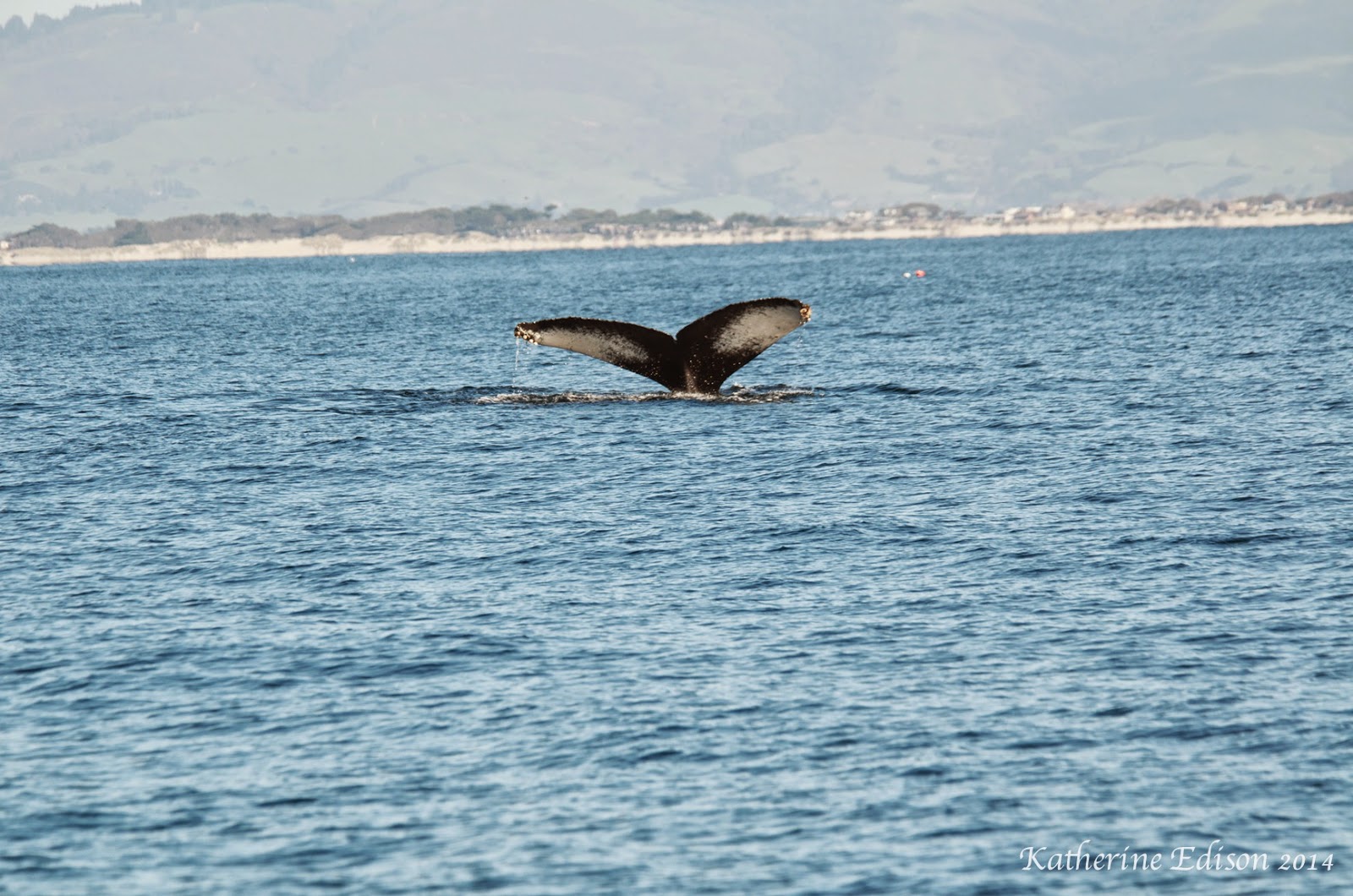
And then came the whales. It was unbelievable. At first we saw distant spouts and sprays, then the the tails. The boat cruised closer and then we saw multiple backs and tails and spouts, all of Humpback whales.  I have no idea how many we saw. It's hard to count them because more than one part can stick out of the water at one time! They are huge, though it is hard to really understand how huge because you can't see the whole whale. According to Wikipedia, adults are from 39-52 feet long and can weigh 75,000 pounds. Humpback Whales come to the Monterrey Bay to feed in the winter and there can be several hundred in the bay at one time. They seemed completely gentle and content and the boat captain turned off the motor so we could just float near them and listen. The sound of a whale breathing is unforgettable. You could sometimes spot a whale by it's spray, and sometimes by the clear circular tracks they left in the water when they came up for a breath. (You can see what I mean from the photo). We never saw a whale jump or breach. We heard that a cruise the day before had seen some amazing acrobatics. But the tails and spouts were enough for me. I felt so lucky for having the opportunity to view these spectacular giants up close, and was very thankful for a powerful telephoto lens.

Whale Spout

Whale Tail

"Circles" in the Water From Surfacing
After a couple of hours of stopping and watching whales in several locations, the cruise wound down and we headed back to the harbor, still floating from the rush of seeing all these magnificent sea mammals. On the way back, we passed seabirds like Pelicans, Western Grebes and Heermann's Gulls and the captain pointed out a beautiful Peregrine Falcon that had taken up residence near the busy waterway. We learned that in the 1970's there were only 5 pairs of Peregrines in all of California, mostly due to DDT poisoning. According to the California Audubon website, protection from the Endangered Species act has brought that number up to 300 breeding sites, and we were looking at one very healthy specimen. Such a hopeful way to end a glorious expedition.

Western Grebe

Heermann's Gull

Peregrine Falcon
Continuing with the theme of the California Giants, a few days later we drove up into the Santa Cruz mountains to Henry Cowell Redwoods State Park to see some Giant Redwoods. The trees are magnificent. They are so tall that I found it very difficult to take a photo with an entire tree in the frame. My smart husband figured out that you could make it work by taking a panoramic photo, spanning slowly from bottom to top. There is a little distortion, but you really get the feeling of the trees towering overhead. The tall trees don't let much light shine down through to the forest floor, so the forest was damp and dark with many varieties of moss, ferns and fungus. The ancient trees--some as many as 1400-1800 years old--muffle surrounding sound and walking among them feels solemn and sacred, as though you are in a chapel or sanctuary.

Giant Redwoods

The park was busy and close to the city so we didn't see much in the way of wildlife, though signs warned us about Mountain Lions. We did find a single, huge yellow Banana Slug on a fence post. The school mascot for UCSC, these day-glo giants can grow as big as 9 inches long! I was happy to see one during our trip out West and bought a Banana Slug Christmas ornament from the gift shop as a memento.

I Wish...

Banana Slug

For our last adventure we drove a very short way up the coast to Davenport and found tidal pools with Anemones and Mussels. No giants that day, unless you count the tall sea cliffs, but we saw West Coast species such as California Ground Squirrels, Black Phoebes, and a first for me--a Say's Phoebe.

Cliffs

Tidal Pool Anemone

Mussels

California Ground Squirrel (There's Another in the rocks Behind This One)

Black Phoebe

Say's Phoebe
After a lovely week together, we wrapped up our family reunion and scattered again to our homes all over the country. I had a wonderful time in California, but I always end a trip wishing I could see and experience more. Santa Cruz is a wonderful place to explore and there is a lot more of California to see. Luckily for me, I have family that will draw me back again. And now that I know I can deal with ocean adventures, maybe we can see some more whales! Condors, anyone?

Friday, April 17, 2015

Santa Cruz, Part 1--How Much Nature Can We Fit into One Week? (A Lot!)

After all the upheaval in the past few months, I feel like things are starting to settle down. I'm getting comfortable with the idea of a big move. In fact, I have to admit that I'm looking forward to it! Things are moving smoothly into place and now I have a little time to think, so I am tidying up loose ends and taking care of things like unposted blogs! So let's take a trip back in time...

At the end of December, my family converged on Santa Cruz, California for a holiday reunion. When we arrived in California, the weather was cool but dry. It had been rainy the week before, but it cleared up while we were there. We were happy that the rain cleared for us because we had outdoor plans. Unfortunately for Californians, who are in the worst drought on record, the rain hasn't returned. One selfish benefit of the rain was that we were allowed more showers and toilet flushes than we had originally expected. Drought is serious business. But we were still stingy with water and practiced the old "if it's yellow, be mellow, if it's brown, flush it down" rule of water conservation and limited showering (probably a little "TMI").

When I awoke the first morning I was still on East Coast time, so I took advantage of being an early riser (a rarity for me) and walked down the street to the Neary Lagoon Park before the rest of the group was ready for our day's excursions. I wrote about visiting this wonderful urban wetland park last January. I just never tire of finding sanctuaries like this in the center of busy cities. Everyone needs a little refuge. I read that this one was visited by a Mountain Lion last fall, so next time I'm in Santa Cruz, I'll keep my eyes open for big paw prints! Neary Lagoon runs right through the middle of Santa Cruz and when I visited it was bustling with birds ready to greet the morning. In the course of a half hour walk along boardwalks, I saw, among other things, a Townsend's Warbler, a Bushtit, a Black and White Warbler, a Western Scrub Jay, Pied Billed Grebes, many Robins and Mallard Ducks, and an Anna's Hummingbird. It was a great welcome back to Santa Cruz!

Townsend's Warbler, right where I left him last year!

Puffy Bushtit

Black and White Warbler

Western Scrub Jay

Robin Redbreast

The Noble Mallard

When everyone was dressed, fed and ready, we headed to Wilder Ranch State Park, just a short drive away. What I really want to do when I visit a new place is check out the wildlife and plants. I haul my backpack full of camera gear everywhere and I want to use it! Luckily for me, my family is interested nature and hiking too, so it didn't take much convincing to get them to go to state parks and take other active outings during our week. My sister-in-law is a huge geocaching enthusiast, so she quickly found that there was one hidden on the trail to the ocean cliffs. And while everyone else was exploring the geocache and signing the log sheet, I was examining the neat pile of innards that was lying on the trail. I don't know what they came from, but I figure some predator tossed them aside, opting instead for yummy flesh. There were no other bits lying around to give hints about what, when or why.

The Geocache

Innards

After a short walk, we reached the cliffs and looked out over the water. The ocean is so big and it always makes me feel so small. The warning sign on the edge reminded us that change here is constant. The fault slips a little here and a little there and the waves pound unceasingly, re-forming the coastal landscape. A few days later when we visited another beach, someone actually fell off of one of the cliffs. We didn't see it and were never able to figure out exactly what happened or if the person survived, but the helicopter, ambulances and emergency teams let us know it was a serious accident.

View from the Trail

It's a Long Way Down

I scanned the horizon for spouts from whales or jumping dolphins. No whales or dolphins (that day!) but I could see hundreds of birds, mostly Cormorants, Seagulls and Brown Pelicans out on the rocks. Nearby there were big, fat Harbor Seals, enjoying the morning sun. Surf Scoters bobbed in the waves and Oystercatchers patrolled the rocks looking for shellfish morsels. On the way back to the car I heard a funny sound and found a pair of Meadowlarks popping up and down in a bush. Our best find of the day was the White Tailed Kite hunting overhead. I had no idea what it was but its fluttering actions seemed familiar somehow. I should have recognized it as a kite, but I just wasn't thinking that way. I thought at first it was a gull, but my mom kept insisting that it was some sort of raptor. She was so right! Proof, once again, that you should always listen to your mother.

Mostly Cormorants

Brown Pelicans

Seals and Gulls

It's a Rough Life--Harbor Seals Sunning
White Tailed Kite

Pop Go the Meadowlarks!

When my parents moved to Santa Cruz, I was surprised to learn that there was a major Monarch Wintering spot right down the road from their house. I had thought (incorrectly) that the Monarchs all wintered in Mexico. Over the years I have learned that there are several populations of Monarchs (even some in Florida) and the ones that live West of the Rockies overwinter in the Eucalyptus trees of coastal California. The Monarch Watch website says that the California Monarchs make up over 5% of the world population, so these are important sites. In boom years, Natural Bridges State Beach in Santa Cruz has had as many as 100,000 Monarchs sheltering there. So, one day we took a trip to Natural Bridges because we heard that there were still some butterflies clustered in the trees. Sadly, the numbers were very low this winter. Drought, deforestation, lack of habitat and many other factors contributed to the low numbers (I read that the local Steller's Jays have developed a taste for them). I saw the one cluster in the park and it was still breathtaking. But we were told that we were seeing only a fraction of what would normally be roosting there. Numbers in the park were up to 7500 after being even lower in years past. I can't imagine what the world will be like if we lose these wonders.

Wintering Monarchs
Next up, part 2--Giants...


Saturday, February 1, 2014

Coast to Coast

We flew from coast to coast recently, from Jacksonville, Florida to Santa Cruz, California. And what a difference a continent makes! But it's not an "in your face" difference. It's gradual. Whether you drive or fly, you have time to get used to the blending of one area to the next, and then there you are. Other than on maps and at official borders there is no real indication that you've suddenly crossed into new territory. It's all relative. If you look at things on the microscopic level, the change from one square foot to the next can be startling. Or from city to city or state to state, or continent to continent. But if you look from a distance, say outer space, you can see how small and similar everything is. The oceans are all connected when it comes down to it. But you get off the plane in California and you know that you're not in Florida anymore.

Usually the difference when we travel is that we're going from subtropics to everywhere else. We're usually coming from a warm and humid place. But this time, when we left Florida, it was just starting to warm up from the Polar Vortex. The rest of the country was still freezing, but not California. As we flew across the middle of the country, the ground was covered with snow and every body of water was frozen into shining ice, glistening in the muted winter sun. After a few hours the terrain turned rougher and whiter as we approached and crossed the Rockies. And then as we eased over Nevada and the Sierras, there was less snow, brown earth, and the mountains were more rounded as they eased towards the ocean. We could definitely see the result of the severe drought in the West. In California, the January weather was reaching into the balmy 70s and 80s by afternoon, in contrast to the frozen middle and east.
Sunrise
The first morning, I woke up at 3:30, as one tends to do when jet lag hits. I tossed and turned, trying to sleep until sunrise, but finally couldn't stand it any more. Even though it was 7am and dark still, my brain said it was 10am and I had to get outside. So I watched the sunrise and went exploring at a Water Reclamation Park (Neary Lagoon) that was a few blocks from where we were staying. It was quite nice, with a couple of miles of paths and boardwalks winding through wetlands. Most of what I saw walking around felt very familiar, with the usual freshwater marsh and pond denizens. Some animals and plants are more ubiquitous. Ducks and coots, grebes and blackbirds were happily enjoying the sunrise as they would in Florida. California flora and fauna, I saw, is in many ways very similar to Florida. Yes, they have Redwoods and Eucalyptus, but both coasts have palm trees and pine trees, citrus and flowering shrubs. But then the little birds showed up and confounded me. They looked vaguely familiar, but to identify them I had to look in my field guild--Dark Eyed Juncos, California Towhees, Black Phoebes, Anna's Hummingbirds. Close to what I know, but so different!
Good Old Familiar Coot

Townsend's Warbler

Dark Eyed Junco

Black Phoebe

California Towhee
The next day we walked along the coastal cliffs, and here is one of the biggest differences between N. California and Florida. The peninsula of Florida is essentially a big sandbar, rising up out of the ocean. Millions of years ago when seas were higher, Florida was ancient sea bed. People can find great fossilized shark's teeth in creeks and river beds all over the state because of this. During the ice age, thousands of years ago, sea levels were lower and Florida was twice as big because more land was exposed. Seashores slope gradually into the sea. Florida is flat! Northern California is high and mountainous with coastal ranges that drop off right into the ocean, the cliffs jutting out over the sea. Parts of the coast are on the edge of the San Andreas Fault. When the plates shift and adjust, earthquakes result and the edges push up just a little higher. Wave action further erodes the cliffs. The shores are rocky, and the water is cold and rough. One website I consulted described the Florida coastline as "a coastline of submergence" and the N. California coast as "a coastline of emergence". The cliffs seem to pop right out of the sea.
The Coast at Big Sur
Looking out over the cliffs you can see the huge waves that attract surfers and dolphins. The height gives you a vantage point from which to see whales, sea lions and seals. We happened to be there during the Gray Whale migration and saw many spouts and tails. That was a thrill of a lifetime! These mammals are so immense, and yet they look so tiny out there on the vast ocean. The cold deep water of the Monterey Bay is home to the great kelp forests. The ocean in California smells different than the ocean in Florida. It's the smell of the kelp. You can see the tops of the kelp beds from the cliffs, and in them you're likely to see Sea Otters floating on their backs, anchored to the kelp with one foot, cracking clams and crabs on their bellies with rocks. Opportunistic Seagulls wait and steal from the otters when they can. Egrets appear to be walking on water when they stand on the kelp and hunt.
Gray Whale Spouts and Fluke

Sea Otter and Opportunistic Seagull
You don't get the full effect of the kelp forest unless you see it from below. The best place to do this (without scuba diving) is to visit the Monterey Bay Aquarium. They have created a kelp forest in a huge tank in the aquarium where you can see the amazing diversity of the Bay. All of the ocean life that they display is brought in right from the Bay, with occasional exhibits of exotic jellyfish and tropical fish. It's the best aquarium I've visited. I can spend hours watching the kelp forest swaying with the waves, with the Sea turtles, Sharks and schools of Tuna. Their permanent jellyfish exhibit is incredible. And I can never get enough of the Anchovy tank! They're located right on the Bay, so during lunch or after your visit at the Aquarium you can step outside and watch the wildlife right on the water. During our visit we saw Pelagic Cormorants gathering seaweed to build nests on the piers of the Aquarium, Monk Seals and lots of Sea Otters.
Kelp Forest

Nettle Jellies

Swimming Anchovies

Pelagic Cormorant with Nest Materials
Another day we took a trip to Año Nuevo State Park to see the Elephant Seals. This was a really special place, located between Santa Cruz and Half Moon Bay on a coastal highway. We took a 2 hour tour on boardwalks over the dunes. Access to the Elephant Seals is restricted, both for their safety and for the safety of visitors. Our docent guide led us to carefully, knowing that the giant Elephant Seals might move around a lot and could be anywhere on the trail. At one point he walked ahead of us and stopped. Then he told us that he had crossed the San Andreas Fault and if an earthquake happened, he'd drop into the sea and we'd be on our own. Little joke. The Elephant Seals are enormous (14-16 feet long and weighing over 2 tons) and they come to this beach to give birth and to mate. They get their name from the flappy trunk-like proboscis found on the mature males. We were told that the proboscis helps the males project sound to assert their territory. The females give birth in December. They find a good place on a safe, high beach that won't flood with the tide, because the pups won't be able to swim for the first month while they nurse and grow. The mother will need to stay with it to keep it warm, protect and feed it. We didn't actually see any being born, but we saw many, many pups. The pups are born with lots of baggy skin to accommodate the quick growth that will be necessary for them to live independently, swimming great distance and keeping warm in the cold ocean water. They grow from 75 pounds at birth to up to 350 pounds in ONE MONTH! Their mother's milk is 55% fat. After the pups are weaned, they are on their own! The males will mate with the females about a month after they give birth. The males fight among themselves to determine dominance and the right to mate. They are pretty aggressive! After mating, the fertilized egg takes a few months to implant, giving the female a chance to build her strength again at sea before beginning gestation, and to be back onshore again to give birth a year later. Our guide told us that the Elephant Seals don't defecate or urinate while they are onshore because they don't eat while they are there. They only feed at extreme depths (2000-5000 feet) when they are far out to sea. They spend most of their lives in the ocean, coming to land only for short periods to mate and give birth. Strange and amazing animals.

Our Docent Guide

Young Male Elephant Seals Dozing

Mother and Wrinkly Pup--They Grow Fast and Change Color in a Month
She's Not That into Him--There Was Another Dominant Male Nearby and This Guy Didn't Stay Around Long
Mothers and Pups Keeping Cool with Sand in the Hot Sun--Note the Transmitters on this female.


We saw 3 species of pinnipeds in California--Elephant Seals, Monk Seals and Sea Lions. Florida has no seals, as the last Caribbean Monk Seals were hunted to extinction. Florida has manatees, which California does not--too cold. California also does not have alligators, and I have to admit that it was nice to walk through the Neary Lagoon and not wonder if an alligator would be sunning itself on a bank. They have snakes, coyotes, mountain lions and foxes, although I didn't see any. I did find the mummified remains of a raccoon on the cliff rocks.
Mummified Raccoon
A trip out on the Santa Cruz Wharf gave me my first view of Western Grebes, which are stunning birds with long necks, red eyes and sharp bills. I also saw a Murrelet, some Whimbrels, Surf Scoters and a big cluster of hungry Sea Lions.
Western Grebe

Surf Scoters--They All Dive and Reappear in Unison

Whimbrels

Sea Lions at the Wharf

I have no idea what this bird is. It was pretty, though. A kind reader has ID'd this as a Female Brewer's Blackbird!
Our trip was very short, only a couple of days, and one of the things I wanted to do was go visit Natural Bridges State Beach on the Santa Cruz Bay. We were almost there but ran out of time. Monarch Butterflies come there to overwinter, like they do in Mexico, though in much smaller numbers. I saw numerous Monarchs flying around Santa Cruz, enjoying the nice warm weather. Another thing we missed was the tide pools along the rocks. They are a lot of fun and I don't know of a place in Florida that has anything like them. Next visit to California I will have a lot more exploring to do.