When we planned our trip to Argentina we knew that we were going to take a couple of weeks to travel after my husband taught his class for a month. We didn't know where we wanted to go exactly, but we knew that we wanted to see Iguazu Falls and Patagonia. And I wanted to see penguins. Well, it turns out that this is a pretty tall order. Argentina is a huge country and what we wanted to do was the equivalent of visiting the U.S for 2 weeks and seeing Niagara Falls, as well as the entire West. There is a lot to Patagonia. Our friends in Buenos Aires seemed a little surprised that we wanted to undertake so much in just 2 weeks. But after consulting with everyone we could (my husband likes to get advice), we finally figured out our itinerary. We would fly to Iguazu falls for 3 days, then fly back to Buenos Aires, and from there fly to Patagonia where we would visit Bariloche for 3 days, El Califate for 2 days and Ushuaia for 3 days with some travel days in between. Then back to Buenos Aires and home to Florida. A whirlwind trip, and miraculously, it all worked out perfectly. But I'm getting ahead of myself.
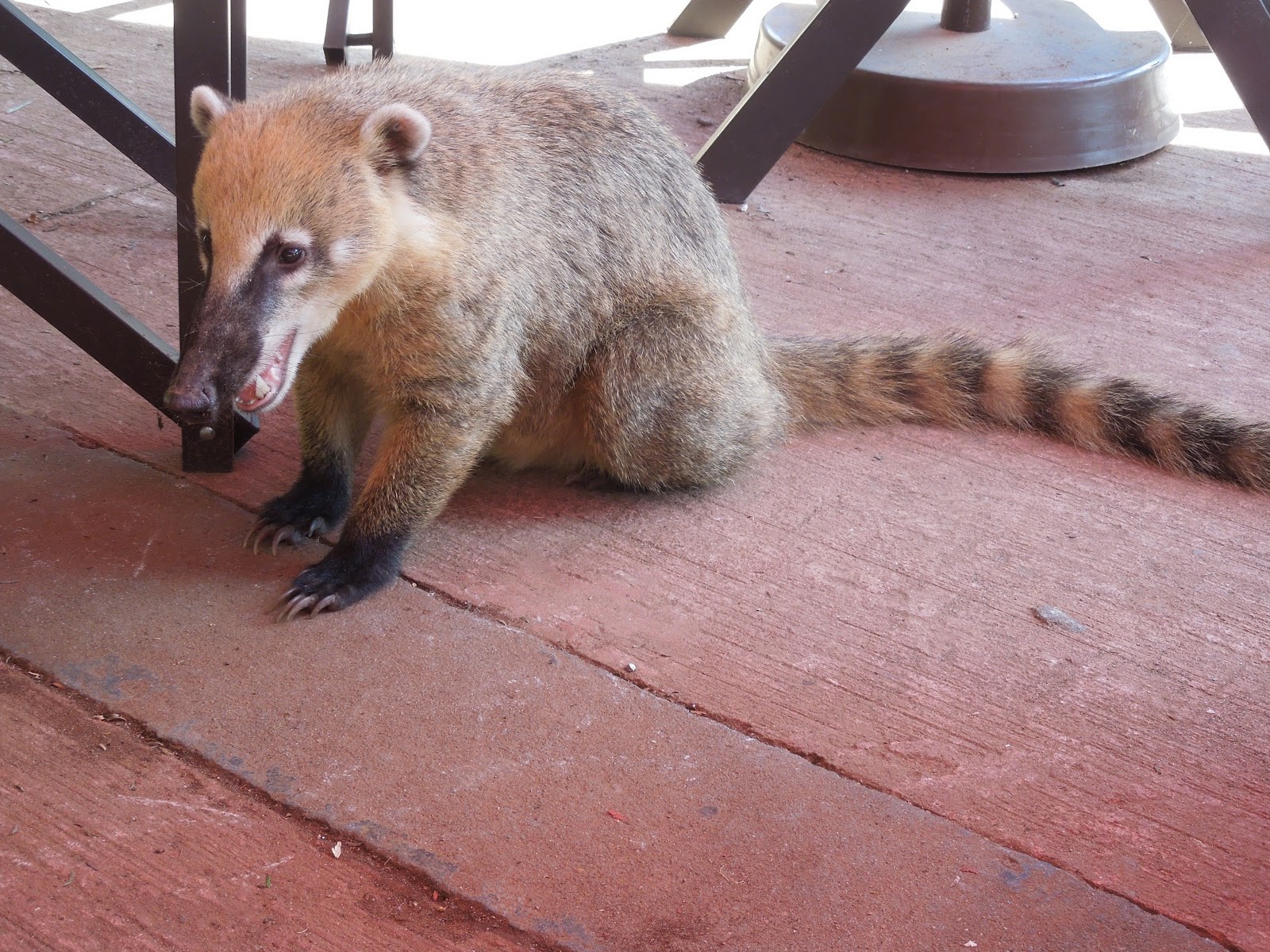
After our magical visit to Iguazu Falls with the butterflies and coatis, we flew back to Buenos Aires to start the Patagonian leg of the trip. It was quite warm up at the falls (in the 90's and humid) and we were looking forward to cooling down again. But as we talked with our fellow travelers, we started to get a bit worried that we hadn't packed well for summer temperatures in Patagonia. We heard all sorts of temperature ranges, from 50's and 60's down to tens and twenties. One Australian woman told us she had to wear all of her pants to keep warm in Ushuaia. As it turned out, we packed just about right. (We now think the Australian lady was probably just wimpy.) It was cool, in the 50's when we arrived in Bariloche. We could see the Andes in the distance as we flew in for a landing. We found a cab and marveled at the amazing change of scenery we had experienced in the course of one day. We had woken up in the hot and humid rain forest and were going to sleep in cold Patagonia. The first part of the half hour trip from the airport was through arid and flat land, with hills in the distance. Our cab driver told us all about the area in Spanish, so we didn't understand everything he was trying to explain about the area. Our Spanish was much better by now, but still sketchy. I'm pretty sure he said something about microclimates.
 |
| View from Cab |
We really had no idea what to expect, but everyone in Buenos Aires told us we had to go to Bariloche so we did. I searched about it online and still didn't have a good understanding of what the main draw would be. It turns out that the draw is the breathtaking beauty of the region. As we got closer to Bariloche and the lake and mountains, the landscape took on different contour and color, with blazes of beautiful yellow flowering shrubs and purple lupines lining the roads. Bariloche is a small city on the shores of lake Nahuel Huapi. The entire region is contained within the boundaries of the Naheul Huapi National Park. The city is built on the hillside overlooking the lake. Apparently there were a lot of German and Swiss immigrants in the early days, and the architecture has a distinctly alpine feel. Swiss chalets. And lots of chocolate shops. The water of the lake is an incredible blue. People told us that the water was so clean you could drink it right out of the lake. I didn't trust them enough to try, though it was very pretty.
 |
| Downtown Bariloche |
 |
| Crystal Clear Water |
Later that evening, from our hotel dining room on the hill overlooking the lake, we could see nesting harriers hopping between the treetops, and past the trees, we saw the vast lake and then the Andes. It was a gorgeous place. We were starting to understand what people love so much about Bariloche. That night, the cool started to set in, but we had a heated floor and a jacuzzi in our cozy room!
 |
| View across the lake |
The next day we signed up for an organized tour that would take us on a catamaran ride to Bosque de Arrayanes and then to Isla Victoria. The first part of the boat ride took about an hour and a half. The views of the mountains and the water were spectacular. To keep the passengers entertained, the ship's staff had crackers that you were supposed to hold high in the air. They would take your picture as a gull grabbed the cracker. I had my own camera, and didn't think much of stuffing the gulls with junk food, or losing a finger, so I just took my own shots.
 |
| Seagulls Chase the Boat |
At Bosque de Arrayanes (The Myrtle Forest), we stopped for about 45 minutes and hiked along a boardwalk through an interesting Myrtle Forest. The forest is a preserve for this endangered ecosystem and is apparently one of the largest forests of these myrtle trees. The bark of the trees is a very striking golden color and it was beautiful as we walked through.
 |
| Myrtle Forest |
Almost more interesting to me, however, were the Beech Trees that we were to see all along our travels through Patagonia. The most peculiar thing about the trees were the galls. These trees had galls growing all over them and lying all over the ground. They were fascinating and looked like weird honeycombed fruits. I had to come home to my computer to figure out what they were though. Nothofagus dombeyi, or "Coihue', in Spanish. There was little information about them in the places we visited. And there is precious little info about them on the internet, either, except to say that they are the
"missing link" for the history of lager beer.
 |
| Beech Gall |
On Isla Victoria (Victoria Island) we hiked with a group of friends we made on the boat ride. Apparently we were the only passengers interested in actually hiking, so one of the guides suggested a trail for us, with the warning that we had to be back on time, or else. The rest of the passengers walked around a bit and had their photos taken at the "Bambi House". Rumor had it that Walt Disney visited the island, saw the cabin, and was somehow inspired to draw a house for Bambi. But we were also told that the rumor was not true, that Disney didn't visit the island, and that anyway, Bambi doesn't live in a house. So why everyone but the 5 of us stayed behind to get their pictures taken there is beyond me, but, oh well. In any case, we headed off on the hike only to find that the trail was closed. But being adventurers (or at least everyone else in my group was), we crossed the barrier and hiked anyway. It turned out to be fine and we had terrific views of the lake from a nice overlook. We came upon big bunches of the gorgeous yellow bushes we'd seen on the taxi ride into Bariloche, along with the lupines and several other beautiful flowers. We really picked a fabulous time to visit Bariloche. I will always think flowers when I think Bariloche.
 |
| Flowering Bushes |
 |
| Lovely Yellow Flowers |
 |
| View of Lago Nahuel Huapi from Isla Victoria |
The next day we skipped the organized tours and rented a car, which gave us the freedom to stop wherever we wanted. Equipped with our map, we headed out of Bariloche into the arid landscape that reminded us very much of central Utah.
 |
| Just outside of Bariloche |
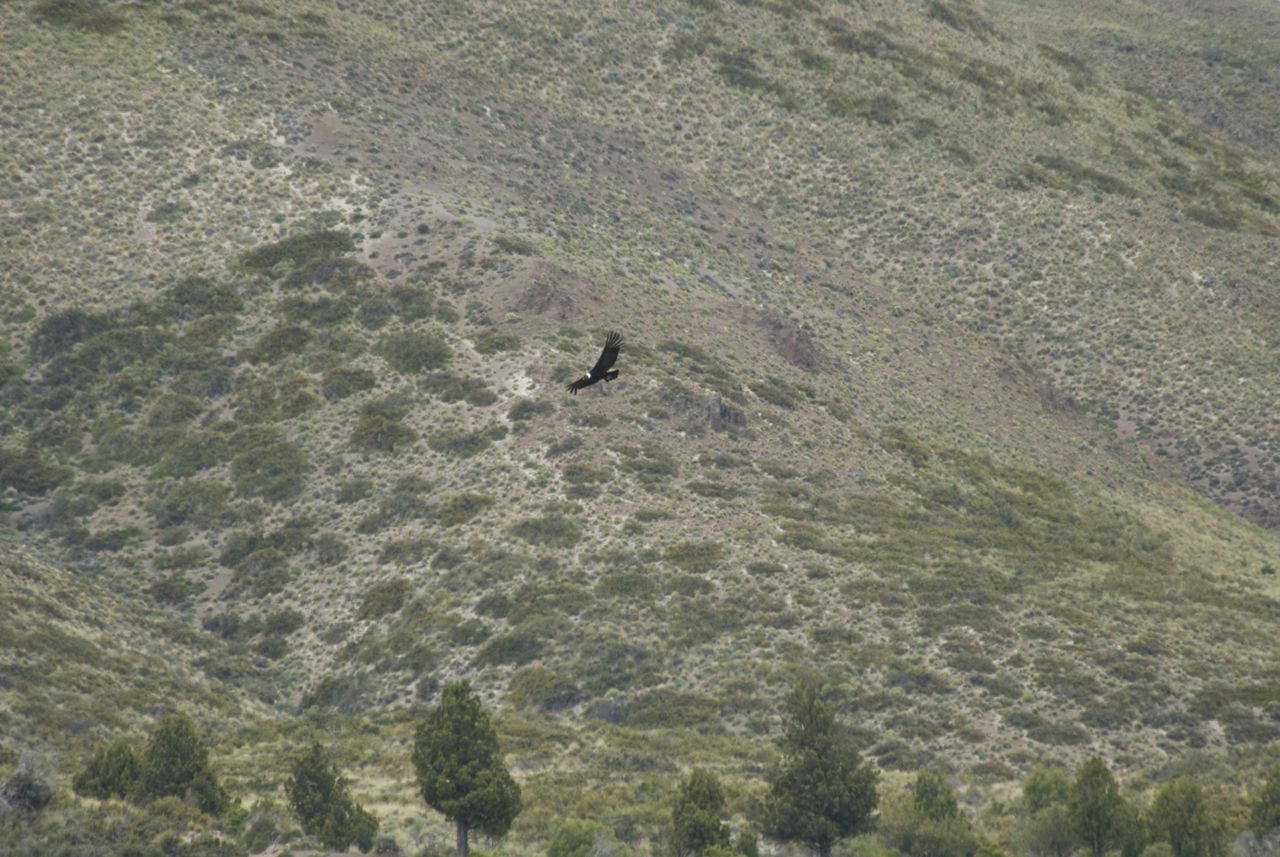
20 miles out of town we turned onto the dirt highway that our hotel guide had marked for us, and we hardly saw another soul for the rest of the day. It was great. We decided to follow a little road to a place that the map designated as a birding site. We started to worry a bit when we came to the decrepit and closed bridge, but decided to take the detour through the creek (in our little rental car) and headed out slowly. Hawks and woodpeckers flushed out of the grasses and horses grazed in the road. It was a good choice. Soon we came to a small village, and then to the end of the village and of the road. No bird sanctuary. But there was an old Gaucho gentleman working in his yard. We stopped and asked as well as we could in Spanish if this was the place to look for birds. He didn't seem to know what we were talking about, but said that we should walk along the river to see more. We asked if we could just park our car and walk on his land and we think he said it was fine. He didn't holler at us or anything. So we took his photo in thanks and walked off to look for birds. The trail was non existent and it was hard to know exactly what we were looking for, but suddenly we looked up and saw a soaring bird. It was an Andean Condor. Perfect!
 |
| Gaucho |
 |
| Andean Condor |
After that we decided we'd had enough off road adventure and went back to the car to continue our journey. Later along the way we found a place to hike. I was reluctant because the signs all said you had to register before your trek. But we weren't really trekking--just taking a little hike.
 |
| Hiking Trail |
So we hiked through the forest and up to a nice lookout. This is where I'm fairly certain we saw a pair of Megallanic Woodpeckers. But they wouldn't stay still and I never got a photo. For this reason alone, I need to go back to Bariloche. They are magnificent birds. I did get photos of a Chilean Flicker, though, as well as of hawks and geese and a Southern Crested Caracara strutting along the beach later in the day.
 |
| Chilean Flicker |
 |
| Ashy-Headed Goose |
 |
| Southern Crested-Caracara |
On our way home that afternoon we stopped at a road construction site and reveled in the astonishing beauty of fields of lupines. The colors were almost overwhelming.
 |
| Field of Lupines |
For our last day in Bariloche we drove to the Monte Tronador area in the Nahuel Huapi National Park to look for some day hikes. The trick was that this section of the park has a one way road. You can drive in, but can't drive out until 4pm. It started out fine. We stopped for pictures along the scenic lower part of the lake.
 |
| View from the Bridge |
Then we made our way to what appeared to be the main park offices and trailhead, but we had a very difficult time figuring out where to go. The signs were very confusing there didn't seem to be any office or person who could tell us where the trails were. And then it started to rain. It was cold and wet and we began to despair, realizing that we'd have to wait in our car or at the restaurant for hours until 4pm came around.
 |
| Nothing was actually open except the restaurant |
But eventually we found a ranger. At first, he told us that it was too cold and wet to take any hikes. But I guess we looked so disappointed that he suggested a 3 hour hike to an overlook, Mirador del Valle. As soon as there was a break in the rain, we took off. It was an interesting path, winding up a fairly steep slope, through bamboo groves and beech trees. We passed a herd of cows at the beginning of the trail, freely roaming through the park. We had to watch out for cow piles for the first half of the hike, until we started climbing steps and walking on bridges, where we left the cows behind.
 |
| Wet Forest Cows |
 |
| Hiking through the Bamboo |
The climb through the forest was beautiful. The trees were so tall! We heard tiny birds but saw little wildlife, except for a rabbit. Later we learned that the rabbits were invasive exotics. There were little yellow violets along the path and occasional blueberry-like bushes. When we finally reached the end of the trail, we were tired but happy. And the views were marvelous. We had hoped to be able to see a glacier from the top, but the clouds were pretty thick. We did see waterfalls across the valley that we figured were glacier fed.
 |
| View from the Top with Waterfalls |
There was a cooperative hawk who posed for me from the branch of a dead tree, and a caracara. And we saw a pair of condors soaring over the valley. At the end of the day as we drove back to Bariloche, we could just make out the craggy tops of the Andes peaking from behind the clouds.
 |
| Unidentified Hawk |
 |
| Chimango Caracara |
 |
| Andes Peeking Through the Clouds |
Click
here to see more of my photos from Bariloche.