Showing posts with label Armadillo. Show all posts

Sunday, May 14, 2017

Motherly Musings

Sandhill Crane Family

The older I get, the more I appreciate moms. And being the product of a long line of mothers (as most of us are), as well as being a mother myself, I think I am in a position to have something to say about the topic.

There are all sorts of ways to mother, ranging from simply depositing eggs and moving on, to full on over-involvement and smothering. I hope my kids see my own personal mothering style as falling somewhere to the "more involved" side, but just short of driving them crazy. There are moms who do everything alone and those who have a nurturing partner, or a posse of friends and family to share in the important task of raising young. There are moms who just aren't up to the job, but there are also those who step into the role of being a mom, even though the children are not their own offspring. There are good moms and bad moms and everything in between. In nature it is less a matter of good or bad mothering, but rather adaptations and strategies for successfully passing on one's genes. In some species, quick development or mass quantities of eggs may lead to success, while in others, shared parenting or lengthy maturation and nurturing may be necessary. Humans fall into the lengthy nurturing and shared parenting category. But no matter what kind of mother, it is a tough job. It takes smarts, strength, tenacity and nerve. Motherhood is not for wimps.

It all begins in much the same way, with an encounter: a coupling, maybe just a moment of passion, or possibly a beautiful relationship.

Mating Red Shouldered Hawks

Mating Ladybugs

Then comes the urgent matter of preparing a safe place for that next generation. Butterflies search hard for the perfect host plant on which to lay their eggs. The hatching caterpillars will eat the plant they are placed upon, and as they grow they become targets for predators. The plant itself may provide a chemical defense for the caterpillar, as in the case of a Pipevine Swallowtail or a Monarch Butterfly. The mother butterfly needs to pick wisely because after she lays the eggs, her work is done.

Gulf Fritillary Eggs and Caterpillars on Passion Vine

Likewise, with toads and frogs, many of whom lay their eggs after lots of singing and fanfare, but hop away after the deed is done. With luck, the puddle doesn't dry up or the eggs aren't eaten before they hatch. It's a risky business, which is why they lay so many.

Southern Toad Eggs Strands in a Pond

Some ray and shark embryos are encased in hard egg sacs called "Mermaid's Purses" that they lay and leave on the ocean floor. The young animal hatches from the egg and the empty "purses" sometimes float on the waves to the shore, like the one pictured below. The Common Octopus, on the other hand, lays clusters of eggs (200-500,000) in her lair and stays with them, fluttering moving water over the eggs to keep them oxygenated and safe while they grow. She doesn't leave them, even to eat, and may consume some of her own arms while she waits. When the eggs hatch, the mother octopus dies soon after from exhaustion and starvation.

Mermaid Purse

Woodpeckers and other cavity builders like Nuthatches scope out the right tree and then spend hours excavating and spewing out sawdust with only their bills as tools. Gnatcatchers and Hummingbirds construct nests made of lichen and spider silk, while Boat Tailed Grackles hide their grass and stick nests in shrubs and Gentoo Penguins make rock nests on the ground, with the Skuas watching nearby. In these cases, both parents work together to build the nest and care for the hatched chicks.

Nuthatch Excavating a Nest. Note dust plume to the left.

Pileated Woodpecker pitches out the debris from a nest cavity

Gentoo Penguin Nest Colony, with some chicks hatched already

Boat-tailed Grackle Sits on Nest

Blue-grey Gnatcatcher sits on nest constructed of lichen and spider webs

And then the waiting begins. Sitting and warming and guarding the eggs. Or in the case of Alligators, letting the heat from the decomposing grass nest warm the eggs while the mama watches nearby. Animals that give live birth must eat for two or three or more as the young inside them grow larger and larger, kicking and squashing bladders, changing their mother's body with the chemistry of hormones and the impact of sheer volume. Being pregnant is uncomfortable.

Blue-footed Booby nesting on the ground. It is sitting on one egg while guarding a hatched chick.

Sometimes careful tending and watching is in all vain and the eggs or young are taken as food for another creature. Birth itself is perilous and painful, sometimes taking the life of either mother or baby. The newborn babies are so small and vulnerable. I am not sure if spiders or frogs notice or care if their young are eaten. But birds are noticeably disturbed when a chick is taken or dies, and mammals like dogs and elephants will mourn and become depressed at the loss of a baby.

Yellow Rat Snake has cleaned out a woodpecker nest (count the eggs)

Mother Sea Lion mourns newborn dead pup.
Tiny Opossum Baby fell off the mother and didn't survive, despite our efforts.

Result of a raid on a nest

Skua and Chick near the Gentoo Penguin colony. Skuas eat penguin chicks.

Despite the best efforts of the watchful parents, Otters ate most of these Black Swan chicks.

Successful hatching and birthing brings about the next challenge of keeping the baby fed and safe until it is ready leave the nest. Those tiny hatchling octopuses and toads will have to make it on their own. But birds and mammals rely on parents, sometimes both mother and father. According to one article I read, Chickadees need over 9000 caterpillars to raise a batch of chicks, so two parents and abundant caterpillars come in handy.

Hungry Swallows see Mama

Nursing takes calories and mama mammals, such as Monkeys, Manatees, Maras constantly search for food. Try eating enough to nurse a baby Rhino! Or an elephant!

Nursing Monkey

Mama Manatee

Mara Family at the Bueno Aires Zoo

Baby and Mama Rhino at the Berlin Zoo

Parents guide the youngsters as they learn to forage for themselves, watching carefully and warning them when danger is nearby. Beware a protective mother bear or alligator!

Mama Bear and Cub in Desolation Canyon, Utah. We had to be very careful not to leave food in the camp because the bears were hungry and knew that people had food in camps.

Turkey Family teaching chicks to forage

Watchful Mama Gator

And then the youngsters try life out on their own. Sometimes they take missteps and have close calls. Often they have protection from a herd or from helpful people. But eventually they are really ready to spread their wings and be independent.

Robin Fledgling

Twin Armadillo babies whose mother had been hit by a car. They were in the care of a wildlife rescue organization.

Wild Horse herd stands guard around newborn

Baby White-breasted Nuthatch I rescued from my curious dogs. It flew away later.

Baby Black Racer sunning on the sidewalk and shooed away from pedestrians.

Baby Snapping Turtle on the trail. I moved it out of harms way but couldn't tell if it was injured, sick or just small and tired and lost.

Speaking as a mother, I find this whole business of raising children to be at the same time very hard, scary, wonderful and rewarding. I adore my daughters and am in awe of the capable and fabulous adults they have become. I don't know if other creatures feel the same after their young have left the nest--whether or not they have longing memories of snuggling sweet smelling babies or spend long nights worrying about them when the going gets tough. I do know that there is a strong instinct to protect our young, to ensure the success of the next generation. Though my daughters are grown, I still feel protective, worrying when they are sick, stressed or sad. I continue to have great hopes for their futures. I imagine that I will feel the same way for the rest of my life, as I imagine my mother feels for me, and her mother before her. Like I said, I come from a long line of mothers, and for that, I am very thankful.

Newly emerged Black Swallowtail, getting ready for its first flight


Saturday, July 16, 2016

Sanity

Tiger Swallowtail on Lantana
I spent the entire day inside yesterday, painting our kitchen. (It looks great, by the way.) I had the radio on all day and by the afternoon I reached a point where I just had to turn it off. My brain and heart are exhausted after the events of the last few weeks. The Orlando night club massacre, the car bombs in Baghdad, police shootings, the 5 murdered police officers in Dallas, and the constant heated rhetoric of our upcoming presidential elections. The attack in Nice this week was the last straw for me. I just can't take it any more. I think this is hitting me hard because my husband and I were just in Nice a month ago and I still have the vacation images from that beautiful, happy place fresh in my mind. But the pain and hate and negativity are just starting to overshadow everything and I can feel myself losing spirit. So I took action today and got my butt outside to take photos. I know it always helps me feel better, which is something I always forget until I'm doing it.

Silver Spotted Skipper on Lantana

I decided to go to the State Botanical Gardens to look for butterflies. They have a lot of Lantana and Zinnias, butterfly favorites, so my chances were good.  Stepping out of the car I caught a low flying Mississippi Kite out of the corner of my eye as it whizzed over the parking lot. I followed it out into the gardens and forgot everything but the pursuit of nature.

Widow Skimmer Dragonfly

The first thing I found was a tiny, juvenile Black Racer on some stepping stones in the grass. I was afraid it was dead because it didn't move away when I came in close. But when I touched it with my shoe it reared up, shook its tail like a rattlesnake, and struck at my toe. Not dead! I took a bunch of photos and pointed it out to several other visitors, including a little boy who wanted to keep it and bridal party having a photo shoot. The snake was probably happy to get away from all the attention.

Juvenile Black Racer, Maybe 8 Inches Long

Next up was a pair of armadillos, digging without care right next to the wedding photos. The wedding photographer called me over this time. The armadillos were not at all afraid of people and I was able to get pretty close for some good shell shots. I pointed them out to some visitors who had never seen an armadillo before. They are the weirdest animals, and they cause so much damage. I feel bad for the landscape crew, but I love watching them. 

Armadillos Ignoring me

I followed the call of a bird that turned out to be an Indigo Bunting, way up in an oak tree. The call led me down a path lined with tall red Swamp Hibiscus flowers. I got in the way of some bumble bees on a mission for nectar and was buzzed several times. Movement in the leaves turned out to be a baby Carolina Wren, whose parent zoomed in and scolded it away from me. Ahead a little further, a Blue-gray Gnatcatcher picked bugs off of the Magnolia leaves. 

Scarlet Rose Mallow (Hibiscus coccineus)
Blue-gray Gnatcatcher in the Magnolia

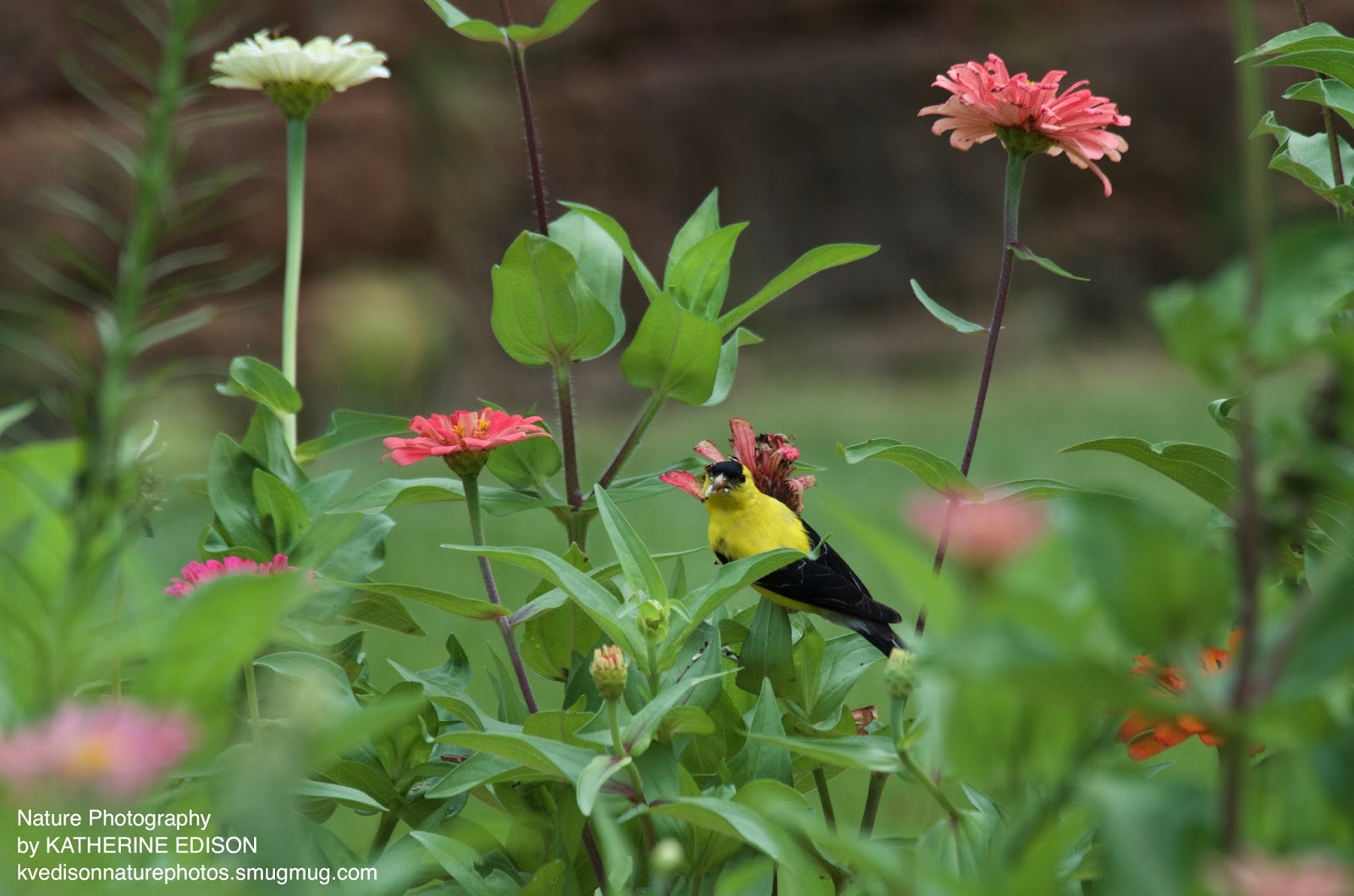
A flash of yellow drew my attention to a Zinnia patch where I saw a pair of Goldfinches picking seeds from the spent flowers. Swallowtail butterflies wafted around, trying to elbow their way in to sip nectar. A little skink on the sidewalk watched for grasshoppers.

Goldfinch in the Zinnias

Giant Swallowtail on a Zinnia

Five-line Skink Looking for Bugs

It was hot and humid with storm clouds building in the west. Sweat poured down my face and into my eyes, temporarily blinding me with sunscreen. As I looked for a place to sit and wipe my eyes, I noticed a huge bed of Hyssop flowers, almost moving with the buzzing of bees, flies, wasps, butterflies and moths. My eyes stopped stinging and I shot photo after photo. If you want a good plant to attract pollinators, try Hyssop. Wow!

American Lady and Ailanthus Webworm Moth on Hyssop

Buckeye on Hyssop

Gray Hairstreak on Hyssop

Juniper Hairstreak on Hyssop

More conversations with other visitors about what I was doing with my head in the Hyssop patch. Then the thunder moved closer and louder and I packed up and went home. The familiar call of a Mississippi Kite made me look up and I saw a pair soaring overhead, too far away for photos.

Silvery Checkerspot

Driving home I felt like I'd been to a retreat. I hadn't thought about anything but what was in front of me for the whole morning. I felt refreshed and rested and reminded of the beautiful world around me. And of the basic kindness and friendliness of the people around me. I just needed a realignment. And to turn off the news and get outside. Always a good idea.

Fiery Skipper on Periwinkle


Tuesday, April 22, 2014

Aprill Shoures

"If April Showers bring May Flowers, What do Mayflowers bring? Pilgrims!"

Ha ha! That's always been one of my favorites!

I have mentioned before that I was an English major in college. I was interested particularly in the history of English and medieval studies--the Anglo Saxons and the Vikings. Don't ask my why--it just seemed cool. One of the courses I took along the way was a semester-long reading of The Canterbury Tales in Middle English. My course was taught by a fabulous professor, Donald Rowe. He was gruff, demanding and could be intimidating. But I adored him. He was an expert in Middle English Literature. And when he talked about Chaucer, it was wonderful! That course was a memorable experience for me and I was disappointed when we reached the end of the book and the end of the semester. One of Professor Rowe's requirements for the class was that we had to memorize the first 18 lines of the Canterbury Tales and recite them for him in his office. We were graded on memorization as well as pronunciation, so we were expected to listen to tapes and practice. (I was amazed to find this version on youtube--what don't they have there? The phonetic translation is a little off, but the accent sounds just about like I remember.) I was proud that he complimented me on my pronunciation, though this was the first and only time that anyone said I had a good Middle English accent. He joked to the class and said that we might not remember anything else from his course, but 10 years in the future, we'd still be able to recite those first 18 lines. Well, it's been more like 20 years for me, and I can still do it. And, in fact, when April rolls around each year, those lines weave in and out of my consciousness as I recall elements of the poetry. This April is nearly over, and seeing that it is Earth Day today, I feel that I need to honor the insistent memory of April, the Canterbury Tales, and Professor Rowe.

(These lines are from my textbook, edited, translated and annotated by Robert A. Pratt)

Here bygynneth the
      book of the 
tales of Canterbury

Whan that Aprill with his shores soote                      soote: sweet
The droghte of March hath perced to the roote,
And bathed every veyne in switch licour                  veyne: vein, sap vessel. switch: such. licour: sap
Of which vertu engendered is the flour;
Whan Zephirus eek with his sweete breeth               Zephirus: the west wind. eek: also
Inspired hath in every holt and heeth                        inspired: breathed on , quickened. holt: wood
The tendre croppes, and the yonge sonne                 croppes: shoots
Hath in the Ram his half cours yronne,                     yronne: run
And smale foweles maken melodye,                        foweles: birds (pronounced "fools")
That slepen al the nyght with open eye
(So priketh hem Nature in hir corages);                    priketh: spurs. hir:their. corages:hearts 
Than longen folk to goon on pilgrimages,                goon: go
And palmeres for to seken straunge strondes           straunge: foreign. strondes: shores
To ferne halwes, kowthe in sondry londes;              ferne: distant. halwes: shrines. kowthe: known
And specially from every shires ende
Of Engelond to Canterbury they wend,
The hooly blissful martir for to seke,
That hem hath holpen when that they were seeke.   hem: them. holpen: helped. seeke: sick

Roughly translated by me, this says that when April's sweet showers end the drought of March and fill the veins of the trees and plants with flowing sap, giving us flowers, and when the west wind breathes life into tender shoots, and when the year is just coming to life again in the spring, and the small birds sing and stay awake through the night because Nature has struck them lovesick, then this is the time that the people want to head out on pilgrimages, seeking meaning and cures at the holy shrines.

For me, April is the time that I see signs of those first lines everywhere. The "shores soote" came again just last week and "bathed every veyne in swich licour".
April Showers--Raindrops on Redbud leaves
"Of which vertu engendered is the flour".

Bring May Flowers--Sweetshrub (Calycanthus floridus)
And I see signs of Zephirus's "sweete breeth" in the "tendre croppes" in the yard as the new plants come to life and grow. Especially some of the plants that send up thick shoots, like the Coralbean.
Tendre croppes--Sprout from Coralbean (Erythrina herbaceae)
But the part I think of most often is the "smale foweles maken melody" because I wake happily each morning to a "small fool" Carolina Wren calling "teakettle, teakettle, teakettle" next to our bedroom window.
Smale foweles--A Baby Carolina Wren cheeps in the bushes all day long!
And often I will wake to the sound of Mockingbirds and toads calling through the night. Nature hath "priketh hem in hir corages", all right! Nature pricks all our hearts at this time of year. There is new life all around--flowers, caterpillars, spiders, tadpoles, armadillos, grebes and even horses.
Brand new batch of Pipevine Swallowtail Caterpillars

Spiderlings on Lyre-leaf Sage

Great Big Tadpole

Baby Armadillo exploring

Pied Billed Grebe and Chicks

Baby Horses and their mothers, nursing
We all feel joyful and full of life in the spring. And now is the time to start new adventures and growth. Here's to Spring! Happy Earth Day, Pilgrims!