Thursday, June 4, 2015

30 Days in June: Day 3, Barr Hammock

Educational Bike Rack at Barr Hammock
After all the reports of Phalarope activity on Tuesday, I seriously considered going to the La Chua Trail, yet again. But after thinking about it, I decided that 1) I probably wouldn't find it, 2) I had lots of other parks to hit in my month, and 3) I never have as much fun when I'm searching for something specific, anyway. So I broke with the pack and went to Barr Hammock. This turned out to be a good decision for many reasons, not the least of which was that it appears that the Phalarope has moved on. Along the highway through the Prairie, I picked up the Bald Eagle that I had missed on Monday. It was being mobbed by crows as it flew over. I got a good look at the  white tail, but had to remind myself that birdwatching and driving don't mix well. I also saw a pair of Sandhill Cranes, as well as some ducks that I couldn't identify from the car. They will merit another drive with a brief stop on the shoulder to figure out what they are, maybe on my way to Bolen's Bluff.

Red Shouldered Hawk

It was sunny and hot and humid after several days with afternoon rain and the Barr Hammock parking lot was almost empty. As I unloaded from the car a cyclist came in off the trail, leaving me with the park all to myself. I headed off on the right hand side of the loop. The plan was to walk to my usual turn around spot at the covered bench. I rarely walk the entire loop because it is 6 miles and I get tired, especially in the heat of the day. And there are no bathrooms. My target bird at Barr Hammock was the Common Yellowthroat, which I heard and then saw minutes into the trail, and all along the trail for the entire 4 hours I was out there. Such reliable little dears! After that I was free to see or not see anything I wanted and it felt great. I started thinking that over the years I have developed a pretty good idea where I could go if I wanted to visit certain plants, animals or insects around Gainesville. I wonder how long it will take me to figure that out in Athens?

Giant Swallowtail on Buttonbush (Cephalanthus occidentalis)
I walked slowly, watching for bugs and butterflies and listening for anything interesting. There were huge numbers of Swallowtail Butterflies. I saw Palamedes, Spicebush, Black, Giant and Tiger Swallowtails, as well as dozens of Viceroys. There are Button Bushes blooming on the sides of the dike and they are a terrific nectar plant. There are also Water Hemlock plants growing alongside and they are a host plant for Black Swallowtails, and Willows that are host plants for the Viceroys. I had good photo ops on several occasions when butterflies landed on the wet sand to "puddle"--ingest essential salts and other minerals.

Black Swallowtail Caterpillars on Water Hemlock (Cicuta maculata)

Viceroy Puddling

Palamedes Swallowtail Puddling

Not too far down the trail I came across a wing and feathers from a Red Shouldered Hawk. I have no idea what ate it, but it was gruesomely fascinating to look at. Something had just yanked the wing off. It was pretty fresh, too, but the ants and flies were making good work of it. A little further down the trail I found a dead turtle. I couldn't tell if it had been run over or stepped on. Even with the small amount of traffic on that trail, if an animal is in the wrong place at the wrong time, it can mean disaster. Like the hawk wing, the ants were busy cleaning off any meat from the turtle. I could see white bones inside through the hole in its shell.

Hawk Wing

Crushed Turtle

I kept walking, enjoying the solitude. The sky was a beautiful blue with big, fluffy clouds. A Snowy Egret and Little Blue Heron flew over, adding 2 more birds to the list. Then around the bend I bumped into a family of Sandhill Cranes out for a stroll. I am pretty sure I saw this family a month or so ago and they had 2 colts (crane chicks), so something must have happened to the other. But this colt looked healthy and tall and was well protected by its parents. They were not too concerned with my presence and let me take photos. But they kept an eye on me, nonetheless, as they moved along. There was another, lone, adult crane further down the trail. I don't know if this was a 2nd year juvenile hanging around its family group, or just a lonely crane. But it moved away before I could get a good look.

Blue Skies

Crane Family Feeding

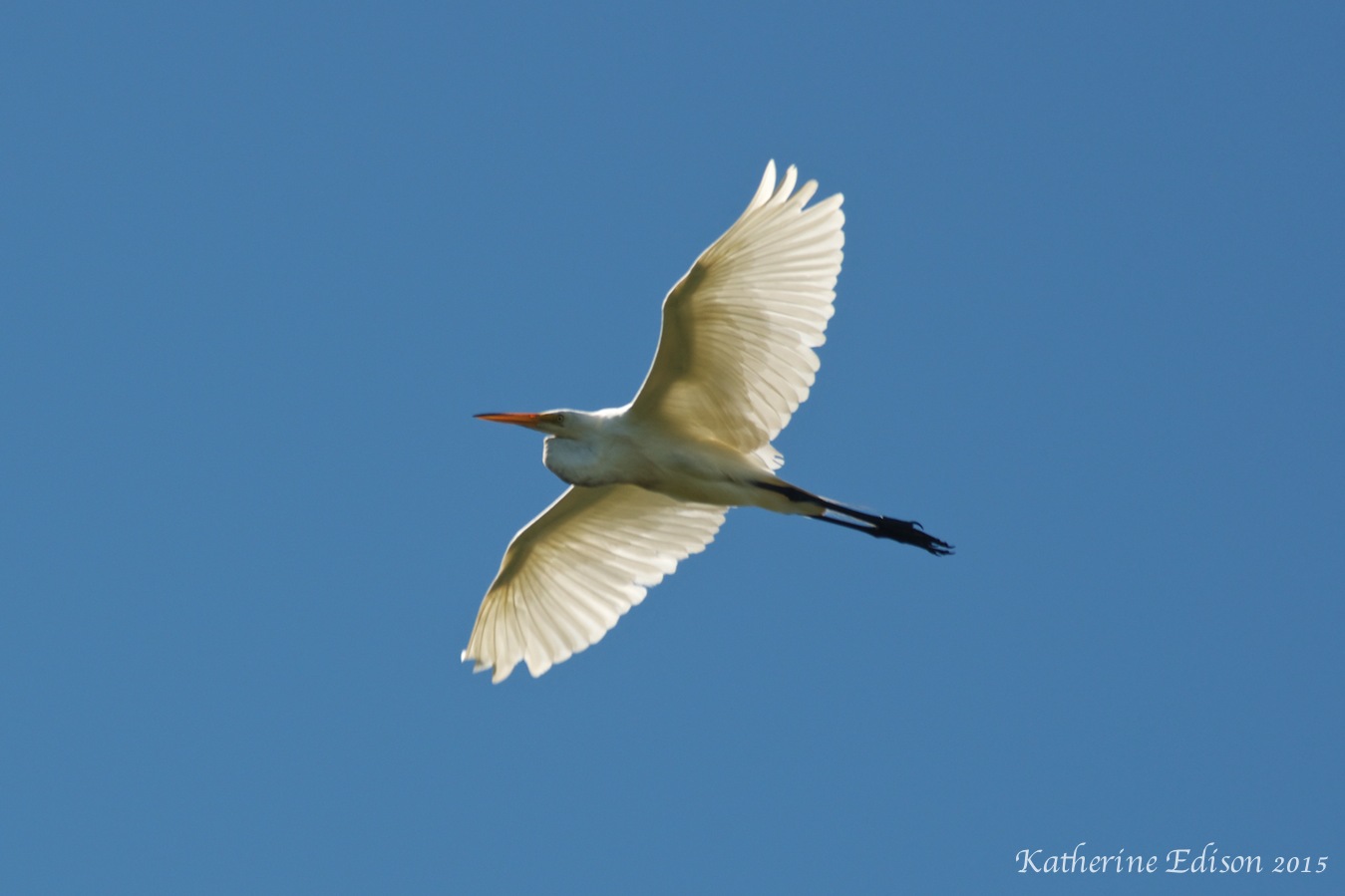
I looked over the bushes for Blue Grosbeaks, but didn't have any luck. I'll have to keep hunting. And I heard a Yellow Billed Cuckoo, but couldn't see it in the bushes. I did see 3 Least Bitterns! They're everywhere! At the turn around spot, I looked up and caught a Hummingbird sitting on a branch, and then heard a flock of common grackles. I think a Red Shouldered Hawk that was flying over had made them nervous. A Green Heron landed on a snag, then flew into the bushes. A Great Egret soared overhead and I saw the sun shining through the layers of its feathers. Red-winged Blackbirds gurgled and chucked from bushes all along the road.

Hummingbird 
Soaring Egret

At the trailhead, I decided to take a short walk the other direction on the loop to see if I could find a snake or a turtle or a Blue Gray Gnatcatcher. There were Northern Parulas everywhere. I'm always hoping to see an otter at Barr Hammock. I've heard them splash and have seen the places where they slide down the banks. No otters or Gnatcatchers this time, but I did see a Raccoon climbing through the greenery, and found some fox or coyote tracks. I saw 2 alligators, too. One was stretched out on a log and another on the path. I was ready to turn around and give up the path to the gator, but it spooked first and I walked on a bit. I scared a Black Racer and caught glimpses of turtles just as they ducked into the water. They are very wary, and understandably so. Everything eats turtles, and turtle eggs. I found a clutch of eaten eggs on the bank of the canal.

Rummaging Raccoon

Green Anole on Cattail

Turtle Eggs

Walking back to the car I considered taking a quick stop at Lake Wauberg to try to catch some more birds for the list. But then I came to my senses and accepted that I was hot and tired. I am not in the June Challenge to win, but sometimes the collector in me becomes obsessed. But what I really want in the coming weeks is to be outside, enjoying and experiencing as much as I can of my favorite places and if I see birds on the list, all the better. I have to keep reminding myself of this when I hear reports of special bird sightings. But then again, if someone reported that Phalarope…

Crane Family

Bird Count: I added 5 today, plus the Black Swans in the my neighborhood Duckpond, for a total of 65 (66). It really was not my intention to write 30 blog entries in the month of June, but so far every day has had enough activity to fill a page and then some. Time will tell if my energy and enthusiasm will last, but I'll ride the wave until then!


Wednesday, June 3, 2015

30 Days in June: Day 2, Morningside

One of the Fantastic Grandaddy Live Oaks at La Chua Trail
After I missed all the excitement at La Chua on June 1, I decided to go back and try again on June 2. Unfortunately, I did not get out early enough and the construction team had closed the trail again, this time entirely. Some of my earlybird friends got out to the platform before the construction started for the morning and were able to see the Phalarope again. But I was not so lucky. I did add a Black Vulture to my list and decided to change plans. It was a nice, overcast day and seemed like a perfect day to be out, so I headed to Morningside Nature Center to see if I could find Nuthatches, Bluebirds, Summer Tanagers and maybe some Owls. I had been there just a few days before and the Nuthatches were making their little squeaky rubber duck sounds from the treetops. Of course, in the perverse world of June Challenge, the Nuthatches were nowhere to be seen or heard. I'll have to come back and try again. But I don't mind because Morningside is one of my favorite places and I hope to get there several times during the month. I did find my Bluebirds in a recently burned sandhill at the back of the park. There were quite a few of them tussling. I think they may have been fledglings, catching bugs in the cinders from the prescribed burn. The area was just starting to green up after being burned and it looked stark and pretty at the same time. Morningside is a great place if you need to find Towhees, Great Crested Flycatchers, and Woodpeckers of all sorts. I had hoped to see Owls but did not find any. When I worked at the park we occasionally saw Barred and Great Horned Owls in the daytime and I figured it was worth a shot. But no luck. I had also hoped to see a Screech Owl because I found one nesting in May. But I have visited the box several times and have seen no sign of it since the initial sighting. The young may have fledged or maybe it just found a new nest. Owls are always one of my weak points in the June Challenge. Along with shorebirds, warblers and sparrows. I have many weak points.

Stark and Beautiful

Longleaf Pine Greening Up

Red Headed Woodpecker

Screech Owl from May

I had also hoped to find a Gopher Tortoise, but did not see any this time. I understand that there was someone poaching the turtles in the park for a while and I don't know if that made a big enough impact on the population, but I haven't seen one at Morningside for a while. Of course, I used to be there more often, too, so it may just be situational. The prescribed burn made the many, many pocket gopher mounds more visible. I hope that I can see a pocket gopher at least once in my lifetime so that I can know they are real. I'm not sure if I believe in them. I did see plenty of lizards zipping through the leaf litter. And as I walked down the East Perimeter Road, a Coyote ran towards the work farm. It was too fast for a photo. I have never seen a Coyote at Morningside before, and it was very exciting, though I have seen scat and other signs.

Six Lined Racerunner--They Make a LOT of Noise Scampering!

I visited an empty Vireo nest off of the north boardwalk. I saw birds sitting on eggs in the nest several times when I was in the park in April and May and it was nice to be able to look carefully at the details of the nest this time without worrying about upsetting the parents. What a beautiful piece of work! Surprisingly, there were no mosquitos around the boardwalk and I was able to sit and enjoy the sounds of buzzing cicadas and Red-Eyed Vireos.

Empty Vireo Nest
In the June Challenge, unlike other birding records, you must actually see the bird in order for it to count on your list. This is a good thing, because I could easily have added another several species to my list just from the sounds made by one noisy Mockingbird. I listened to it for almost 5 minutes and heard it mimic a Carolina Wren, Bluejay, Great Crested Flycatcher, Osprey, Titmouse, Woodpeckers, and Mississippi Kite, just to name a few. Those Mockingbirds can be very tricky.

Though I didn't add many new birds to my list, I had a peaceful and very satisfying visit to Morningside. Then I went back home and saw White Winged Doves in our front yard feeder, bringing my count total to 55.


30 Days in June: Day 1

2014 Winners, My Friends Danny and Maralee, With the Trophy That They Shared
Every June, the Alachua County Audubon chapter has a fun contest called the "June Challenge". I've talked about it in previous June blogs, but in a nutshell, the idea is to try to see as many birds as as possible in Alachua County, in the month of June. The winner gets to keep the cool trophy for a year and is worshipped by fellow birders as a birding god. Just kidding. But I've participated for several years now and can say that it is a lot of fun. So I was really happy to realize that our moving plans would allow me one more June Challenge before we left for Georgia. I had also been thinking that I wanted to be sure to spend as much time as I could in my favorite Florida nature spots before we moved away, so I came up with the brilliant idea to combine the June Challenge and my Au Revoir Tour of my favorite places and share the experience here. 30 days in June to see as many birds as I can. 30 days to see about 30 parks and preserves, some more than once. Perfect! So here goes!

The June Challenge Kickoff started on June 1st, bright and early, led as always by local birder extraordinaire, Rex Rowan. The Kickoff is a great way to commune with fellow birders and to take advantage of the combined eyes, ears and knowledge of a big group to get your list going. At the end of the morning it is usually possible to have 50-60 birds checked off the list. Without the Kickoff, my list is considerably shorter at the end of the month. Rex plans the morning to hit 4-5 locations with certain target species and it usually very successful.
Sunrise in the Flatwoods
We met at 6:15am in the Longleaf Flatwoods Reserve to look for Common Nighthawks, Bachman's Sparrows, and possibly an owl. The first Nighthawk showed up as we were gathering in the parking lot and we saw 2 more later on. We were treated to a mating display as a male circled and dived to show off for the females. We saw Eastern Towhees and Pine Warblers, and we were led to the Bachman's Sparrow a while later after we heard the "hear kitty, kitty" call. We also saw Red Bellied and Red Headed Woodpeckers. After we had found our targets we headed to the next stop. The sun was rising and we had a lot of ground to cover!

Nighthawk!

Here, Kitty Kitty...

Next stop was the boat ramp at Owens-Illinois Park in Windsor, on the east side of Newnan's Lake to look for Eagles and Limpkins. We walked down to the lakeshore and were mobbed by midges until we stood in the sun. They had completely covered the grass and plants in the shady edges. It was pretty impressive how many insects were out there, but they werent biting, and they probably provide lots of good food for insectivores. At Windsor we saw a Limpkin eating snails, a Laughing Gull, a fishing Osprey, Red-winged Blackbirds, Grackles, an Anhinga, Black Bellied Whistling Ducks, Cormorants, a Great Egret, a Green Heron and a Great Blue Heron as well as a cool Black Mudsnake. I've never seen one of these before, but I understand now that they are very common. I missed the Bald Eagle because I was looking at the snake. We also saw a Least Bittern climbing up some cattails. Least Bitterns have been very plentiful this year and I almost laugh when I see yet another. They are delightful little birds, though. On the way back to our cars people heard a Prairie Warbler, which would have been a great bird for the list, but no one was able to see it. We did see a Red Eyed Vireo, though.

Millions of Midges

Red Belly of a Black Mudsnake

Successful Osprey over Newnan's Lake

Can You Find the Least Bittern?
After Windsor we visited Earl Powers Park on the south side of the lake. There we found dozens of Turkey Vultures, had a flyover by a Cooper's Hawk and a Red Shouldered Hawk, heard and saw a Fish Crow, and got a nice look at several Northern Parulas and a Yellow Throated Warbler. There was another Bald Eagle sighting there, but I couldn't positively ID the eagle so decided not to count it today. I know I can find another.

Next stop, Palm Point Park, on the west side of the lake, to try to find a Prothonotary Warbler. I was so impressed to learn that both Rex and Mike Manetz, another expert birder in our group, could each make a pretty convincing Screech Owl call! No luck with the Prothonotaries, but we did find a Tri-Colored Heron, another Limpkin, a Carolina Wren, White Eyed Vireo and a Pileated Woodpecker. It was getting pretty hot, but we trudged on to the last stop, La Chua Trail at Paynes Prairie Preserve State Park.

It was about 10:30 and was getting hotter and hotter. It seemed like a bad sign that the Iron Ranger (self-pay station) at the park entrance was covered with a sign saying no fee was necessary because the trail was closed. But we decided to try anyway. When we got inside the park, we met one of the workers doing the road construction and he told us to stay on the boardwalk rather than on the road closer to the bushes where we wanted to go. So we looked from the boardwalk as the bulldozers chased away birds at the edge of the road. It was not ideal. Still, we saw an Orchard Oriole, an Indigo Bunting and a family of Common Gallinules.

At the end of the boardwalk, we realized that the construction would not impede our access to the rest of the trail, so the group marched on. We hoped to find a King Rail or Purple Gallinule along the old Sweetwater Branch, but the vegetation was too high to continue. We did see a Mississippi Kite as well as White Ibises and Cattle Egrets flying overhead and a Barn Swallow resting on a branch.
Mississippi Kite

Barn Swallow
At this point I was so hot and tired that I had to quit, so I went home even as the rest of the group continued to the observation platform where they were treated to whole list of marvelous birds, including a Red Necked Phalarope, a species that had not been seen in the county for 15 years. When I heard what I had missed I was terribly envious, but I was also too pooped to go on.

After I had cooled off and showered at home, I took a peek around my yard and added Mourning Doves, Brown Thrasher, Mockingbird, Cardinal, Titmouse,  Carolina Chickadee, Downy Woodpecker, Ruby Throated Hummingbird, Brown Headed Cowbird, Bluejay and House Finch. And later on an evening walk, I added Chimney Swifts, and drove past the Beef Unit on the UF Campus to add Rock Pigeons to my list.

At the end of the day I was exhausted, had visited 5 parks, and had 51 birds on my list. Not a bad start. 29 days to go!

Friday, May 8, 2015

Fledglings

When you live in a college town everyone feels the rhythm of the academic year. Summer is relatively quiet. Come August, though, excitement builds as students arrive. The stores and roads are busier, nighttime near campus is rowdier, and everyone wears school colors as the football season begins again. There is a lull during the winter holidays, but the bustle returns once the Spring semester gets underway. In March and April the mood becomes more serious. Shorts and flip flops are replaced with business clothes and briefcases as the soon-to-be graduates apply for internships and attend job fairs. Graduation weekend comes at the end of April or beginning of May and proud families commemorate the event with photos of their young adults taken in front of the local landmarks. Hope and possibility fill the air. Young people step up and try their wings and their parents step back and trust that their offspring have learned what they need to make it on their own.

Common Gallinule and 6 Chicks, Growing Fast!

I am happy to say that our own daughters fledged successfully several years ago, but I remember each and every benchmark along the way. Pre-school, elementary school, middle, high school, and college, lessons, clubs, summer programs, student loans and study abroad, dating, marriage, jobs. We tried to teach them how to be kind and ethical people, did our best to keep them healthy, and worried about them when they were not. Together we navigated the emotional ups and downs of growing up--making and losing friends, moving, academic pressure, boys, and just the general unease of the teenage years. I remember at each stage agonizing over how to let them go and do what they needed to do without having their parents by their side. I never stopped worrying. But we gave them independence, little by little. And, just like when you are learning to ride a bicycle, when we let go, they glided off as smooth as can be.

Successful Fledgling--Mockingbird

In our yard, and pretty much everywhere I go, birds are nesting, chicks are hatching and fledglings are fledging. The butterflies are laying eggs, caterpillars are munching host plants, and chrysalids are already appearing on unfortunate places like my front door. Spiderlings have emerged from eggsacs left by their mothers before the cold weather killed them. Paper wasps build nests under leaves. Softshell turtles lay eggs on the banks of the water. Tiny offspring of watersnakes that mated in March have hatched and are fending for themselves. Mama gators watch last fall's young, even as they prepare nests for the next clutch. Parents of all shapes and sizes will be guarding, feeding and preparing their young in the best way they can so they can reach maturity and continue the cycle of life.

Spiderlings on Lyreleaf Sage (Salvia lyriata)


Mama Gator and Young

Hungry Titmouse Chick
Blue-Gray Gnatcatcher on a Lichen Nest

Blue Grosbeak Nest with Eggs

I am constantly filling and refilling the suet feeders in our yard because exhausted bird parents stop there to inhale some quick energy when they get a break from sitting quietly on a nest for days and weeks, not moving or making a sound so as not to draw attention to themselves. Or between flights back and forth taking caterpillars to their hungry young. A recent article about the importance of native trees in the landscape said that a Carolina Chickadee would need 5000 caterpillars to feed each clutch of eggs! Pity the poor, exhausted Chickadee parents. Hungry baby birds make such a ruckus calling for food that it's a wonder they don't all get eaten by predators. At Paynes Prairie, the poor Great Blue Heron adults hunt and hunt to feed themselves as well as their offspring that have nearly reached adult size. These babies are hungry and they sound like fighting bobcats screeching in the trees when mother or father return with food. It's full time working feeding baby birds!

Hungry Herons

White Eyed Vireo on Nest

Carolina Wrens Need Food Now!

Mama Thrasher and her 3 Hungry Chicks

Boat Tailed Grackle is Hungry!

Baby Crow gets the Last of the Suet

Daddy Cardinal Feeding Young

This Mississippi Kite Chick Cries All Day Until the Food Comes!

The perils are great as the young hatch and grow. My friend Rex Rowan talked about this in a recent blog post titled "A Hard World for Little Things". (His nature blog, Field Guide, is fun and interesting, and very informative, and I recommend it to everyone, not just Gainesvillians.) The young are in danger from day one. Eggs of every kind are a quick and easy source of protein and lizards, snakes and raccoons all know it. Once the eggs hatch, the young, be they chick or larva, are choice targets. They are small and vulnerable, and easy pickings for birds, cats, coyotes, hawks and crows. As I mentioned, hungry chicks make a huge amount of noise and attract predators. They are still in danger, even after they learn to fly, because they are young and inexperienced, just like their human counterparts. Juvenile birds don't sense the cat stalking or hear the whoosh of the hawk, or they fly into the window, or in front of a car. And then there are the Brown Headed Cowbirds, nest parasites who lay their eggs in other birds' nests, letting them raise the Cowbird's young at the possible expense of their own. The parents become targets, too, when they stop to lay eggs or fly back and forth with food for their young, or chase of predators. A tiny Mockingbird will gladly take on a Crow or Hawk if it is threatening the nest. It's tough out there.


This Black Necked Stilt Bravely Challenges an Alligator Heading Toward its Nest

Stinkbug Eggs

Downy Woodpecker Feeds Sawfly Larva to Young

Tiny Bluejay is Noisy and Easy to Catch

Tiny Clapper Rail 

Northern Parula Feeds Giant Cowbird Chick

Mother's Day is this Sunday and I'd like to honor of all the Parents, Mothers and Fathers and supportive caretakers out there (it does take a village!), doing their best to raise and fledge the next generations. It takes a lot of work to get our young ready to launch; lots of love, patience and time. And the gratification comes in the end results. In the words of Barbara Kingsolver, "But kids don't stay with you if you do it right. It's the one job where, the better you are, the more surely you won't be needed in the long run."  Happy Mother's Day, Everyone.

Osprey Family