Wednesday, September 18, 2013

Morningside


Every time I drive into Morningside Nature Center in East Gainesville, I slow way down, turn off the radio, and if it is not too hot or cold, open the windows so I can listen. There's a sign to remind me to take it slow, but I don't need it. I've been there too often and have seen too many things on that entry road to hurry. If I go too fast, I might miss seeing something interesting. Or, worse, I may run over something interesting! Over the years, I've seen deer, raccoons, numerous gopher tortoises, a large family of Northern Bobwhite Quail, a juvenile black racer, a yellow rat snake, a coachwhip snake, and jillions of yellow-rumped warblers, to name just the most memorable. I've also seen a squashed rough green snake and coral snake. Some people aren't so careful.
Slow Down! There really are tortoises in the road!
I worked as a nature educator at Morningside for several years and one of the special benefits of working there was getting to know the park very well. Yes, sometimes there are changes and surprises. But in general, I know where I am most likely to find certain kinds of plants and wildlife. That kind of familiarity is comforting and reassuring. And it's nice to follow the progress after various restoration projects. I've watched burns and regrowth, beetle infestations and re-planting, floods and drought. And I know that there is something beautiful and interesting to be found on any day, at any time of year. Over the years I taught classes and led groups along the trails and in the some of the special outdoor classroom spaces and learned many of the interesting things to look for. After I'd been working there long enough to learn from staff experts like Gary and Geoff about the wildflowers and ecology, I became one of the Fall Wildflower Walk leaders. It was a great thrill for me to lead these groups because I've always been interested in wildflowers. Although I am not a trained botanist, I know enough to lead a group of interested people. And I'm not ashamed to tell them when I don't know something. I just let them know what I do know, and after many years, it's enough to get by.

So I was really happy when the staff asked me to come back and lead a walk again this fall! But now that I no longer work there every day, it's been necessary for me to take trips there weekly to scope out the trails and chart the beginnings of the fall wildflower display. Not that this is a chore! I should mention for Non-Floridians that here in North Central Florida, our best wildflower displays are in Fall. And one of the best habitats to see wildflowers is the sunny, dry, flat Sandhill. Morningside happens to have wonderful and lovingly managed Sandhill, and the wildflowers are magnificent.

This year the land management staff for the City of Gainesville conducted several summer prescribed fires. This is good and very important to maintain the fire dependent ecosystems of Morningside. The problem is that they burned in some of the places I have come to rely on for easily accessible walks! Some things will grow back in time for the walks later in the month (they will take place every Saturday in October), but mine will be the first Saturday (October 5 at 9am!), and it doesn't appear that the burn areas will have recovered enough for me to lead the walk there. But this is not really a problem. Next year everything will have grown back and the colors will be wonderful. This year, we'll just need to walk a bit further to get to the action!

So this week I made a couple of trips to see how things were progressing. I headed over at noon on Sunday, when my car thermometer said the temperature was 100 Fahrenheit.
Hot
It was sunny and humid. Not the best conditions for hiking, but I had my water, my hat and my cell phone, and I set out. *SPOILER ALERT* This is the part in my blog where I tell you what I saw on my walk. If you're planning on going on my hike on October 5th, you may want to just plug your ears and thumb through the pictures. Or you can read along and be prepared!

From the parking lot I headed towards Sandhill Road (the name itself is promising for good wildflower displays!) As I walked I could hear the racket of the Red Headed Woodpeckers that frequent the picnic area across the road. I could also hear the sounds of the farm animals in the Living History Farm, who were probably getting their Sunday lunch, or maybe they were just calling to me. The woods along the path were still black from the burn, which took place only about a month ago. I could see green peeking from the Saw Palmettos and grasses that were already growing back. The scrub was mostly burned back, making room for the sun and rain to fall on wildflower and grass plants on the forest floor.
Greening Up After the Burn

Open Spaces
At the end of the burned area I came to a sunny, open stretch. This is always a good spot for some specific wildflowers, but it's a little overgrown and the fall display isn't as good here as other spots. Still, this is a place where I know I can find Pale Meadowbeauty and Seedbox early in the fall. It's also a great spot for Rabbit Tobacco. (When I hear Rabbit Tobacco, I think of little juvenile delinquent rabbits with cigarettes hanging off of their snarling lips, or granddaddy rabbits with corncob pipes, and it makes me smile.) Later in October, the False Foxglove usually stands tall with it's pink, hairy blooms that are irresistible to butterflies and bees. It is also a host plant for Buckeye butterflies, and if you look closely, you can often see the caterpillars with their iridescent blue spikes. I couldn't find any hint of the Foxglove yet, so I hope it shows up in a few weeks. Every year is slightly different. The combination of weather conditions and the regrowth and encroachment of the scrub can change the landscape slowly over the year. I walked by the Goldenrod, covered with eager Lovebugs. Goldenrod is an important and attractive nectar source in the early stages of fall, when there are not as many plants in bloom. All around the Goldenrod I could see that the Slender Flattop Goldenrod (not really a goldenrod!) buds were just about ready to pop open. There was just the tiniest hint of yellow in the tops. I passed a Pocket Gopher mound and wished that just for once, I could be there when one popped out. I know they exist because other people have seen and photographed them. But they just seem imaginary or legendary since I've seen no actual Gophers as proof of their existence. They are crepuscular (love that word!), meaning that they come out mostly at dawn and dusk.
Ceraunus Blue Butterfly enjoys Pale Meadowbeauty (Rhexia mariana)

Spent Flowers of Seedbox (Ludwigia maritima) . When the seed capsule dries, it has an interesting geometric shape.
You can tip it over and shake seeds out of it, like a little salt shaker.

Rabbit Tobacco (Pseudognapthalium obtusifolium)

Goldenrod (Solidago sp.) and Lovebugs

I do believe in Pocket Gophers. I do believe in Pocket Gophers.
After the sunny stretch, I reached the beginning of what I think of as the "Good Stuff." The Sandhill namesake of Sandhill Road. This area had a prescribed fire about 4 years ago and the results are glorious. Majestic Longleaf Pines stand tall, with plenty of space for new seedlings to sprout and get the sun and space that they need. There is very little scrub and the ground is instead covered with Wiregrass and Wildflowers and Saw Palmetto. Warblers and Woodpeckers flit from tree to tree and the Gopher tortoises have plenty of clearance to burrow and roam for food. Although I hoped all day that I'd see a Gopher Tortoise, I didn't. But I did see plenty of burrows. And I was lucky to see a rare Florida Pinesnake, another sandhill resident. The scene would be complete if the Red Cockaded Woodpeckers and Sherman's Fox Squirrels that were once so abundant in the park could return. Maybe one day again the Longleaf Pines will be be healthy and mature enough to support a population.
The Good Stuff

Gopher Tortoise Burrow

Florida Pinesnake, either going into its burrow, or chowing down on Pocket Gophers.
Wait--maybe that's why I haven't seen any Gophers!
Looking over the sandhill, I could see that very soon the Blazing Star, Silk Grass, Yellow Buttons  and Paint Brush will be full bloom. Palafoxia, Summer Farewell and White Topped Aster will follow close behind. But for now, there are just the stalks, leaves and buds waving just over the grass and palmettos. Occasionally a bud has popped and there is a spot of purple or yellow, a teasing taste of things to come. There is great potential in those woods! But the plants of the sandhill are interesting even without the blooms. They are adapted to living in a dry and fire dependent ecosystem, so they have features such as hairy leaves, close to the ground to conserve moisture or withstand a quick burn-over. Or needle-like leaves, clasped close to the stem, also to conserve moisture.
The Sandhill, Soon to be in Full Bloom

Hairy leaves of Hieracium (Hawkweed)

Hairy Basal Rosette of Chrysopsis (Goldenaster)--Another late fall bloom
Florida Paintbrush leaves (Carphephorus corymbosus)--well adapted to dry conditions and fire
At Morningside there are 3 species of Gayfeather or Liatris. Two (Liatris tenuifolia and Liatris gracilis) are commonly seen in October, and one (Liatris pauciflora), I have learned, blooms earlier. In the past, when I worked there, September was a very busy time with the cleanup after summer camp and the start of school classes, so I rarely got out exploring in time to see them. But now that I can go looking whenever I want and I have learned that this is a good time to find Few-flowered Gayfeather. This year there seems to be an especially large crop. The flower heads are larger than those of the other Gayfeathers, and grow on only one side of the stem. The flowers seem to weigh down the stems, so they flop or arch all over the sandhill. Interspersed among the brilliant Liatris are stalks of Florida Toothache Grass, with their long, comblike heads. When the seed heads dry, they arch and stretch to disperse the seeds. This endemic and endangered grass is thriving in the well-maintained sandhill. When I was first introduced to the plant there were just a few at Morningside. Now there is a huge swath! It's nice to be able to see the benefits of successful land management.

Fewflower Gayfeather (Liatris pauciflora)

Florida Toothache Grass (Ctenium floridanum)
Shortleaf Gayfeather (Liatris tenuifolia) almost ready to bloom
Another very common flower in the sandhill is Florida Paintbrush (Carphephorus corymbosus). There are 3 species of Carphephorus found at Morningside, but each one grows in a different habitat. Paintbrush prefers the Sandhill. It has fine hairs along the stem and leaves in a basal rosette, close to the ground, that help it conserve moisture. The other two species live in slightly wetter conditions. The Vanilla Leaf (Carphephorus odoratissimus) (so named because its leaves really do have a lovely vanilla smell that wafts across the flatwoods in the late spring) is almost done flowering, but there are a few examples in the flatwoods on the other side of the road. Deertongue (Carphephorus paniculatus) prefers much wetter conditions. I see it blooming later in the fall in flatwoods and wet areas like ditches. I love it when the Paintbrush blooms because it is so pretty, and because lots of critters use its flat-topped blooms as as a perch. Butterflies and bees flock to the blossoms, and smart hunters such as Praying Mantises can often be seen laying in wait. I can always count on finding a big, fat Green Lynx on one of these large purple flowers. Smaller Crab spiders hang around, too. They come in an assortment of colors. I've found white ones on Spanish Needles, Yellow ones on Tickseed and Yellow Buttons, and purplish green ones on Paintbrush. Very adaptive creatures!
Florida Paintbrush (Carphephorus corymbosus)

Crab Spider waiting on Carphephorus bud. 
Continuing down the road, I saw acres of Liatris and Carphephorus, not quite ready, but soon! There were small patches of Fragrant Eryngium and Black Senna (another host plant for Buckeye caterpillars), Partridge Pea and Hedge Hyssop. Along with Elephant's Foot, these few early blooming plants provide important nectar for the hungry insects. Plants that bloomed in the spring are now producing fruits. Gopher Apple, Paw Paw, Gallberry and Palmetto fruits provide food for the larger animals such as birds, raccoons and gopher tortoises. Fall is a time for feasting, and in a week or so there will be a feast for our eyes. I will be at Morningside in the next few weeks, checking and getting ready. I hope to see you in October!
Fragrant Eryngium (Eryngium aromaticum)

Black Senna (Seymeria pectinata)

Elephant's Foot (Elephantopus elatus)

Rough Hedge Hyssop (Gratiola hispida)

Saw Palmetto Berries (Serenoa repens)
Jean Dorney Memorial Fall Wildflower Walks take place at Morningside, every Saturday in October at 9am. Click here for more information.


Wednesday, September 11, 2013

Blue Skies

On September 11, 2001, I was taking care of chores around the house, listening to Public Radio and drinking my morning coffee. The kids had caught their bus to school, and my husband was at work. I don't recall what my plans were for that morning, but I do know that it was a perfect fall day. Chances were that I was going to be outside in any case. And then began the reports of planes and towers and death and destruction. The day is a blur after that. I know I was scared and stunned and sad. I wanted my family close to me. I needed to hold them. Everyone was in shock. I heard over and over again how 9/11 started out as a spectacularly beautiful day.
Blue Skies--Cranes Migrating
Jump ahead to September 11, 2013. It was another beautiful fall morning. Pretty blue skies, the occasional puffy cloud. I spent the morning outside in the garden, pulling weeds, watching butterflies and birds, and feeling happy. But in the back of my mind was the nagging knowledge that today was 9/11. Every time I looked at my phone or the computer, I was reminded again. It just felt like there was a blog post in there somewhere. But I couldn't figure out how to relate a national tragedy to my theme of sharing nature. This was such an incredibly unnatural act.
Blue Skies--Barn Swallow Resting
But as I thought about it throughout the morning, I found the connection. All these years later, the sock in the gut feeling is gone. I'm still sad when I remember, but it's not fresh and painful. I didn't lose anyone, so for those people who did I'm sure the experience is much different. But I lost my sense of safety. For me, time is healing those feelings. They are muffled and diluted, and I have to dredge deep to recall the ache. But what I do remember well is that clear blue sky.  I can smell the perfect autumn air and see the cloudless sky that everyone remembers so well from that day. We had the same weather all the way down here in Florida. Each year on the anniversary, people recall the blue sky. And it seems like September 11 is often a pretty day with blue skies, reminding us of the promise in store that lovely morning. If only...
Blue Skies--Red Tailed Hawks Courting
But today was not like that 9/11. Yes, the sky was blue, but there were clouds. It was hot and muggy and it rained hard in the afternoon. Today is a brand new day. We are not trapped in a cycle of ever repeating perfect blue sky days where everything starts out nicely and then the whole world goes to hell. It happened and it is done. We are healing. Life must go on. This is the eternal cycle of life, death and regrowth.
Blue Skies--Regeneration After The Burn
Our family visited Ground Zero in 2002. There was a huge, gaping hole in the ground and the air still smelled like wet dust. It smelled like destruction and pain. The memorials for the missing and fallen were still in place. It was very difficult to see and experience. I fought back tears most of the time we were there. The lump in my throat ached. It was really sad.
Blue Skies--Swallowtail Feeding
We visited the site again in 2011 and saw the new, beautiful memorials. The huge waterfalls dropping down into the deep marble monuments evoke so much--falling, empty space, inverted skyscrapers, and healing, soothing water. There is renewal and regrowth all around the site and it feels solemn, respectful, and hopeful.
Blue Skies at the 9/11 Memorial 
The tragedy is part of us, but it is what we do with it that matters now. We can choose to scratch open those wounds and relive that hurt over and over again. We can remain fearful and scared. Or we can pick up and keep going and be hopeful. The birds and butterflies in my yard have no concept of our history. Life goes on. Chicks hatch, caterpillars transform into butterflies, flowers die and seeds disperse. The weeds need pulling. Life goes on. And I see blue skies.
Blue Skies--Paper Cranes for Peace


Tuesday, August 27, 2013

Save Our Parks

UPDATE, Aug. 27, 3:30pm: The Gainesville City Commission received an email today from the developer, withdrawing his offer to purchase the 5 acres of Loblolly Woods. There will be no sale of this public park land! Thanks to the many people who voiced their opinion and stood up for conservation!

*********************************************************************************
This weekend I joined about 70 other people on a walk to tour a piece of property in the Loblolly Woods of NW Gainesville. The purpose of the tour was to rally support and familiarize people with 5 acres of public conservation land that a private real estate developer is trying to buy from the city. (I'm not using the developer's name because I don't believe this is about the person. Rather, I think this is about the bigger issue of selling public property and the dangerous precedent it sets.) The property is part of the much larger Loblolly Woods city nature park and preserve, and it butts up to the developer's home property. He says that he wants to purchase the land to provide more buffer around his home, and says that he plans to preserve the land. In exchange, he proposes to give the city one million dollars. We were there in the woods to see why this would be a bad idea.
Supporters Hiking in
We were led on the walk through the woods by a UF Biologist and by neighbors whose homes are next to the property in question. We learned that the property provides the only eastern access to the greater Loblolly Woods city nature park. If the purchase is made, roads and paths will be closed to the public. The entrance is popular with walkers, hikers, runners, bikers and children walking to school.
East Entrance
We learned about the kinds of trees and plants in the landscape and saw how the slight elevation changes there make it a unique habitat for both wetlands and uplands plants. We learned that the land is ecologically sensitive. It is home to rare and endangered plants and is part of a wetlands floodplain. It was acquired by the City in the first place because it was determined that there was good reason to protect it. We saw examples of escaped exotic invasive plants from neighboring homes and from the urban creek system that runs through the woods and were reminded that the land needs continued, careful stewardship. Large amounts of money and time have already been spent by the City evaluating and maintaining the property.
The Woods
The people came with children, friends, cameras and dogs on leashes. The children explored and relished in the wonder of the wild places. They lifted logs and peeked into stumps and found spiders and snakes and caterpillars. (Hiking hint: if you want to see the coolest things, follow the kids. They know how to look!)
Florida Redbelly Snake

Saddleback Caterpillar

Millipede
Our leader pointed out different types of trees--Maple, Sugarberry, Box Elder, Water Oak, Dogwood and Sable Palm, to name just a few. The landscape is diverse. I was at the tail end of the crowd, so I missed much of his discussion, but the group was kindly helpful and would share interesting information down the line.

Sugarberry Tree

Maples, Palms and Sugarberries
The group stopped in admiration to look at the rare and endangered Godfrey's Privet , the interesting Green Dragon, and the vivid Hearts a Bustin'. We listened to bugs and birds and each other. We also heard the loud and upset dogs on the developer's property, barking from behind their tall fence at our intrusion into their territory.
Godfrey's Privet (Forestriera godfreyi)

Green Dragon (Arisaema dracontium)

Heart's a Bustin' (Euonymus americanus)
I've written about this in previous blog posts, but I believe that public land belongs to the people and must not just be sold off to the highest bidder. Contrary to what some might say, we do not have too much land in conservation--indeed, there is not nearly enough. Habitat loss and fragmentation are the leading cause of species decline and extinction. Carving it away in 5 acre pieces does not help. Birds, mammals, reptiles, amphibians, insects and plants all need a large and healthy habitat. These woods provide places for animals to find shelter, food, and raise their young. They are critical resting spots for migrating birds. The wetlands filter water as it makes its way through the landscape and into our aquifer. The trees give us oxygen and filter our air. The green space gives us peaceful sanctuary. We need to preserve our natural places.

Green Sanctuary
This land is not even for sale. This person has approached the City of Gainesville and made an offer on a piece of land, just because he wants it. He is waving a million dollars in the face of the City at a time when money is scarce. He has also made the red herring suggestion that the money could be spent to purchase another desirable piece of property nearby that is also ecologically important. But this property is also not for sale and has nothing to do with the purchase of this particular 5 acres, except that hinting that it could be purchased with the sale money pits groups of people who want to conserve land against each other.
Ebony Jewelwing Damselfly
The developer's thinking about this completely backwards. His home is next door to a City nature park and preserve. He already has a buffer! And he already owns the land! We all do. The problem is that he want to possess the land and fence it off for himself and keep the rest of us away, and that's just not fair. It doesn't contribute to the common good.
Turkey Tail Fungi
The Gainesville City Commission will be discussing this issue at their meeting on Thursday, Sept. 5 (exact time yet to be determined). Please consider attending the meeting. You don't have to speak, although if you want to, it would be welcome. But just show up to let them know that we don't want them to sell our public lands. Wear green as a sign of support. If you can't show up, write a letter (CityComm@cityofgainesville.org). (For more information go to http://saveloblollywoods.org) But do something. This really matters. Our Parks are counting on us.
UPDATE, Aug. 27, 3:30pm: The Gainesville City Commission received an email today from the developer, withdrawing his offer to purchase the 5 acres of Loblolly Woods. There will be no sale of this public park land! Thanks to the many people who voiced their opinion and stood up for conservation!

Denizen of the Forest (Praying Mantis)


Monday, August 12, 2013

About That Ditch...

It's Been Such a Long Time

So it's been months now since I've been out and crawling around in the ditches and it felt this morning like it was time to get back to it. I left a little too late, on a day that was a little too hot, and was disappointed to see that the County had mowed.
There's Still Hope After the Mowing
But no matter! There was a little breeze and some merciful cloud cover, and the County kindly left an un-mowed swath close to the fence line. Ahhh! Being out there again was perfect! With sweat dripping down my cheeks and mosquitoes swarming, I squatted down close to the Green Lynx Spiders and Little Metalmark Butterflies.
Green Lynx Spider on Carolina Yellow Eyed Grass (Xyris caroliniana)

Little Metalmark Butterfly on Orange Milkwort (Polygala lutea)

The breeze made it challenging to get good shots of the Yellow Eyed Grass, but I was in no hurry. Some of the old familiars from spring were still in bloom--Polygala, St. John's Wort, and the Pitcher Plants. But there were some new ones. 3 types of Rhexia, a couple of new St. John's Worts,  Barbara's Buttons, and a few others that I need to identify. The fall wildflowers are getting ready to put on a spectacular show, with Deer Tongue shoots leading the charge on the roadside and other Carphephorus species in the flat woods.
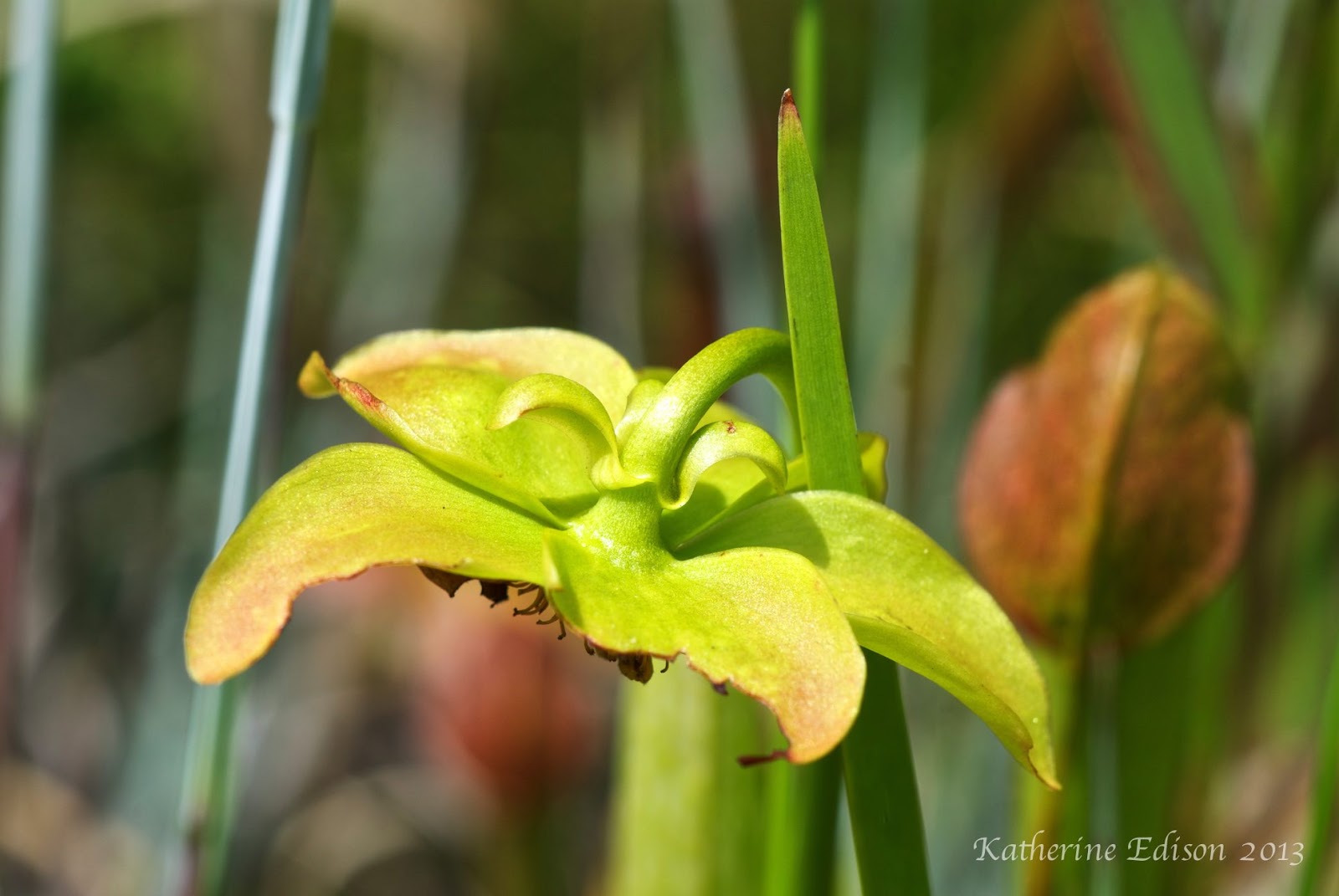
Hooded Pitcher Plant (Sarracenia minor)

Hooded Pitcher Plant Flower

St. Peters's Wort (Hypericum crux-andreae)

Pale Meadowbeauty (Rhexia mariana)

Handsome Harry (Rhexia virginica)

Barbara's Buttons (Marshallia tenuifolia)

St. Andrew's Cross (Hypericum hypericoides)

Unidentified flower with green hitchhiker
(Now identified at Carolina Redroot, or Lachnanthes caroliana--Thanks, Rex!)

I found some large and busy caterpillars eating Fetterbush leaves. They took an interesting offensive pose whenever I got close, rearing up like snakes. One even lay back and showed its legs, as if they were claws or fangs. Reading up on these caterpillars, I learned their food plants are oak and members of the rose family, but that they also feed on blueberry, birch, willow and other nearby shrubs. Fetterbush is is the blueberry family (ericaceae), so it would make sense that the caterpillars were feeding on it.  Grasshoppers popped out of the grass like popcorn pieces. I heard some frogs and a few Towhees in the trees. I didn't see as many swallowtail butterflies as I'd hoped, but it may have been too hot, or too early. They might be more abundant when the fall wildflowers bloom.
Yellow Necked Caterpillars (Datana ministra)

Grasshopper Waiting to Pop

It was so satisfying to be back, but I was a little rusty. Being away so long I got spooked by the idea of Cottonmouth Snakes and avoided walking into the tall grass around the swampy areas and the culvert. And I should have brought a long sleeved shirt to help protect from the mosquitoes. But I was still enjoying myself so much that I decided to stop in the Longleaf Pine Flatwoods for just a short visit before I left. The Winged Sumac is in bloom and every bunch had its own personal bumblebee.
Carpenter Bee on Winged Sumac (Rhus copallina)

I didn't see many other flowers along the first part of the path, but I did find a Green Milkweed and a little Black Senna.
Savannah Milkweed (Asclepias pedicellata_

 I found one snake--a black racer that was climbing a palmetto on its way into a bush. When it saw me it froze and I was able to snap off a few good shots. I resisted the urge to reach in and try to grab it. My photo sharing friend, Lloyd, posted a picture of the bite marks on his hand that he received after bothering a rat snake. I was bitten by a snake once (a ball python) and though I know now that a non-venomous snake bite isn't a big deal, I didn't like the surprise. I'll leave the snakes alone.
Black Racer Staring Me Down

After about 10 minutes of being swarmed by mosquitoes on the path, I gave up and went home. I could hear the Bachman's Sparrow and Eastern Towhee calling from the pines and I know I'll need to get back soon.
Dewy Spiderweb in the Grass

Saturday, August 10, 2013

What I Learned Over My Summer Vacation

My husband and I have been traveling a lot. Seems like I haven't been home for more than 2 weeks all summer. Just when I get unpacked and tidy up the house, it's time to go again. After our visits to New York and Maine, we turned around and drove to Arkansas, and wrapped up the road trip with a few days in New Orleans on the way back home. What a whirlwind! While on the road these past few months, I have made some observations.

1) I do better with a Taoist approach when trying to get great photos. I'm almost always disappointed when I go out with the intention of getting a specific shot. It's so much better to just go and see what I can see. Go with the flow. I made this same observation last year in this blog, but I never seem to learn. When I was in Salt Lake in June, I determined before I got there that I wanted to see a Western Tanager. People reported seeing them this spring here in Florida, where they were unusual. I wanted to see them where they were more common. That never happened, but instead I stumbled upon a Lazuli Bunting when I least expected it, and it was wonderful! The same thing happened in Maine. When we were planning our trip, I decided that wanted to see Puffins, but it turned out that they were much further north than I'd thought. But while I was moping about Puffins, the Eider Ducks were happily swimming off shore at every beach I walked on. It happened again during our trip to Arkansas. My friend (and exquisite photographer) Barbara, visited Mt. Magazine State Park in Arkansas a few years ago and took marvelous photos of Diana Fritillary butterflies. I wanted to get some photos of them, too, and I figured that since I would be in the area, it would be worth a 2-hour drive to a place where they were supposed to be a sure bet. As you probably expect, I didn't see any Dianas. But there were nests of hungry Barn Swallow chicks all around the lodge and Narrow Leaf Sunflowers along the paths through the forest. Rather than let myself be disappointed about missing the Diana butterflies, I need to be happy about what I did see.
Barn Swallow Feeding Hungry Chicks (Mt. Magazine State Park, AR)

Narrow Leaf Sunflower and little spider (Mt. Magazine State Park, AR)

2) Just because I didn't photograph something doesn't make it less special. Reading up on Mt. Magazine, I saw that, in addition to Diana Fritillaries, one might also see Roadrunners! In Arkansas?! Scanning over the park's bird checklist I saw that they were listed as "uncommon" for all seasons, so I didn't actually expect to see any. So imagine our surprise when, as we were driving out of the park, we spotted a Roadrunner. In the road! In Arkansas! It ran off the road and into the bushes before I could get a picture. But I will remember it fondly. I have to remind myself of this, because sometimes I get into "collector" mode and convince myself that my excursion was not successful because I didn't get photos. The experience is what matters most.

3) I'm learning that I love telling stories with photos. I feel like I can share what I love and do with images. As I've become more accustomed to carrying a digital camera with me, I find myself looking at scenes and wanting to capture and share them with other people. I study photography in magazines and movies and I am a lot more appreciative of what is interesting, attractive and illustrative. I hope to put this to use in my blogs, etc.
Musicians Playing French Tunes in our Restaurant (New Orleans, LA)

4) I'm almost always happier when I'm around nature. We drove and visited a lot of places this summer and I found myself gravitating to the locations with greenery, flowers and animals wherever we went.  Watching for hidden rattlesnakes as I walked up the path in the foothills above Red Butte Garden in Salt Lake. Standing on the Maine coast, breathing in the fresh ocean air, listening to the sound of the gulls and the crashing waves. Walking above the city streets on the High Line in Manhattan and looking at the cars below through a curtain of purple flowers and bees. Stooping to try and catch a tiny frog on the park path in Arkansas and laughing as it hopped out of reach. Peeking through the thick glass at the elegant Seahorses and Jellyfish at the Audubon Aquarium in New Orleans. Nature in those places made me feel revived, relaxed and connected.
Seahorse (Audubon Aquarium, New Orleans, LA)

5) Nature connects people. When I stop to look and take photos, often people notice and want to know what I'm doing, and it gives me an opportunity to meet someone and share my love of nature. One afternoon in Maine I was on the roadside crouching down to get a good picture of a Jewelweed flower when a woman stopped and asked if I was seeing any neat little bugs. I told her that I was trying to get a good shot of the Jewelweed, and that, by the way, it was supposed to be a good antidote for poison ivy. She told me that as a kid she remembered touching the seed pods and making them explode. I've done that, too, and we laughed about how much fun it is. We connected for just a moment. And it happened again just last week while driving home from New Orleans. We were stopped in a Florida rest stop. As I was walking back to the car, I happened to look up and noticed a perfect Luna Moth, resting under the eaves of the restroom building. I aimed my camera phone just as a woman walked by. She asked what I was looking at and I told her it was a Luna moth. She had never seen one before and was very excited. She told me she was going to get her daughter to show it to her. In that brief encounter, we shared a special experience. And she passed it on. For all I know, maybe it kept passing from visitor to visitor all day long.
Luna Moth (Highway Rest Stop, I-10, Florida)

6) I have really enjoyed my trips to other countries, but I always like to remember that the U.S. is a wondrous and diverse country, with fabulous cities, parks and natural areas. We have superb historical sites, museums, regional food, music and culture. Our state and national park system is extensive and excellent and the broad expanses of wilderness are astonishing. We have unique plants and animals that people from other parts of the world go out of their way to come see. Things like Bison, Alligators, Prairie Dogs, Sandhill Cranes, Diana Fritillaries, Giant Sequoia, Pitcher Plants, Red Cockaded Woodpeckers. We have ancient and mysterious ruins and ceremonial sites such as Chaco Canyon, Mesa Verde, Serpent Mound and the Toltec Mounds. No matter where I go, every new species I see, every new place I visit serves as a future reference point and helps me understand where I am in relation to the rest of the world. I think it's good to have a broad perspective.
Toltec Mounds at edge of Cypress Swamp (Little Rock, AR)
(Mississippi River Valley archeological site, ca. A.D. 700)

7) Traveling is fun, but it's really nice to come home again.